
Polymer crystallization is a fascinating phenomenon that dictates the properties and applications of many plastics we use daily. Understanding the intricacies of the polymer crystallization process allows scientists and engineers to tailor materials for specific uses, from high-strength fibers to flexible packaging.
This article explores the fundamentals of polymer crystallization, the factors that influence it, and the techniques used to study it. We will also examine how controlling crystallinity affects polymer properties and discuss real-world examples of crystalline polymers and their diverse applications.
By grasping these concepts, we gain valuable insights into the world of polymer science and its impact on modern technology. Ultimately, understanding the polymer crystallization process helps us develop better materials for a wide range of applications.
Fundamentals of Polymer Crystallization
Polymer crystallization is the process where polymer chains arrange themselves into ordered, crystalline regions. This phenomenon is analogous to the crystallization of small molecules, but with unique complexities due to the long-chain nature of polymers.
Unlike small molecules that form perfect crystals, polymers typically form semi-crystalline structures with crystalline regions interspersed with amorphous regions. The degree of crystallinity, which is the fraction of the material that is crystalline, significantly affects the polymer’s properties.
The polymer crystallization process involves two main steps: nucleation and crystal growth. Nucleation is the initial formation of small, ordered nuclei from the disordered melt or solution.
Crystal growth is the subsequent addition of more polymer chains to the nuclei, leading to the formation of larger crystalline structures. The rate of nucleation and crystal growth determines the overall crystallinity and morphology of the polymer.
Nucleation can occur homogeneously, where nuclei form spontaneously within the polymer melt, or heterogeneously, where nuclei form on impurities or added nucleating agents. Heterogeneous nucleation is generally more common and easier to control in industrial processes.
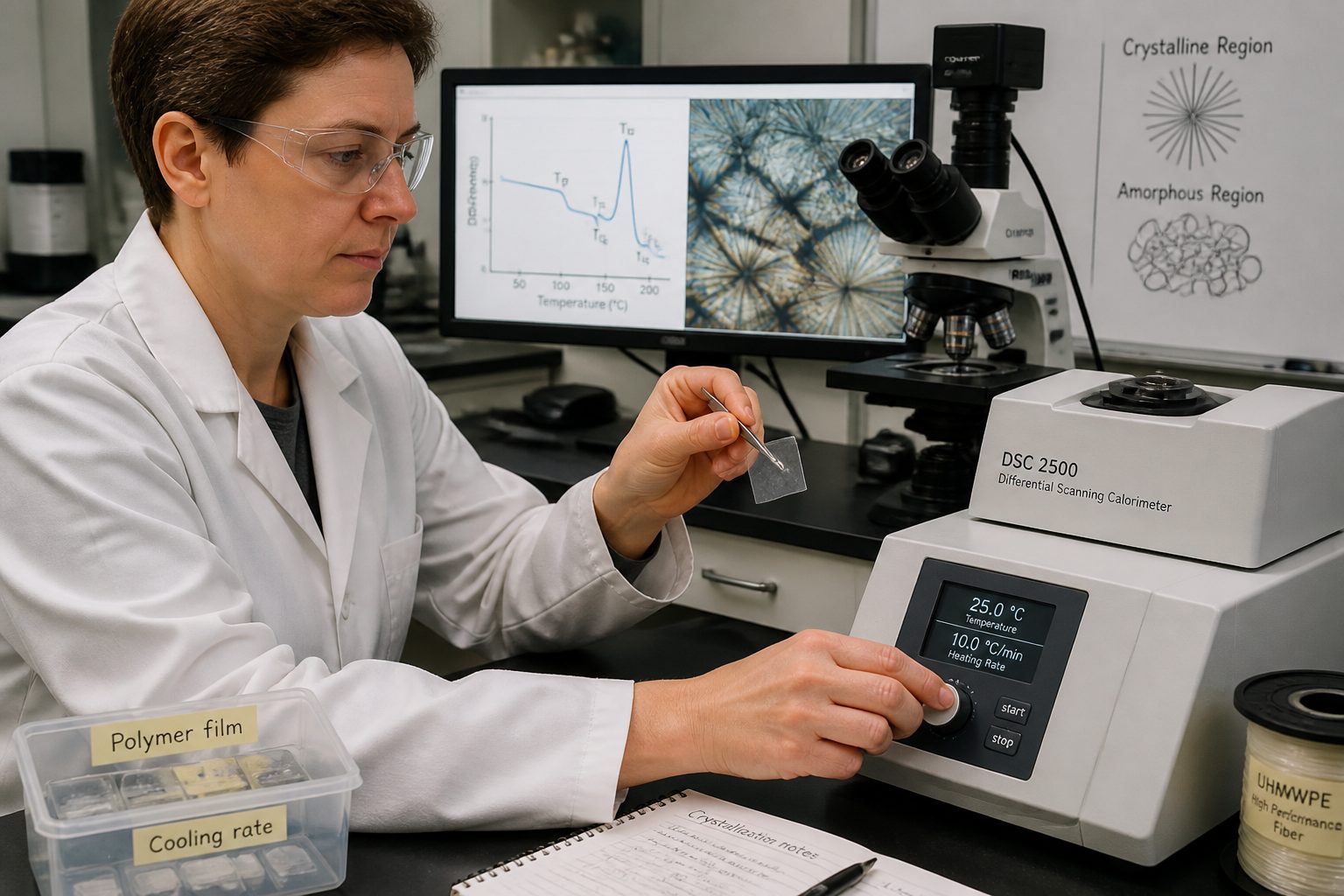

The size and shape of the crystalline regions, known as crystallites, also influence the polymer’s properties. Spherulites, which are spherical aggregates of crystalline lamellae, are commonly observed in many crystalline polymers.
The arrangement of polymer chains within the crystalline lamellae can be parallel or folded, depending on the crystallization conditions and the polymer’s molecular structure. Chain folding is a common mechanism that allows long polymer chains to fit within the relatively thin crystalline lamellae.
Understanding the interplay between nucleation, crystal growth, and the resulting morphology is crucial for controlling the properties of crystalline polymers. By manipulating these factors, we can tailor polymers for specific applications with desired mechanical, thermal, and optical characteristics.
The presence of amorphous regions between the crystalline regions contributes to the overall flexibility and toughness of the polymer. These amorphous regions allow for chain movement and energy dissipation, preventing brittle fracture.
The ratio between crystalline and amorphous phases determines the balance between strength and flexibility in a polymer material. Carefully controlling the crystallization process allows us to fine-tune this balance for optimal performance.
Factors Influencing Polymer Crystallization Kinetics
Several factors influence the kinetics of the polymer crystallization process, including temperature, molecular weight, and chain architecture. Temperature plays a critical role, as crystallization typically occurs within a specific temperature range below the melting temperature (Tm) of the polymer.
Higher temperatures provide more thermal energy, hindering the formation of stable nuclei and slowing down crystal growth. Conversely, lower temperatures can lead to rapid nucleation but may also limit chain mobility, resulting in smaller and less perfect crystals.
Molecular weight also affects the crystallization kinetics. Higher molecular weight polymers tend to crystallize more slowly due to increased chain entanglement and reduced chain mobility.
Chain architecture, including branching and tacticity, significantly influences the ability of polymer chains to pack into ordered structures. Linear, isotactic polymers generally crystallize more readily than branched or atactic polymers.
The cooling rate during crystallization also plays a significant role. Rapid cooling can lead to the formation of smaller, less perfect crystals, while slow cooling allows for the growth of larger, more well-ordered crystals.
The presence of solvents or plasticizers can also affect the crystallization process. Solvents can lower the glass transition temperature and increase chain mobility, potentially accelerating crystallization.
However, high concentrations of solvents can also hinder crystallization by disrupting the intermolecular forces between polymer chains. Plasticizers, on the other hand, are added to increase the flexibility and processability of polymers.
These additives can also affect the crystallization kinetics by altering the chain mobility and the glass transition temperature. The effect of solvents and plasticizers on crystallization depends on the specific polymer-solvent or polymer-plasticizer interaction.
Pressure is another factor that can influence polymer crystallization. Increased pressure can promote crystallization by increasing the density of the polymer melt and reducing chain mobility.
The effect of pressure on crystallization is particularly important in industrial processes such as injection molding and extrusion. Controlling the pressure during these processes can help to optimize the crystallinity and properties of the final product.
Techniques for Studying Polymer Crystallization
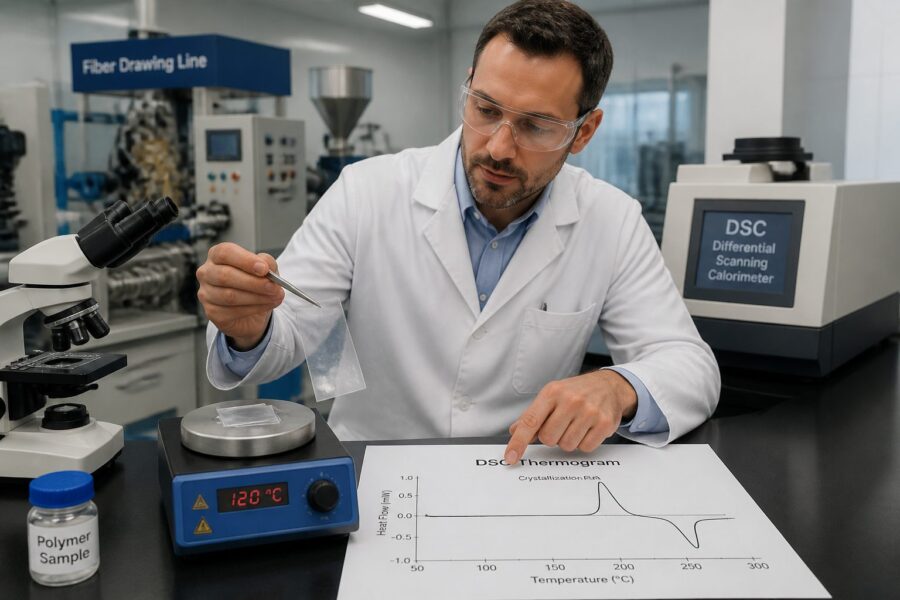
Various experimental techniques are employed to study polymer crystallization, each providing unique insights into the process. Differential Scanning Calorimetry (DSC) is a widely used technique that measures the heat flow associated with phase transitions, such as crystallization and melting.
DSC can determine the crystallization temperature, melting temperature, and the degree of crystallinity of a polymer sample. These factors provide a comprehensive look into the polymer crystallization process and material properties.
| Technique | Principle | Information Obtained |
|---|---|---|
| Differential Scanning Calorimetry (DSC) | Measures heat flow during phase transitions | Crystallization temperature, melting temperature, degree of crystallinity |
| Wide-Angle X-ray Scattering (WAXS) | Analyzes the diffraction pattern of X-rays by crystalline regions | Crystalline structure, crystallite size, degree of crystallinity |
| Polarized Optical Microscopy (POM) | Observes the morphology of crystalline structures using polarized light | Spherulite size and shape, crystal orientation |
| Atomic Force Microscopy (AFM) | Images the surface of materials at the nanoscale | Crystal morphology, lamellar thickness |
| Raman Spectroscopy | Analyzes the vibrational modes of molecules | Changes in molecular order during crystallization |
Wide-Angle X-ray Scattering (WAXS) is another powerful technique that provides information about the crystalline structure and the degree of crystallinity. WAXS analyzes the diffraction pattern of X-rays by the crystalline regions in the polymer.
The diffraction pattern reveals the spacing between the crystalline planes, allowing for the determination of the crystal structure and crystallite size. Polarized Optical Microscopy (POM) is used to observe the morphology of crystalline structures, such as spherulites.
POM uses polarized light to visualize the birefringence of the crystalline regions, which arises from the orientation of the polymer chains. The size, shape, and orientation of the spherulites can be determined using POM.
Atomic Force Microscopy (AFM) is a technique that images the surface of materials at the nanoscale. AFM can be used to study the morphology of polymer crystals, including the lamellar thickness and the arrangement of polymer chains within the crystals.
Raman Spectroscopy is a vibrational spectroscopy technique that provides information about the molecular order and the changes that occur during crystallization. Raman spectroscopy analyzes the vibrational modes of the molecules, which are sensitive to the local environment and the degree of order.
By monitoring the changes in the Raman spectrum during crystallization, it is possible to gain insights into the mechanism of crystal formation and the structure of the crystalline regions. Each of these techniques offers unique information, and their combined use provides a comprehensive understanding of the polymer crystallization process.
Controlling Crystallinity for Specific Applications
Controlling the crystallinity of polymers is essential for tailoring their properties to meet the requirements of specific applications. By manipulating the crystallization conditions, such as temperature and cooling rate, the degree of crystallinity and the resulting polymer morphology can be precisely controlled.
For example, in high-strength fibers, a high degree of crystallinity is desired to enhance the tensile strength and modulus of the material. This can be achieved by carefully controlling the drawing process, which aligns the polymer chains and promotes crystallization along the fiber axis.
In contrast, for applications requiring flexibility and toughness, a lower degree of crystallinity is preferred. This can be achieved by introducing branching or using copolymers, which disrupt the chain packing and reduce the extent of crystallization.
The use of nucleating agents is another effective method for controlling crystallinity. These additives provide heterogeneous nucleation sites, increasing the nucleation rate and resulting in a larger number of smaller crystals, which can improve the mechanical properties and transparency of the polymer.
The type and concentration of nucleating agent can be tailored to achieve the desired degree of crystallinity and crystal morphology. Common nucleating agents include inorganic fillers such as talc and calcium carbonate, as well as organic compounds such as sorbitol derivatives.
The cooling rate during processing also plays a crucial role in controlling crystallinity. Slow cooling allows for more time for crystal growth, resulting in larger and more perfect crystals.
Rapid cooling, on the other hand, can lead to the formation of smaller and less perfect crystals. The cooling rate can be controlled by adjusting the temperature of the mold or the cooling medium in processes such as injection molding and extrusion.
Another approach to controlling crystallinity is through the use of blending. Blending two or more polymers can alter the crystallization behavior of the individual components.
For example, adding a small amount of a miscible amorphous polymer to a crystalline polymer can reduce the overall crystallinity and increase the flexibility of the blend. Conversely, adding a crystalline polymer to an amorphous polymer can induce crystallization and improve the mechanical properties of the blend.
The molecular weight distribution of the polymer can also affect its crystallization behavior. Polymers with a narrow molecular weight distribution tend to crystallize more readily than polymers with a broad molecular weight distribution. This is because polymers with a narrow distribution have more uniform chain lengths, which facilitates chain packing and crystal formation.
The Impact of Crystallization on Polymer Properties
The degree of crystallinity significantly impacts various polymer properties, including mechanical strength, thermal stability, and barrier properties. Higher crystallinity generally leads to increased tensile strength, stiffness, and resistance to deformation.
Crystalline regions act as physical crosslinks, restricting chain movement and enhancing the material’s ability to withstand stress. Polymers with high crystallinity tend to have higher melting temperatures and improved resistance to heat distortion.
- Enhanced tensile strength
- Improved stiffness
- Increased thermal stability
- Better barrier properties against gases and liquids
- Enhanced chemical resistance
Crystallinity also affects the barrier properties of polymers, influencing their ability to prevent the permeation of gases and liquids. Crystalline regions are denser and more ordered than amorphous regions, providing a more tortuous path for permeating molecules and reducing the permeability of the material.
However, high crystallinity can also lead to reduced impact resistance and increased brittleness. Balancing crystallinity is key to achieving the desired combination of properties for a specific application.
The optical properties of polymers are also influenced by crystallinity. Crystalline polymers tend to be more opaque than amorphous polymers due to the scattering of light by the crystalline regions.
However, by controlling the size and morphology of the crystalline regions, it is possible to produce crystalline polymers with high transparency. This is achieved by creating small, uniform crystals that do not significantly scatter light.
The chemical resistance of polymers is also affected by crystallinity. Crystalline regions are generally more resistant to chemical attack than amorphous regions due to their higher density and ordered structure.
Polymers with high crystallinity are therefore often used in applications where chemical resistance is important, such as in the construction of chemical storage tanks and pipes. The electrical properties of polymers can also be influenced by crystallinity.
Crystalline regions tend to be more insulating than amorphous regions, so polymers with high crystallinity generally have higher dielectric strength and lower conductivity. This makes them suitable for use as insulators in electrical and electronic applications.
Examples of Crystalline Polymers and Their Uses
Several common polymers exhibit crystallinity and are used in a wide array of applications. Polyethylene (PE) is one of the most widely used polymers, available in various grades with different degrees of crystallinity.
High-density polyethylene (HDPE) has a high degree of crystallinity and is used in applications requiring strength and rigidity, such as milk jugs and pipes. Low-density polyethylene (LDPE) has a lower degree of crystallinity and is used in flexible films and packaging.
Polypropylene (PP) is another crystalline polymer known for its excellent chemical resistance and high melting temperature. PP is used in a variety of applications, including automotive parts, packaging, and textiles.
Polyethylene terephthalate (PET) is a crystalline polymer commonly used in beverage bottles, fibers, and films. PET’s high strength, clarity, and barrier properties make it ideal for packaging applications, while its ability to be drawn into strong fibers makes it suitable for textiles.
Polyamides, also known as nylons, are a family of crystalline polymers with excellent strength, toughness, and chemical resistance. Nylons are used in a wide range of applications, including textiles, automotive parts, and engineering plastics.
Polyoxymethylene (POM), also known as acetal, is a highly crystalline polymer with excellent stiffness, dimensional stability, and resistance to wear. POM is used in applications requiring high precision and durability, such as gears, bearings, and automotive components.
Polyvinylidene fluoride (PVDF) is a crystalline polymer with excellent chemical resistance, high dielectric strength, and piezoelectric properties. PVDF is used in a variety of applications, including chemical processing equipment, electrical insulation, and sensors.
Liquid crystal polymers (LCPs) are a class of highly crystalline polymers that exhibit liquid crystalline behavior in the molten state. LCPs have exceptional strength, stiffness, and thermal stability, making them suitable for use in high-performance applications such as electronic components and aerospace structures.
Each of these polymers exhibits unique properties that are directly related to their degree of crystallinity and crystal morphology. By understanding the relationship between structure and properties, we can select the appropriate polymer for a specific application and optimize its performance.
Conclusion
The polymer crystallization process is a complex phenomenon that plays a crucial role in determining the properties and applications of polymers. Understanding the fundamentals of nucleation and crystal growth, as well as the factors influencing crystallization kinetics, is essential for tailoring polymer materials to meet specific performance requirements.
By controlling crystallinity through techniques such as manipulating temperature, using nucleating agents, and modifying chain architecture, we can optimize polymer properties for a wide range of applications. From high-strength fibers to flexible packaging, the ability to control polymer crystallinity is key to unlocking the full potential of these versatile materials.
Further research into the mechanisms of polymer crystallization and the development of new techniques for controlling crystallinity will continue to drive innovation in polymer science and engineering. This will lead to the creation of new and improved polymer materials with enhanced properties and expanded applications.
As we continue to develop a deeper understanding of polymer crystallization, we can expect to see even more sophisticated and tailored polymer materials emerge. These advanced materials will play an increasingly important role in addressing some of the world’s most pressing challenges, from sustainable packaging to advanced medical devices.
The future of polymer science is bright, and the continued exploration of polymer crystallization will undoubtedly be a key driver of progress in this exciting field. By harnessing the power of polymer crystallization, we can create materials that are stronger, lighter, more durable, and more sustainable, ultimately benefiting society as a whole.