
Polymers, unlike simple solids or liquids, exhibit a fascinating behavior known as viscoelasticity. This means they display properties of both viscous liquids and elastic solids. Understanding viscoelastic polymer behavior is critical in designing everything from tires to adhesives, ensuring these materials perform as expected under various conditions.
This article will explore the science behind viscoelasticity, the methods used to measure it, and its importance in numerous applications. We will also look at how temperature and time affect this unique property.
Ultimately, mastering the concepts of viscoelasticity allows engineers and scientists to create innovative materials with tailored performance characteristics. Let’s begin our exploration of this complex subject.
Understanding Viscoelasticity: A Dual Nature
Viscoelasticity arises from the long, chain-like structure of polymers. These chains can stretch, bend, and slide past each other, leading to a combination of elastic and viscous responses.
Elasticity refers to a material’s ability to return to its original shape after a force is removed. A rubber band snapping back into place is a great example of elasticity.
Viscosity, on the other hand, describes a fluid’s resistance to flow. Think of honey slowly pouring from a jar, that is viscosity in action.
In a viscoelastic polymer, both of these behaviors are present simultaneously. When a force is applied, part of the deformation is recoverable (elastic), and part is permanent (viscous).
This dual nature is what makes viscoelastic materials so interesting and challenging to understand. Their behavior is not simply a matter of being solid or liquid, but a complex interplay of both.
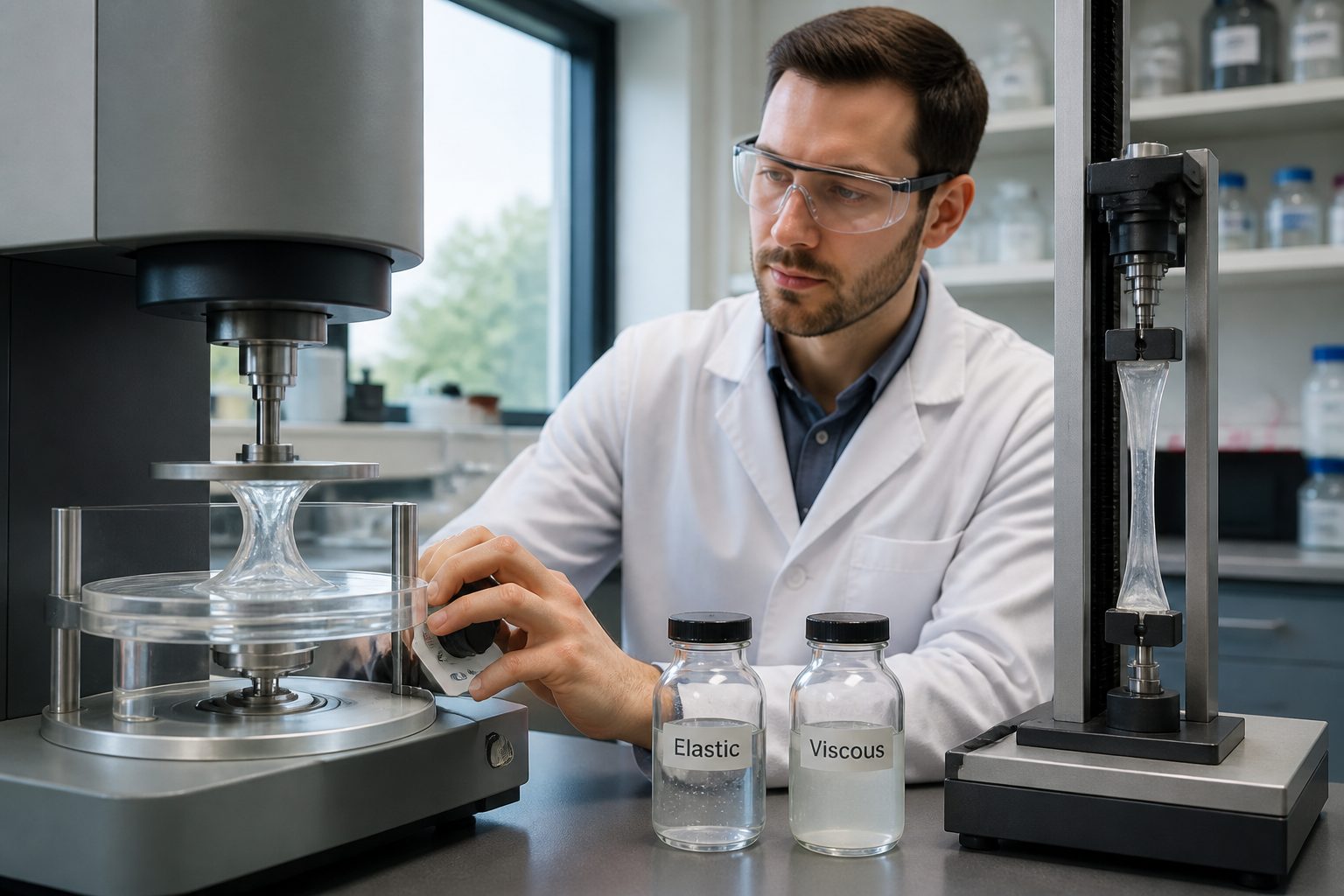

The relative contributions of elasticity and viscosity depend on the polymer’s structure, temperature, and the rate at which the force is applied. A material might behave more elastically under rapid deformation, but more viscously under slow, sustained loading.
Consider silly putty, which bounces like a rubber ball when dropped quickly, demonstrating elasticity. However, if left on a table for a long time, it will slowly flow and flatten out, showcasing its viscous nature.
This time-dependent behavior is a hallmark of viscoelasticity and is crucial for understanding how these materials perform in real-world applications. The ability to tailor this balance between elastic and viscous properties is what makes polymers so versatile.
Another important aspect of viscoelasticity is hysteresis. This refers to the energy lost during a cycle of loading and unloading.
In a perfectly elastic material, all the energy used to deform it is recovered when the force is removed. However, in a viscoelastic material, some of the energy is dissipated as heat due to the viscous component.
This energy loss is what causes hysteresis, which can be observed as a difference in the loading and unloading curves on a stress-strain plot. Hysteresis is important in applications where damping or energy absorption is desired, such as in shock absorbers or vibration isolators.
Modeling Viscoelastic Behavior: Common Approaches
To predict and analyze viscoelastic polymer behavior, scientists use various models. These models are mathematical representations that mimic the material’s response to stress and strain.
The Maxwell model, for instance, represents a viscoelastic material as a spring (elastic element) and a dashpot (viscous element) connected in series. This model is good for describing stress relaxation, where stress decreases over time under constant strain.
Another common model is the Voigt-Kelvin model, which connects the spring and dashpot in parallel. This model better describes creep, where strain increases over time under constant stress.
More complex models, such as the Standard Linear Solid model, combine elements of both Maxwell and Voigt-Kelvin models. These advanced models provide a more accurate representation of real polymer behavior, capturing both stress relaxation and creep phenomena.
These models, while simplified representations, provide valuable insights into the fundamental mechanisms governing viscoelastic behavior. The Maxwell model, with its series arrangement, suggests that under constant stress, the dashpot will continue to deform indefinitely, leading to creep.
Conversely, the Voigt-Kelvin model, with its parallel arrangement, predicts that the deformation will eventually reach a limit as the spring resists further stretching. The Standard Linear Solid model combines these features, allowing for both initial elastic deformation and long-term creep.
It’s important to note that these models are idealizations and may not perfectly capture the behavior of all viscoelastic materials. Real polymers often exhibit more complex behavior due to factors such as chain entanglement, crosslinking, and the presence of fillers or additives.
Therefore, more sophisticated models, such as those based on integral constitutive equations or finite element analysis, are often used to accurately predict the behavior of real-world viscoelastic materials. These advanced models can account for non-linear behavior, large deformations, and complex geometries.
Furthermore, the parameters used in these models, such as the spring constant and viscosity coefficient, must be determined experimentally. This involves performing tests such as creep tests, stress relaxation tests, and dynamic mechanical analysis to characterize the material’s response to different loading conditions.
By combining experimental data with theoretical models, engineers and scientists can gain a comprehensive understanding of viscoelastic behavior and use this knowledge to design materials with tailored properties for specific applications. The selection of the appropriate model depends on the specific application and the level of accuracy required.
Measuring Viscoelastic Properties: Experimental Methods
Several experimental techniques are used to quantify viscoelastic properties. These methods apply controlled forces or deformations to a polymer sample and measure its response.
Creep tests involve applying a constant stress and measuring the resulting strain as a function of time. Stress relaxation tests, conversely, involve applying a constant strain and measuring the resulting stress decay over time.
| Technique | Applied Condition | Measured Response |
|---|---|---|
| Creep Test | Constant Stress | Strain vs. Time |
| Stress Relaxation Test | Constant Strain | Stress vs. Time |
| Dynamic Mechanical Analysis (DMA) | Oscillating Stress or Strain | Storage Modulus (E’), Loss Modulus (E”) |
| Rheometry | Controlled Shear Stress or Strain | Viscosity, Complex Modulus |
Creep tests are particularly useful for evaluating the long-term behavior of viscoelastic materials under sustained loading. The creep curve, which plots strain as a function of time, provides information about the material’s resistance to deformation and its tendency to flow over time.
Stress relaxation tests, on the other hand, are useful for assessing the material’s ability to relieve stress under constant deformation. The stress relaxation curve, which plots stress as a function of time, provides information about the material’s ability to maintain its shape and prevent failure under sustained strain.
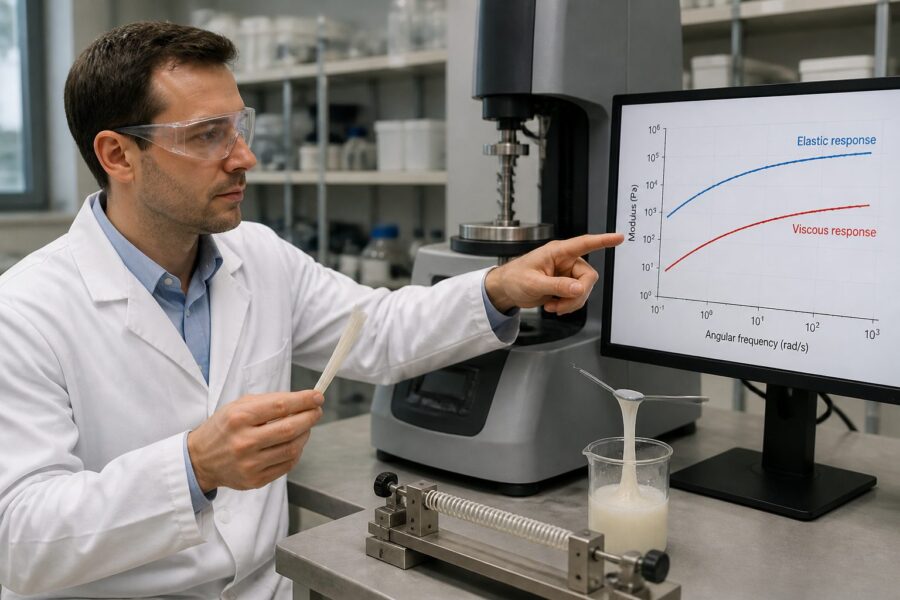
Dynamic Mechanical Analysis (DMA) is a more sophisticated technique that involves applying an oscillating force or displacement to a sample and measuring its response. DMA provides information about the material’s storage modulus (E’), which represents the elastic component, and its loss modulus (E”), which represents the viscous component.
Rheometry is another important technique for characterizing the flow behavior of viscoelastic materials. Rheometers apply controlled shear stress or strain to a sample and measure its viscosity and complex modulus. Rheometry is particularly useful for studying the behavior of polymers in the molten state or in solution.
In addition to these common techniques, there are other specialized methods for measuring viscoelastic properties, such as nanoindentation and ultrasonic testing. Nanoindentation involves pressing a small indenter into the surface of a material and measuring its resistance to deformation.
Ultrasonic testing involves sending sound waves through a material and measuring their speed and attenuation. These techniques can provide information about the viscoelastic properties of materials at small length scales or at high frequencies.
Dynamic Mechanical Analysis: A Powerful Tool
Dynamic Mechanical Analysis (DMA) is a particularly versatile technique. DMA involves applying an oscillating force or displacement to a sample and measuring its response.
From DMA data, two key parameters are obtained: the storage modulus (E’) and the loss modulus (E”). The storage modulus represents the elastic component, indicating the material’s ability to store energy elastically.
The loss modulus represents the viscous component, indicating the material’s ability to dissipate energy as heat. The ratio of the loss modulus to the storage modulus is known as the tan delta, which provides information about the damping characteristics of the material.
DMA can be performed over a range of temperatures and frequencies, providing a comprehensive understanding of a material’s viscoelastic behavior under different conditions. This makes it invaluable for material selection and product design.
The temperature dependence of the storage and loss moduli can reveal important information about the material’s glass transition temperature (Tg). The glass transition temperature is the temperature at which a polymer transitions from a glassy, rigid state to a rubbery, more flexible state.
At temperatures below Tg, the storage modulus is typically much higher than the loss modulus, indicating that the material is primarily elastic. Above Tg, the storage modulus decreases significantly, and the loss modulus increases, indicating that the material is becoming more viscous.
The frequency dependence of the storage and loss moduli can also provide valuable insights into the material’s viscoelastic behavior. At low frequencies, the material has more time to respond to the applied force, and the viscous component becomes more dominant.
At high frequencies, the material has less time to respond, and the elastic component becomes more dominant. By analyzing the frequency dependence of the storage and loss moduli, it is possible to determine the material’s relaxation time, which is a measure of the time it takes for the material to return to equilibrium after being deformed.
DMA can be used to characterize a wide range of materials, including polymers, composites, and adhesives. It is a particularly useful technique for studying the effects of temperature, frequency, and composition on the viscoelastic properties of these materials.
Time-Temperature Superposition: Simplifying Viscoelastic Analysis
Time-Temperature Superposition (TTS) is a powerful concept that simplifies the analysis of viscoelastic materials. TTS allows us to relate the behavior of a polymer at different temperatures and time scales.
The principle behind TTS is that the effects of changing the temperature are equivalent to changing the time scale of the experiment. In other words, a polymer will exhibit similar behavior at a high temperature and short time scale as it does at a low temperature and long time scale.
This relationship is quantified by the Williams-Landel-Ferry (WLF) equation, which relates the shift factor (aT) to the temperature difference from a reference temperature. By using TTS, data obtained at different temperatures can be shifted along the time or frequency axis to create a master curve.
This master curve provides a complete picture of the viscoelastic behavior of the material over a wide range of time scales or frequencies. TTS is particularly useful for predicting long-term behavior from short-term experiments, saving time and resources.
The WLF equation is an empirical equation that relates the shift factor (aT) to the temperature difference from a reference temperature (T0). The equation is given by: log(aT) = -C1(T – T0) / (C2 + T – T0), where C1 and C2 are material-dependent constants.
The reference temperature is typically chosen to be the glass transition temperature (Tg) of the polymer. The WLF equation is valid for temperatures above Tg and is most accurate near Tg. At temperatures far above Tg, the WLF equation may not accurately predict the shift factor.
The process of creating a master curve involves shifting the data obtained at different temperatures along the time or frequency axis until they overlap to form a single, continuous curve. The amount of shift required at each temperature is determined by the shift factor (aT).
The master curve can then be used to predict the viscoelastic behavior of the material at any temperature or time scale within the range of the experimental data. TTS is a powerful tool for extrapolating short-term experimental data to predict long-term behavior, which is particularly useful for applications where long-term durability is critical.
However, it is important to note that TTS is based on certain assumptions, such as the material being thermorheologically simple, meaning that the temperature dependence of the relaxation times is the same for all relaxation modes. If these assumptions are not met, TTS may not accurately predict the viscoelastic behavior of the material.
Applications Where Viscoelasticity is Crucial
Viscoelasticity plays a critical role in a wide range of applications. From everyday products to advanced technologies, understanding and controlling viscoelastic behavior is essential for optimal performance.
In the automotive industry, tires are designed to provide grip, comfort, and durability. The viscoelastic properties of the rubber compounds used in tires determine their ability to dampen vibrations, resist wear, and maintain traction under varying road conditions.
Adhesives and sealants rely on viscoelasticity to bond materials together and prevent leakage. The adhesive must be able to deform and flow to fill gaps, while also providing sufficient elasticity to resist separation.
In the biomedical field, viscoelastic materials are used in drug delivery systems, tissue engineering scaffolds, and implants. The viscoelastic properties of these materials influence their biocompatibility, degradation rate, and mechanical performance within the body.
In the food industry, viscoelasticity is important for the texture and mouthfeel of many products. For example, the viscoelastic properties of dough determine the texture of bread, while the viscoelastic properties of gelatin determine the texture of desserts.
In the aerospace industry, viscoelastic materials are used in vibration damping systems and structural adhesives. The ability of these materials to absorb energy and reduce vibrations is critical for ensuring the safety and performance of aircraft and spacecraft.
In the construction industry, viscoelastic materials are used in asphalt pavements and roofing membranes. The viscoelastic properties of these materials influence their resistance to cracking, rutting, and deformation under traffic loads and temperature variations.
In the sporting goods industry, viscoelastic materials are used in athletic shoes, protective gear, and sports equipment. The ability of these materials to absorb impact forces and provide cushioning is critical for protecting athletes from injury and enhancing performance.
The specific viscoelastic properties required for each application depend on the specific performance requirements. For example, tires need to have high damping to absorb vibrations, while adhesives need to have high elasticity to resist separation.
Specific Examples of Viscoelastic Applications
Consider the design of a running shoe. The midsole material must provide cushioning to absorb impact forces, while also providing sufficient energy return to enhance performance.
This requires a careful balance of elastic and viscous properties. Similarly, in the packaging industry, viscoelastic polymers are used to create films and containers that protect products from damage during shipping and handling.
The viscoelastic properties of the packaging material determine its ability to withstand impacts, resist tearing, and maintain its shape under load. In construction, asphalt is used as a binder in road pavements.
The viscoelastic properties of asphalt influence the pavement’s resistance to cracking, rutting, and deformation under traffic loads and temperature variations. Therefore, viscoelasticity is broadly considered for a variety of engineering applications.
Another example is the use of viscoelastic polymers in noise damping applications. These materials can be applied to surfaces to reduce the transmission of sound waves, making them useful in automotive, aerospace, and building construction.
The viscoelastic properties of these polymers allow them to absorb and dissipate sound energy, reducing the amount of noise that is transmitted through the material. In the medical field, viscoelastic materials are used in wound dressings and skin adhesives.
These materials need to be able to conform to the shape of the wound or skin, while also providing sufficient adhesion to stay in place. The viscoelastic properties of these materials allow them to stretch and deform without tearing or losing adhesion.
In the textile industry, viscoelastic polymers are used to create fabrics with enhanced comfort and performance. These polymers can be added to fibers to improve their elasticity, drape, and wrinkle resistance.
The viscoelastic properties of these polymers allow the fabrics to stretch and recover their shape without losing their original appearance. The applications of viscoelastic materials are constantly expanding as new materials and technologies are developed.
Factors Affecting Viscoelastic Properties
Several factors can influence the viscoelastic properties of polymers. These include temperature, molecular weight, crosslinking, and the presence of additives.
Temperature is a particularly important factor, as it affects the mobility of polymer chains. At low temperatures, polymers tend to be more glassy and elastic, while at high temperatures, they become more rubbery and viscous.
- Temperature
- Molecular Weight
- Crosslinking Density
- Polymer Composition
- Plasticizers
The effect of temperature on viscoelastic properties is often described by the glass transition temperature (Tg). Above Tg, the polymer chains have more mobility, leading to a decrease in stiffness and an increase in damping.
Molecular weight affects the entanglement of polymer chains. Higher molecular weight polymers have more entanglements, leading to increased viscosity and elasticity.
Crosslinking creates chemical bonds between polymer chains, restricting their movement. Higher crosslinking density leads to a more rigid and less deformable material, increasing the elastic modulus.
The chemical composition of the polymer backbone and side groups influences its flexibility and intermolecular forces. Polymers with bulky side groups or strong intermolecular forces tend to be more rigid and have higher glass transition temperatures.
Additives, such as plasticizers, can alter the viscoelastic properties of a polymer by changing the interactions between polymer chains. Plasticizers increase chain mobility, making the material more flexible and less viscous, effectively lowering Tg.
How Molecular Weight and Crosslinking Play a Role
Molecular weight also plays a significant role. Higher molecular weight polymers tend to be more viscous and less elastic due to increased chain entanglement.
Crosslinking, which involves the formation of chemical bonds between polymer chains, can significantly enhance the elastic properties of a material. Higher crosslinking density leads to a more rigid and less deformable material.
The chemical composition of the polymer also influences its viscoelastic behavior. Polymers with bulky side groups or strong intermolecular forces tend to be more rigid and have higher glass transition temperatures.
Finally, the addition of plasticizers can alter the viscoelastic properties of a polymer. Plasticizers are small molecules that increase the mobility of polymer chains, making the material more flexible and less viscous.
Increasing the molecular weight of a polymer generally increases its viscosity because longer chains have more opportunities for entanglement and friction. This makes it more difficult for the chains to slide past each other under stress.
Crosslinking, on the other hand, creates a network structure within the polymer, which restricts chain movement and enhances elasticity. The degree of crosslinking can be controlled to tailor the material’s stiffness and resistance to permanent deformation.
Polymers with strong intermolecular forces, such as hydrogen bonding or van der Waals forces, tend to have higher glass transition temperatures and greater stiffness. These forces hold the polymer chains together more tightly, reducing their mobility.
Plasticizers work by inserting themselves between the polymer chains, disrupting the intermolecular forces and increasing chain mobility. This reduces the glass transition temperature and makes the material more flexible at lower temperatures.
The interplay of these factors allows for a wide range of viscoelastic properties to be achieved in polymeric materials. By carefully controlling the molecular weight, crosslinking density, chemical composition, and the addition of additives, it is possible to design materials with tailored properties for specific applications.
Conclusion
Viscoelasticity is a fundamental property of polymers that governs their behavior under stress and strain. Understanding viscoelastic polymer behavior is crucial for designing materials with tailored performance characteristics.
By using models, experimental techniques, and the principle of time-temperature superposition, scientists and engineers can predict and control the viscoelastic properties of polymers for a wide range of applications. This knowledge enables the creation of innovative products that meet the demands of modern technology and everyday life.
From the tires on our cars to the adhesives that hold our products together, viscoelasticity plays a vital role in ensuring the performance and reliability of countless materials. The ability to manipulate and control this property has led to significant advancements in various industries.
As our understanding of viscoelasticity continues to grow, we can expect even more innovative applications to emerge in the future. The development of new polymers and advanced characterization techniques will further expand our ability to tailor materials for specific needs.
The ongoing research and development in this field promise to unlock even greater potential for viscoelastic materials, leading to more efficient, durable, and sustainable products. Mastering the intricacies of viscoelasticity is key to engineering the materials of tomorrow.