
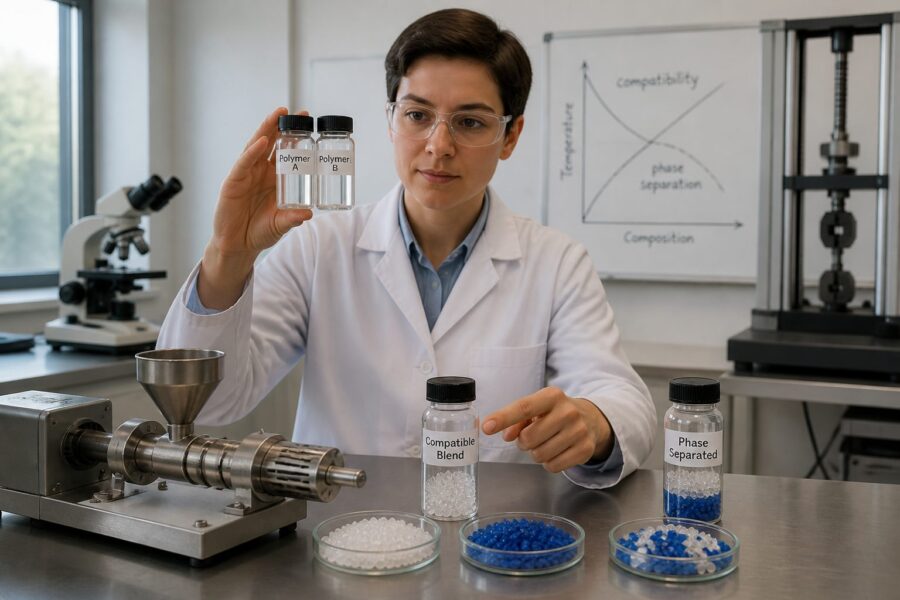
Polymer blends are mixtures of two or more polymers to create materials with unique properties. The primary goal of polymer blending is to achieve a combination of characteristics that are not available in a single polymer. However, the effectiveness of polymer blending heavily relies on achieving sufficient polymer blending compatibility between the constituent polymers.
When polymers are compatible, they can mix at a molecular level, leading to a homogeneous blend. Incompatibility, on the other hand, results in phase separation, where the polymers remain distinct and form separate domains. This article explores the critical aspects of polymer blending compatibility, including the factors that influence it, techniques to assess it, and strategies to enhance it.
We will also look at examples of compatible and incompatible blends and their applications. Understanding and controlling polymer blending compatibility is essential for designing high-performance materials with tailored properties. Let’s begin by understanding why compatibility is so important.
The Importance of Compatibility in Polymer Blends
The compatibility of polymers in a blend dictates the overall properties and performance of the resulting material. High polymer blending compatibility leads to a homogeneous mixture, where the polymers are uniformly dispersed. This results in a material with consistent properties throughout.
In contrast, incompatibility leads to phase separation, where distinct domains of each polymer are formed. Phase separation can significantly affect the mechanical, thermal, and optical properties of the blend. Understanding the effects of compatibility is crucial for designing polymer blends with specific characteristics.
For instance, a compatible blend is more likely to exhibit improved mechanical strength and toughness. This is because the uniform dispersion of polymers allows for better stress distribution throughout the material. With incompatible blends, the interfaces between phases can act as weak points, leading to premature failure.
Furthermore, polymer blending compatibility affects the thermal behavior of the blend. Compatible blends often show a single glass transition temperature (Tg), indicating a homogeneous mixture. Incompatible blends, however, typically exhibit multiple Tgs, each corresponding to the individual polymers.
Optical properties are also influenced by compatibility. Compatible blends tend to be transparent due to the absence of phase boundaries that scatter light. Incompatible blends, on the other hand, can be opaque or translucent due to light scattering at the interfaces.
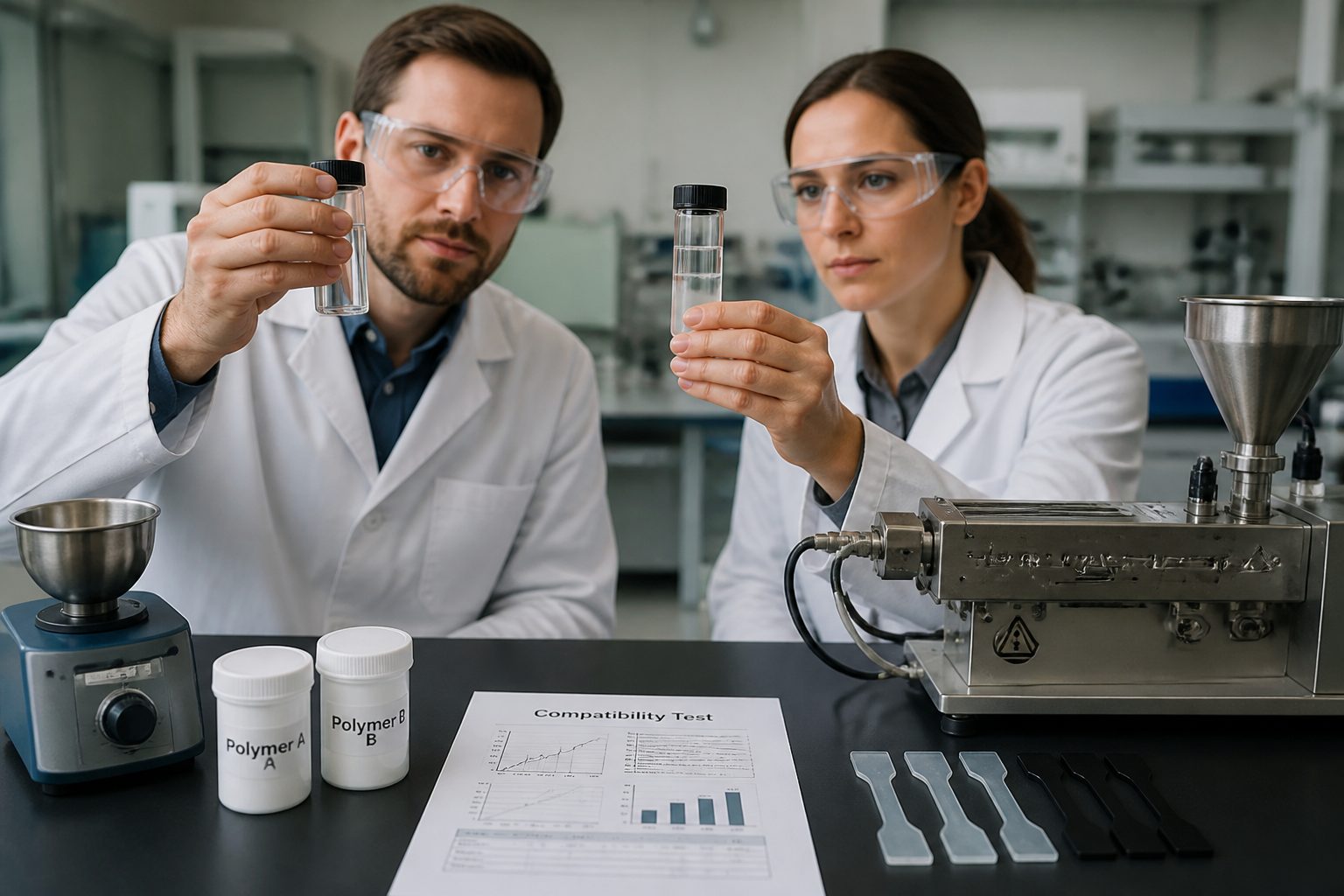

Therefore, achieving the desired level of polymer blending compatibility is crucial for tailoring the properties of polymer blends. By understanding the factors that affect compatibility, we can design blends with enhanced performance for various applications. Let’s look at these factors next.
Factors Affecting Polymer Blend Compatibility
Several factors influence the polymer blending compatibility of polymer blends. These factors can be broadly categorized into thermodynamic, kinetic, and structural aspects. Understanding these factors is essential for predicting and controlling the compatibility of polymer blends.
Thermodynamic factors include the enthalpy and entropy of mixing. For two polymers to be miscible, the Gibbs free energy of mixing must be negative. This requires a favorable (negative) enthalpy of mixing and a positive entropy of mixing.
The enthalpy of mixing is related to the intermolecular interactions between the polymers. Strong attractive forces between the polymers favor miscibility, while repulsive forces lead to phase separation. The Flory-Huggins interaction parameter, χ, is often used to quantify the interaction between polymers.
The entropy of mixing is generally small for high molecular weight polymers due to the limited number of configurations available. Therefore, a negative enthalpy of mixing is often necessary to achieve miscibility. This can be achieved through specific interactions such as hydrogen bonding or dipole-dipole interactions.
Kinetic factors, such as the viscosity and diffusion rates of the polymers, also play a role. High viscosity can hinder the mixing process and prevent the system from reaching equilibrium. Slow diffusion rates can also limit the extent of mixing, leading to incomplete compatibility.
Structural factors, such as the molecular weight, architecture, and composition of the polymers, also affect compatibility. Lower molecular weight polymers tend to be more miscible due to the increased entropy of mixing. The architecture of the polymers, such as branching or crosslinking, can also influence compatibility.
Techniques for Assessing Polymer Blend Compatibility
Assessing polymer blending compatibility is crucial for understanding the behavior and properties of polymer blends. Several techniques can be used to evaluate the miscibility and phase behavior of polymer blends. These techniques provide insights into the degree of mixing and the morphology of the blend.
These techniques include thermal analysis, microscopy, and scattering methods. Each technique offers unique information about the blend’s structure and properties. Let’s explore these methods in more detail.
| Technique | Principle | Information Provided |
|---|---|---|
| Differential Scanning Calorimetry (DSC) | Measures heat flow as a function of temperature | Glass transition temperature(s), miscibility |
| Dynamic Mechanical Analysis (DMA) | Measures mechanical properties as a function of temperature and frequency | Glass transition temperature(s), phase behavior |
| Optical Microscopy | Visual inspection of the blend morphology | Phase size, distribution, and shape |
| Scanning Electron Microscopy (SEM) | High-resolution imaging of the blend morphology | Phase morphology, interface characteristics |
| Transmission Electron Microscopy (TEM) | High-resolution imaging with enhanced contrast | Phase morphology, interface structure |
| Small-Angle X-ray Scattering (SAXS) | Measures scattering of X-rays at small angles | Phase size, domain spacing |
| Small-Angle Neutron Scattering (SANS) | Measures scattering of neutrons at small angles | Phase size, domain spacing |
These techniques provide valuable information about the compatibility of polymer blends. By combining the results from multiple techniques, a comprehensive understanding of the blend’s behavior can be achieved. Next, we will explore how compatibilizers can be used to enhance blend properties.
Using Compatibilizers to Improve Blend Properties
Compatibilizers are substances added to polymer blends to improve their miscibility and reduce phase separation. They work by reducing the interfacial tension between the polymers and enhancing the interfacial adhesion. This leads to a finer and more stable morphology, resulting in improved mechanical properties.
There are several types of compatibilizers, including block copolymers, graft copolymers, and reactive compatibilizers. Each type works through different mechanisms to enhance polymer blending compatibility. Let’s explore them more closely.
Block copolymers consist of two or more blocks of different polymers covalently bonded together. These copolymers can locate at the interface between the two polymers in the blend, reducing the interfacial tension. The blocks are typically chosen to be miscible with the corresponding polymers in the blend.
Graft copolymers have a backbone of one polymer with branches of another polymer grafted onto it. Similar to block copolymers, graft copolymers can also locate at the interface between the two polymers. The backbone and branches are chosen to be miscible with the corresponding polymers in the blend.
Reactive compatibilizers are molecules that react with both polymers in the blend, forming covalent bonds between them. This chemical bonding enhances the interfacial adhesion and prevents phase separation. Reactive compatibilization often involves the use of functional groups that can react with the polymers.
The effectiveness of a compatibilizer depends on several factors, including its molecular weight, composition, and concentration. The optimal compatibilizer should be chosen based on the specific polymers in the blend and the desired properties. Careful selection and optimization of compatibilizers can significantly improve the performance of polymer blends.
Examples of Compatible and Incompatible Polymer Blends
Understanding specific examples of compatible and incompatible polymer blends can provide valuable insights into the factors that govern miscibility. These examples illustrate the principles discussed earlier and highlight the importance of considering polymer-polymer interactions. Let’s examine some notable cases.
One well-known example of a compatible blend is poly(2,6-dimethyl-1,4-phenylene oxide) (PPO) and polystyrene (PS). These two polymers are miscible over a wide range of compositions due to favorable interactions between the phenyl groups. The resulting blend exhibits a single glass transition temperature, indicating a homogeneous mixture.
- Polyethylene (PE) and polypropylene (PP)
- Polystyrene (PS) and polymethylmethacrylate (PMMA)
- Polyvinyl chloride (PVC) and polyethylene terephthalate (PET)
- Polycarbonate (PC) and polypropylene (PP)
- Polyamide (PA) and polyethylene (PE)
These examples illustrate the importance of considering polymer-polymer interactions when designing polymer blends. By understanding the factors that promote or inhibit miscibility, we can create blends with tailored properties for specific applications. Next, let’s explore some of these applications.
Applications of Polymer Blends
Polymer blends find applications in a wide range of industries due to their ability to combine the properties of different polymers. By carefully selecting and blending polymers, materials with tailored characteristics can be created for specific applications. These applications span automotive, packaging, biomedical, and construction sectors.
In the automotive industry, polymer blends are used to produce lightweight and high-strength components. For example, blends of polypropylene (PP) and ethylene-propylene rubber (EPR) are used in bumpers and interior parts. These blends offer a good balance of impact resistance, stiffness, and processability.
In the packaging industry, polymer blends are used to create films with improved barrier properties and mechanical strength. Blends of polyethylene (PE) and polyamide (PA) are commonly used in food packaging to provide barrier against oxygen and moisture. This helps extend the shelf life of packaged foods.
In the biomedical field, polymer blends are used to develop materials for drug delivery systems and tissue engineering scaffolds. Blends of polylactic acid (PLA) and polycaprolactone (PCL) are biodegradable and biocompatible, making them suitable for these applications. The blend composition can be adjusted to control the degradation rate and mechanical properties.
In the construction industry, polymer blends are used to enhance the durability and weather resistance of building materials. Blends of polyvinyl chloride (PVC) and acrylic polymers are used in siding and window profiles. These blends offer improved impact resistance, UV resistance, and color retention.
Other applications of polymer blends include: improved tire performance using styrene-butadiene rubber (SBR) and butadiene rubber (BR); enhanced electronic device housings with polycarbonate (PC) and acrylonitrile butadiene styrene (ABS); and specialized coatings using polyurethane (PU) and acrylic polymers. The versatility of polymer blends allows for continuous innovation across various sectors.
The Role of Molecular Weight in Polymer Blending
Molecular weight is a critical parameter influencing the compatibility and properties of polymer blends. It affects the miscibility, viscosity, and mechanical behavior of the resulting material. Understanding the role of molecular weight is essential for designing polymer blends with desired characteristics.
Generally, lower molecular weight polymers tend to be more miscible than higher molecular weight polymers. This is because the entropy of mixing increases as the molecular weight decreases. The increased entropy favors mixing and reduces the likelihood of phase separation.
However, lowering the molecular weight can also reduce the mechanical strength and toughness of the blend. Lower molecular weight polymers have shorter chain lengths, which can lead to weaker entanglement and lower resistance to deformation. Therefore, a balance must be struck between compatibility and mechanical properties when selecting the molecular weight of the polymers.
The viscosity of the polymers also depends on their molecular weight. Higher molecular weight polymers have higher viscosities, which can hinder the mixing process. High viscosity can make it difficult to achieve a homogeneous blend, especially in melt processing. Therefore, it is important to consider the viscosity of the polymers when designing the blending process.
In some cases, using a bimodal molecular weight distribution can be beneficial. A bimodal distribution involves using a blend of low and high molecular weight polymers. The low molecular weight polymer can improve miscibility and processability, while the high molecular weight polymer can enhance mechanical strength and toughness.
The molecular weight distribution also affects the crystallization behavior of semi-crystalline polymers in the blend. Narrow molecular weight distributions tend to promote higher crystallinity, while broad distributions can hinder crystallization. Controlling the crystallinity can influence the mechanical and thermal properties of the blend.
Advanced Techniques in Polymer Blend Research
Advancements in polymer science have led to the development of sophisticated techniques for studying polymer blends. These advanced techniques provide detailed insights into the structure, dynamics, and properties of polymer blends at the molecular level. Such insights are crucial for designing high-performance materials with tailored characteristics.
One such technique is molecular dynamics (MD) simulation. MD simulations can be used to model the behavior of polymer blends at the atomic level. This allows researchers to study the interactions between polymers, predict the miscibility, and optimize the blend composition.
Another advanced technique is atomic force microscopy (AFM). AFM can be used to image the surface of polymer blends with nanometer resolution. This allows researchers to study the morphology of the blend, measure the interfacial adhesion, and identify phase boundaries.
Broadband Dielectric Spectroscopy (BDS) is another powerful tool for studying the dynamics of polymer blends. BDS measures the dielectric response of the blend over a wide range of frequencies and temperatures. This provides information about the segmental mobility, relaxation processes, and phase behavior of the polymers.
Time-resolved infrared spectroscopy (TR-IR) can be used to study the kinetics of mixing and phase separation in polymer blends. TR-IR measures the infrared spectrum of the blend as a function of time. This allows researchers to monitor the changes in the chemical environment of the polymers during the blending process.
These advanced techniques, combined with traditional methods, provide a comprehensive toolkit for studying polymer blends. By using these techniques, researchers can gain a deeper understanding of the structure-property relationships and design high-performance materials for various applications. Continued development and application of these techniques will undoubtedly drive further innovation in polymer blend technology.
Conclusion
Polymer blending is a versatile strategy for creating materials with tailored properties by combining two or more polymers. Achieving sufficient polymer blending compatibility between the constituent polymers is crucial for optimizing the performance of these blends. Factors such as thermodynamics, kinetics, and polymer structure all play significant roles in determining compatibility.
Techniques like DSC, microscopy, and scattering methods are essential for assessing polymer blending compatibility and understanding blend morphology. Compatibilizers, including block and graft copolymers, can be used to enhance miscibility and improve blend properties. By understanding these principles and utilizing advanced research techniques, it is possible to design high-performance polymer blends for a wide range of applications.