
Copolymers represent a fascinating class of polymers, built from two or more different monomer units. By carefully selecting and arranging these building blocks, scientists and engineers create materials with unique and often superior properties. This ability to tailor a polymer’s characteristics—from mechanical strength to thermal stability and chemical resistance—makes copolymers incredibly versatile.
This precise control over molecular architecture drives innovations across countless industries. From everyday plastics to advanced biomedical devices, copolymers improve performance and enable new functionalities that single-monomer homopolymers cannot match. Understanding their fundamental design and synthesis is key to unlocking their full potential.
This article explores the world of copolymers, examining how their structure dictates behavior and where they make a real impact. We will delve into different types, synthesis methods, and diverse applications, demonstrating how monomer sequence drastically alters material performance.
Defining Copolymers and Monomer Combinations
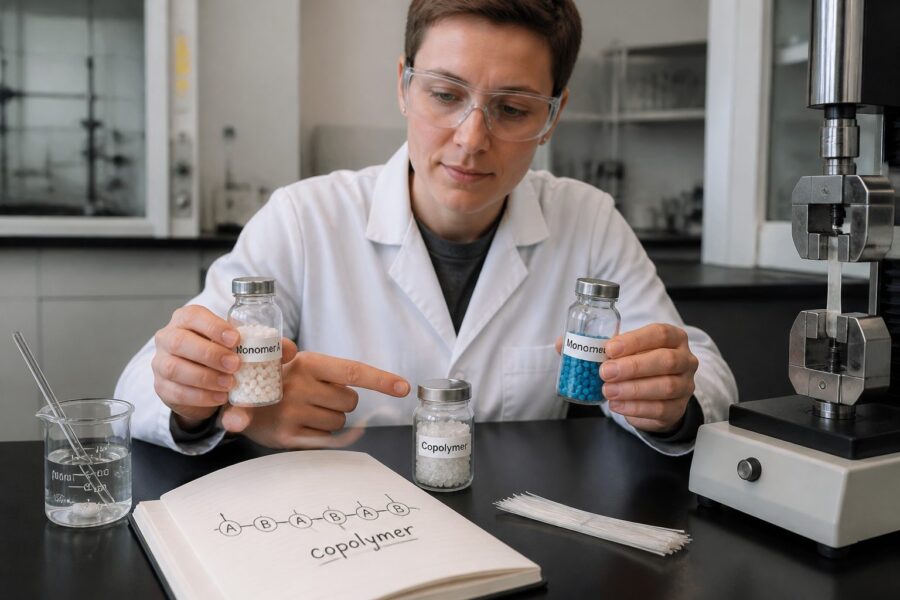
A copolymer is a polymer derived from two or more different monomer units, unlike a homopolymer which consists of only one. This allows combining desirable attributes of individual homopolymers into a single material, achieving properties like flexibility and strength simultaneously within one macromolecule. For instance, combining ethylene monomers with vinyl acetate forms ethylene-vinyl acetate (EVA), exhibiting increased elasticity and adhesion compared to pure polyethylene, significantly expanding its copolymer properties applications.
The choice of monomers is paramount, as each contributes unique chemical functionalities and physical characteristics. Aromatic monomers impart rigidity, while aliphatic ones contribute flexibility. Understanding these individual contributions helps predict the final material’s performance.
The ratio of different monomers also critically determines final material properties. A higher percentage of one monomer results in characteristics closer to its homopolymer, allowing for fine-tuning of material behavior. For example, increasing styrene in styrene-butadiene rubber improves hardness and tensile strength, while more butadiene enhances elasticity. Such precise adjustments are essential for specific copolymer properties applications.
Chemical bonds between monomers influence stability and reactivity. Strong covalent bonds ensure structural integrity, while weaker interactions can enable tunable responses. Monomer compatibility during synthesis is also crucial; monomers must react under controlled conditions to form stable chains, as incompatibility can lead to phase separation.
This fundamental understanding of monomer selection and ratio is the bedrock of copolymer design. Modern design processes often incorporate computational modeling to predict monomer combination behavior, reducing experimental trials and accelerating material development.
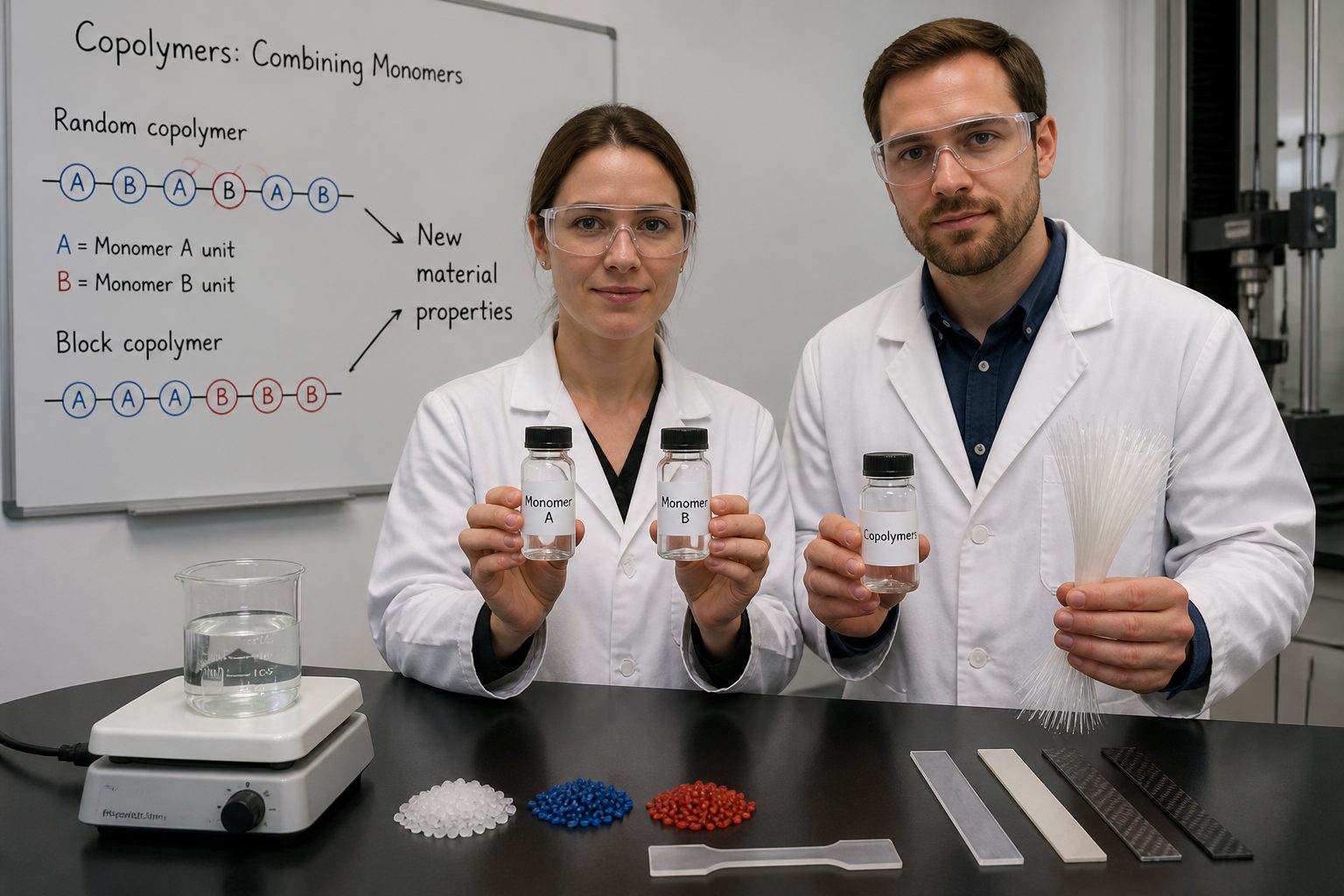
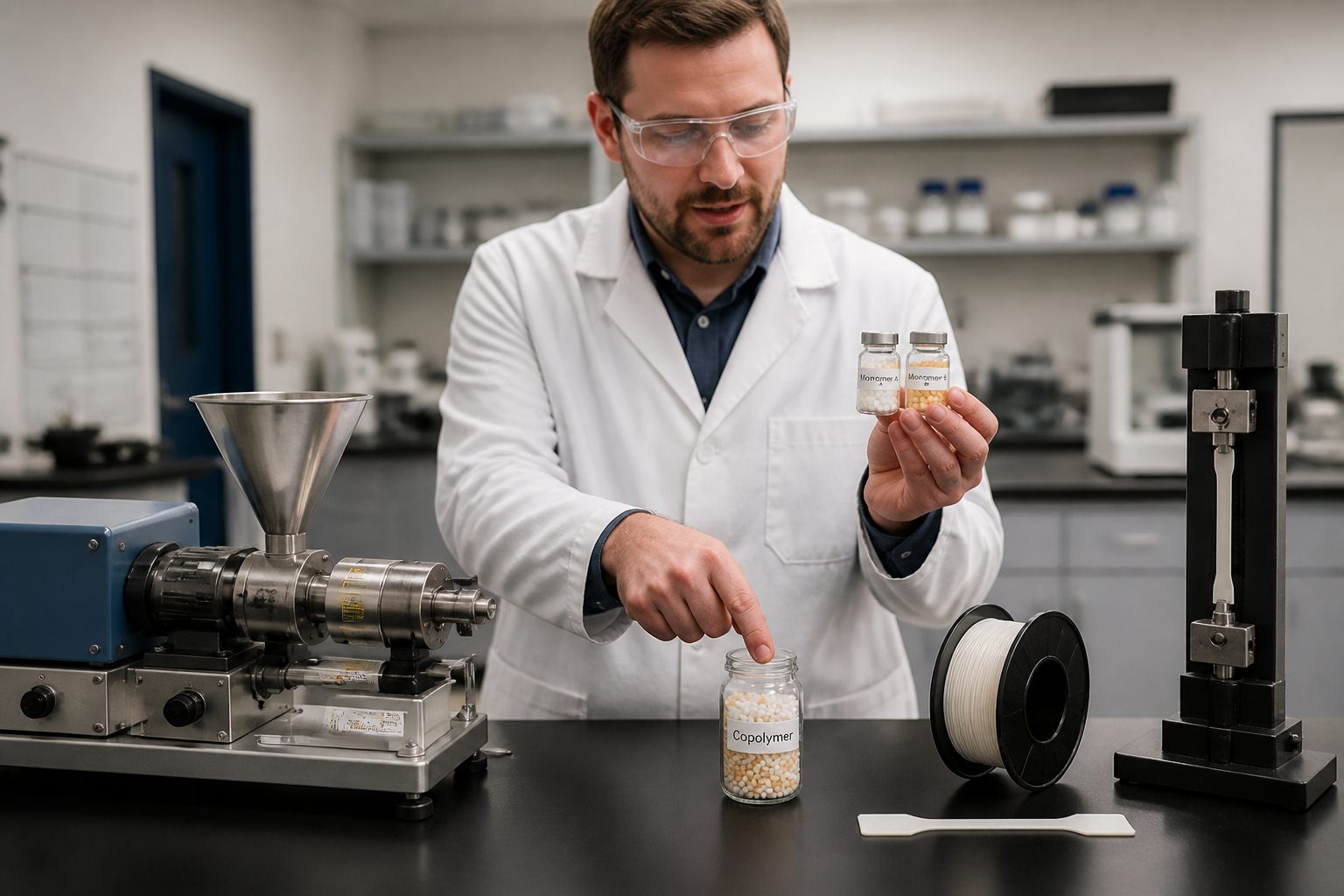
Ultimately, copolymers offer inherent flexibility in design and bridge performance gaps. They are not mere mixtures but new chemical entities with emergent properties, making them powerful tools for material innovation.
Types of Copolymers: Block, Random, and Alternating
The arrangement of different monomer units along the polymer chain profoundly impacts a copolymer’s properties. Three primary classifications—random, alternating, and block copolymers—each offer distinct advantages for various copolymer properties applications. Understanding these structural differences is key to predicting material behavior and designing for specific purposes, as molecular architecture directly drives real-world performance.
| Copolymer Type | Monomer Arrangement | Key Characteristics |
|---|---|---|
| Random | A-B-B-A-B-A-A-B | Homogeneous mixing, average properties, often amorphous. |
| Alternating | A-B-A-B-A-B-A-B | Regular, repeating sequence, predictable properties, often semi-crystalline. |
| Block | A-A-A-A-B-B-B-B | Distinct segments, microphase separation, unique self-assembly. |
| Graft | A-A-A-A-A-A-A-A | B-B-B | Side chains of one monomer type attached to a main chain of another. |
Random copolymers feature monomer units distributed irregularly, leading to an averaging of individual homopolymer properties. Styrene-butadiene rubber (SBR) is a classic example; its random copolymer synthesis yields excellent abrasion resistance and elasticity, ideal for tires. This lack of long-range order typically results in amorphous structures.
Alternating copolymers have a highly ordered A-B-A-B-A-B sequence. This precise arrangement can lead to distinct properties, sometimes superior to either homopolymer or a random copolymer. Ethylene-carbon monoxide copolymers exemplify alternating copolymer design, with their regular sequence often allowing for some crystallinity and predictable chain packing, significantly impacting thermal and mechanical behavior.
Block copolymers are characterized by long sequences, or “blocks,” of one monomer type followed by another (e.g., AAAA-BBBB). These distinct blocks often have different chemical affinities, leading to fascinating self-assembly. Styrene-butadiene-styrene (SBS) block copolymer, a thermoplastic elastomer, is a prime example. Its hard polystyrene blocks provide strength, while soft polybutadiene blocks offer elasticity, allowing it to behave like rubber at room temperature but be processed like plastic when heated. The microphase separation in block copolymers is a direct consequence of their distinct structure, forming nanoscale domains with intricate morphologies that dictate material properties.
Graft copolymers are another type, where side chains of one monomer are grafted onto a main polymer chain of another. This structure uniquely combines backbone and grafted chain properties, often used for surface modification or as compatibilizers in polymer blends.
Understanding these fundamental copolymer types is essential for polymer scientists. The choice between random, alternating, or block copolymer structure guides the entire material design process, offering unique pathways to achieve specific performance goals in various copolymer properties applications.
How Copolymer Structure Controls Material Properties
The arrangement of monomers within a copolymer chain fundamentally dictates its macroscopic material properties. This molecular architecture directly translates into how a material performs under stress, heat, or chemical exposure, making the intricate relationship between structure and function central to polymer engineering.
The glass transition temperature (Tg), defining a polymer’s transition from rigid to flexible, is critically influenced. In random copolymers, Tg often averages between the corresponding homopolymers’ Tg values, allowing precise control over flexibility. For instance, adding butadiene to styrene lowers Tg, enhancing elasticity for applications like tire treads where cold-weather flexibility is crucial.
Block copolymers, with distinct segments, exhibit more complex Tg behavior, as each block can retain its individual Tg. This enables materials with multiple glass transition temperatures, rigid in some parts and flexible in others. Microphase separation in block copolymer structure creates domains with different properties; in SBS copolymers, hard polystyrene domains act as physical crosslinks, while soft polybutadiene domains provide rubbery elasticity.
Mechanical properties like tensile strength, modulus, and elongation are highly sensitive to copolymer structure. A crystalline alternating copolymer might possess greater stiffness and strength than an amorphous random copolymer of similar composition, influenced by chain packing.
Functional groups within monomers introduce new properties: hydrophilic monomers can make a copolymer water-soluble, while hydrophobic ones enhance water repellency, enabling material design for specific environments. Chemical resistance is also influenced; incorporating monomers with strong bonds or bulky side groups shields the polymer backbone from chemical attack, making copolymers valuable in harsh industrial settings.
Crystallinity control is another powerful aspect. Introducing a second monomer can disrupt regular chain packing, reducing crystallinity and increasing flexibility. Conversely, an alternating copolymer design might promote specific crystalline structures. Surface properties—adhesion, wettability, friction—are also tunable. Block copolymers can self-assemble into surfaces with specific chemistries, useful in coatings or biomedical implants, as surface chemistry dictates interaction with surroundings.
Ultimately, the power of copolymers lies in this precise control over material properties through molecular design. Every characteristic, from mechanical resilience to thermal performance and chemical inertness, can be engineered. This level of control, impossible with homopolymers, highlights the unique advantages of copolymer properties applications.
Synthesis Methods for Engineering Copolymers
Creating copolymers with specific structures and properties requires a diverse toolkit of polymerization techniques. The chosen synthesis method directly influences monomer arrangement, molecular weight, and overall architecture, making understanding these methods crucial for engineering materials with desired copolymer properties applications.
Free radical polymerization is a common and versatile method, producing random copolymers by mixing and initiating two or more monomers. Monomer reactivity ratios determine the sequence randomness. While traditional free radical polymerization offers limited control, Controlled Radical Polymerization (CRP) techniques like ATRP and RAFT provide much better control over chain growth, enabling synthesis of well-defined block copolymers and complex architectures.
Anionic polymerization is powerful for creating block copolymers with precise block lengths. It relies on “living polymerization,” where chain ends remain active, allowing sequential addition of different monomers to form distinct blocks. This precise control makes anionic polymerization invaluable for high-performance materials and specific block copolymer structure designs.
Condensation polymerization also synthesizes copolymers, especially alternating ones. Monomers react, eliminating a small molecule like water, to form a perfectly alternating sequence. Polyester and polyamide copolymers are often synthesized this way, with precise stoichiometry and reaction conditions critical for achieving desired alternating copolymer design and highly ordered structures.
Ring-opening polymerization (ROP) is useful for synthesizing block copolymers from cyclic monomers. This technique involves opening a cyclic monomer ring, which adds to the growing chain. Sequential polymerization of different cyclic monomers creates various block copolymer structures. Biodegradable block copolymers, for instance, often involve ROP of lactides or caprolactones, with the living nature of ROP systems allowing precise control over block lengths for biomedical applications.
Catalyst selection is paramount across all methods, influencing monomer reactivity, stereochemistry, and polymerization rate. Process parameters like solvent, temperature, and pressure also affect synthesis, influencing monomer solubility, kinetics, and chain conformation. Optimizing these is essential for efficient, scalable routes. Ultimately, engineering copolymers with tailored properties relies on mastering these diverse synthesis methods. Ongoing research aims for finer control over molecular architecture, driving the expansion of copolymer properties applications into new frontiers and unlocking new performance capabilities for advanced materials.
Copolymers in Packaging, Adhesives, and Elastomers
Copolymers are ubiquitous, enhancing countless everyday products. Their ability to combine disparate properties makes them ideal for demanding roles in packaging, adhesives, and elastomers, sectors heavily reliant on unique copolymer properties applications to meet diverse consumer and industrial needs.
In packaging, copolymers improve barrier properties, flexibility, and heat sealability. Ethylene-vinyl alcohol (EVOH) copolymer, an alternating copolymer design, offers exceptional oxygen barrier properties, indispensable for extended food shelf life. Ethylene-acrylic acid (EAA) copolymers provide strong adhesion to aluminum foil and other substrates, perfect for laminates and complex packaging structures.
- Enhancing food freshness and shelf life
- Improving peelability of flexible packaging
- Providing strong, durable bonds in adhesives
- Creating highly elastic and resilient rubber products
- Increasing impact resistance in plastic containers
- Allowing for multi-layer film coextrusion
- Offering heat-seal capabilities for various films
- Improving adhesion to difficult substrates
For adhesives, copolymers are workhorses, offering tailored tack, peel strength, and temperature resistance. Poly(ethylene-co-vinyl acetate) (EVA) is widely used in hot-melt adhesives due to its excellent adhesion and flexibility, with its random copolymer synthesis allowing the ethylene to vinyl acetate ratio to directly influence adhesive strength and melt viscosity. Acrylic copolymers are prominent in pressure-sensitive adhesives (PSAs) for tapes and labels, engineered for permanent or removable adhesion by controlling monomer composition and glass transition temperature.
In elastomers, block copolymers have revolutionized the industry by offering thermoplastic elastomer (TPE) properties. Styrene-butadiene-styrene (SBS) and styrene-isoprene-styrene (SIS) block copolymers behave like vulcanized rubber but are thermoplastic, meaning they are recyclable and easier to manufacture. Their distinct block copolymer structure forms physically crosslinked networks where hard polystyrene blocks act as temporary crosslinks for elastic recovery, softening when heated for reshaping.
Nitrile-butadiene rubber (NBR), a random copolymer of acrylonitrile and butadiene, is critical for its excellent oil and fuel resistance, ideal for seals, gaskets, and hoses. Butyl rubber, a copolymer of isobutylene and isoprene, is known for low gas permeability and good flex-fatigue resistance, perfect for inner tubes and protective linings. The small isoprene amount allows for vulcanization, creating a chemically crosslinked network.
These examples highlight the vast copolymer properties applications in these sectors. Their unmatched versatility makes them indispensable to modern material science, allowing manufacturers to produce functional, cost-effective, and sustainable products.
High-Performance Copolymers in Engineering Applications
Beyond everyday products, high-performance copolymers are engineering marvels, pushing boundaries in demanding fields like automotive, aerospace, medical, and electronics. These applications require exceptional thermal stability, mechanical strength, chemical resistance, and specialized functionalities, making advanced copolymer properties applications truly transformative.
In the automotive industry, copolymers contribute to lighter, more fuel-efficient vehicles. Impact-modified polyamides offer enhanced toughness and strength for engine components, replacing heavier metal. Acrylonitrile-butadiene-styrene (ABS) copolymer, a random copolymer, combines polybutadiene’s toughness with styrene-acrylonitrile’s rigidity, used extensively in automotive interiors and electronic housings.
Aerospace applications demand materials resistant to extreme temperatures, radiation, and stress. Polyether ether ketone (PEEK) copolymers provide superior thermal stability and chemical inertness for critical aircraft components. Fluoropolymers like ethylene-tetrafluoroethylene (ETFE) copolymer, an alternating copolymer, offer exceptional chemical resistance, high-temperature performance, and UV stability for architectural facades and electrical insulation.
Medical devices benefit immensely from specialized copolymers. Poly(lactic-co-glycolic acid) (PLGA) is a biodegradable random copolymer for sutures, drug delivery, and tissue engineering, with its degradation rate controlled by monomer ratio. Biocompatible block copolymers like poly(ethylene glycol)-poly(propylene glycol) (PEG-PPG), or Pluronics, are used in drug delivery, their unique block copolymer structure allowing self-assembly into micelles for targeted drug encapsulation.
In electronics, copolymers serve as insulation, encapsulants, and flexible circuits. Silicone-based copolymers offer excellent thermal stability and dielectric properties. Emerging conductive copolymers find use in antistatic coatings, sensors, and flexible displays, with precise arrangement allowing fine-tuning of electrical properties.
Responsive “smart” copolymers, which change properties based on temperature, pH, or light, are an exciting area for drug delivery, sensors, and actuators. High-performance fiber science also leverages copolymers; spandex, a segmented polyurethane-urea block copolymer, provides exceptional elasticity for activewear and medical textiles due to its unique block copolymer structure.
Ongoing research and development in high-performance copolymers continue to open new possibilities for engineering solutions. By precisely tailoring molecular structures, scientists create materials that meet the most extreme demands of modern technology, truly showcasing the power of advanced copolymer properties applications.
Conclusion
Copolymers represent a triumph of molecular engineering, offering unparalleled ability to design materials with tailored properties. From simple random mixtures to complex block architectures, the strategic combination of different monomers unlocks a vast spectrum of performance characteristics, making them indispensable across industries.
We’ve explored fundamental definitions, distinct types like block, random, and alternating, and their profound impact on material behavior. Synthesis methods provide the tools to precisely craft these molecular chains, enabling diverse copolymer properties applications.
The versatility of copolymers is evident in their widespread use, from packaging and adhesives to elastomers, underpinning much of modern convenience. High-performance copolymers push limits in aerospace, automotive, and medicine, withstanding extreme conditions and enabling technological advancements.
Ongoing research into novel monomers, advanced polymerization techniques, and computational modeling promises even more exciting developments. Scientists continually seek new ways to manipulate copolymer structure for unprecedented functionalities. The future of material science undoubtedly involves more ingenious copolymer properties applications.
As our understanding of polymer science deepens, so does our capacity to engineer materials for specific challenges. Copolymers stand as a testament to human ingenuity, their continued evolution driving innovation across countless sectors and shaping the materials of tomorrow.