
Electrospinning is a versatile and cost-effective technique for nanofiber fabrication. This process uses an electric field to draw charged threads of polymer solutions or melts, creating fibers with diameters in the nanometer range, opening up a world of possibilities for advanced applications.
The resulting electrospinning nanofibers polymers exhibit unique properties, such as high surface area to volume ratio and tunable porosity. These properties make them ideal for diverse applications, from biomedical engineering to energy storage.
In this article, we will discuss the electrospinning process, the parameters that affect nanofiber formation, and the wide range of applications for these fascinating materials. We will also examine the advantages and disadvantages of electrospinning as a nanofiber fabrication technique.
Introduction to Electrospinning
Electrospinning is a fiber production method that utilizes electric force to draw charged threads of polymer solutions or polymer melts. The process was patented in 1934 by Anton Formhals, and has gained significant attention in recent decades due to its simplicity and versatility in producing continuous nanofibers. It is now a well-established method for electrospinning nanofibers polymers.
Unlike traditional fiber spinning techniques, electrospinning does not require mechanical drawing or complex processing steps. This makes it a cost-effective and scalable method for producing nanofibers with controlled morphology and properties.
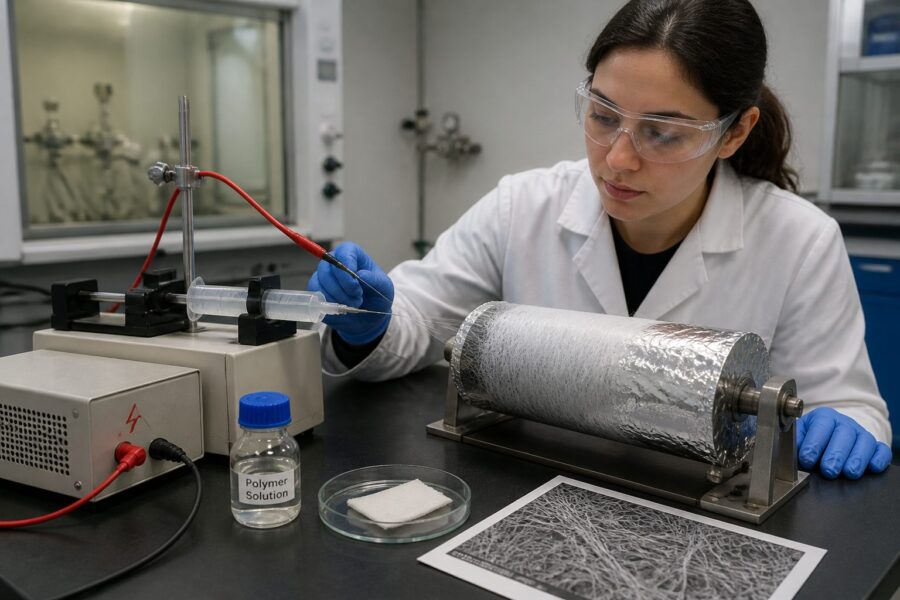
The basic setup for electrospinning consists of a high-voltage power supply, a spinneret (usually a needle or capillary), and a grounded collector. A polymer solution or melt is fed through the spinneret, and a high voltage is applied between the spinneret and the collector.
This electric field induces a charge on the surface of the liquid, and when the electrostatic force overcomes the surface tension, a charged jet is ejected from the tip of the spinneret. As the jet travels towards the collector, the solvent evaporates, and the charged jet undergoes a whipping instability, resulting in the formation of long, thin fibers that are collected on the grounded target.
The Electrospinning Process: A Step-by-Step Guide
The electrospinning process can be broken down into several key steps, each of which plays a crucial role in determining the final properties of the electrospinning nanofibers polymers. Understanding these steps is essential for optimizing the electrospinning process and tailoring the nanofibers for specific applications.
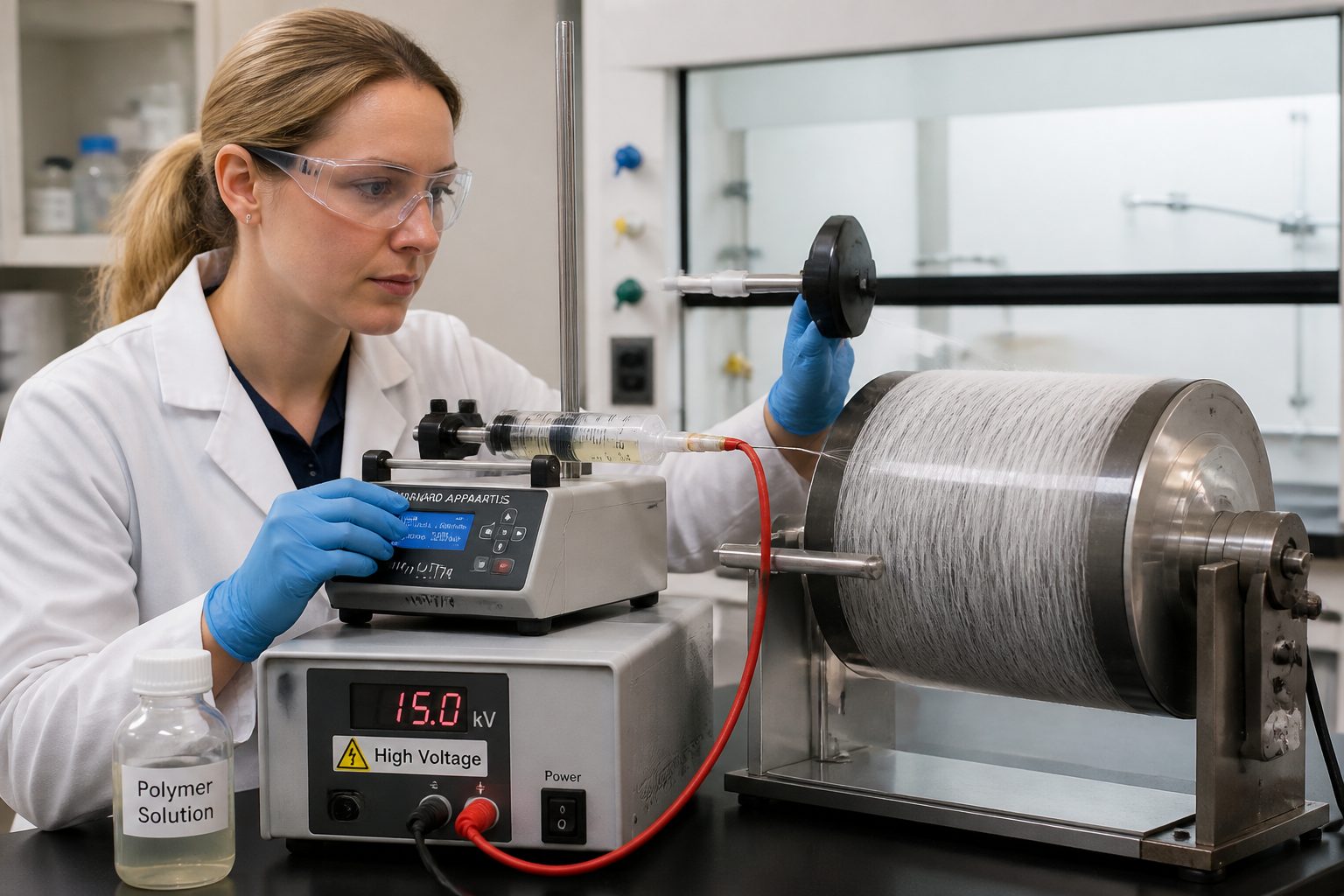
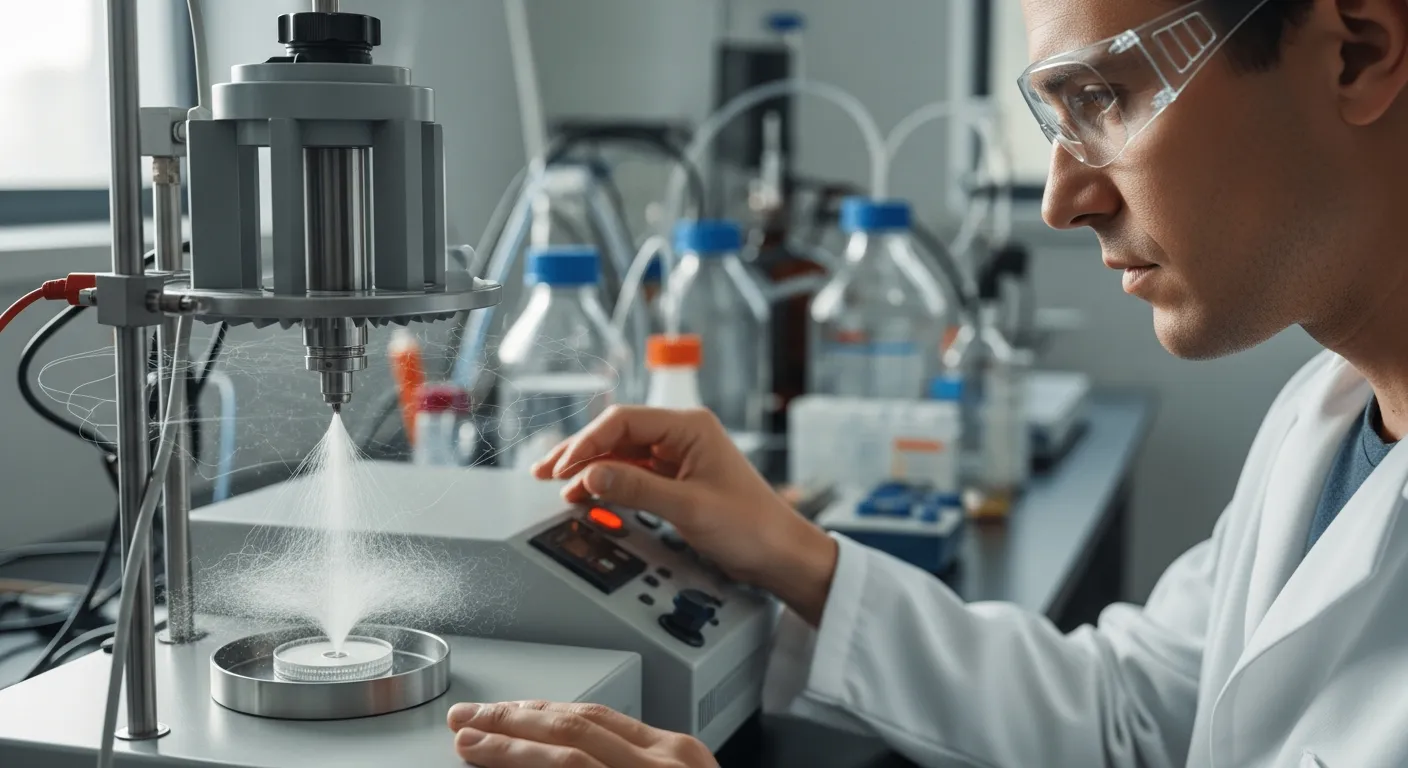
First, a polymer solution or melt is prepared by dissolving or melting the polymer in a suitable solvent or at an appropriate temperature. The choice of solvent and polymer concentration is critical, as it affects the viscosity, surface tension, and conductivity of the solution, which in turn influence the fiber formation process.
Next, the polymer solution is loaded into a syringe or reservoir and fed through a spinneret, which is typically a metallic needle or capillary. A high-voltage power supply is connected to the spinneret, and a grounded collector is placed at a certain distance from the spinneret.
When the high voltage is applied, an electric field is created between the spinneret and the collector. As the electric field strength increases, the surface of the polymer solution at the tip of the spinneret becomes charged.
When the electrostatic force exceeds the surface tension of the liquid, a charged jet is ejected from the tip of the spinneret, forming a Taylor cone. This charged jet then travels towards the collector, undergoing a whipping instability due to the electrostatic repulsion between the charges on the jet’s surface.
During this whipping process, the solvent evaporates, and the jet solidifies into a fiber. The resulting fibers are collected on the grounded collector, forming a nonwoven mat of electrospinning nanofibers polymers.
Key Parameters Affecting Nanofiber Formation
The electrospinning process is influenced by a complex interplay of parameters that affect the morphology, diameter, and properties of the resulting nanofibers. These parameters can be broadly categorized into solution properties, process parameters, and ambient conditions.
Careful control and optimization of these parameters are essential for achieving the desired nanofiber characteristics and ensuring the reproducibility of the electrospinning process, especially when fabricating electrospinning nanofibers polymers.
| Parameter Category | Specific Parameter | Effect on Nanofiber Formation |
|---|---|---|
| Solution Properties | Polymer Molecular Weight | Higher molecular weight leads to increased viscosity and fiber entanglement, resulting in larger fiber diameters and reduced bead formation. |
| Solution Properties | Polymer Concentration | Increased concentration leads to increased viscosity, resulting in larger fiber diameters. Too low concentration can lead to bead formation. |
| Solution Properties | Solution Viscosity | Higher viscosity generally results in larger fiber diameters. Optimal viscosity range is crucial for stable jet formation. |
| Process Parameters | Applied Voltage | Higher voltage increases the electrostatic force, leading to thinner fibers and increased jet instability. |
| Process Parameters | Flow Rate | Higher flow rate can lead to thicker fibers and increased bead formation due to insufficient solvent evaporation. |
| Process Parameters | Tip-to-Collector Distance | Increased distance allows for more solvent evaporation, leading to thinner and drier fibers. Too long distance can cause jet instability. |
| Ambient Conditions | Temperature | Higher temperature can increase solvent evaporation rate, leading to thinner fibers. |
| Ambient Conditions | Humidity | High humidity can affect solvent evaporation and fiber morphology, potentially leading to pore formation or fiber bonding. |
Materials Used in Electrospinning
A wide variety of materials can be electrospun into nanofibers, including synthetic polymers, natural polymers, and composite materials. The choice of material depends on the desired properties of the nanofibers and the intended application.
Each material brings its own unique characteristics to the electrospinning nanofibers polymers, influencing their mechanical strength, biocompatibility, conductivity, and other functional properties.
Synthetic polymers such as poly(ethylene oxide) (PEO), poly(lactic acid) (PLA), poly(caprolactone) (PCL), and poly(urethane) (PU) are commonly used in electrospinning due to their ease of processing and tunable properties. These polymers can be tailored to achieve specific mechanical strength, degradation rate, and biocompatibility, making them suitable for various biomedical and engineering applications.
Natural polymers such as collagen, gelatin, silk fibroin, and chitosan are also widely used in electrospinning, particularly for biomedical applications, due to their inherent biocompatibility and biodegradability. These polymers can promote cell adhesion, proliferation, and tissue regeneration, making them ideal for wound healing, tissue engineering, and drug delivery applications.
Composite materials, which combine two or more different materials, can also be electrospun to create nanofibers with enhanced properties. For example, incorporating carbon nanotubes or metal nanoparticles into a polymer matrix can enhance the mechanical strength, conductivity, or catalytic activity of the nanofibers.
The versatility of electrospinning allows for the creation of nanofibers with tailored properties by carefully selecting the appropriate materials and optimizing the electrospinning parameters. This opens up a wide range of possibilities for designing electrospinning nanofibers polymers for specific applications.
Applications of Electrospun Nanofibers
Electrospun nanofibers possess unique properties such as high surface area to volume ratio, high porosity, and tunable mechanical properties. These attributes make them attractive for a wide range of applications across various fields.
From biomedical engineering to energy storage and environmental science, electrospinning nanofibers polymers are finding increasing use in advanced technologies and innovative products.
In biomedical engineering, electrospun nanofibers are used for tissue engineering scaffolds, drug delivery systems, and wound healing dressings. The high surface area and porosity of the nanofibers promote cell adhesion and proliferation, while the ability to incorporate drugs or growth factors allows for controlled release and targeted therapy.
In energy storage, electrospun nanofibers are used as electrode materials in batteries and supercapacitors. The high surface area of the nanofibers allows for increased charge storage capacity and improved electrochemical performance.
In environmental science, electrospun nanofibers are used for air and water filtration. The high porosity and small pore size of the nanofibers allow for efficient removal of pollutants and contaminants.
Other applications of electrospun nanofibers include protective clothing, sensors, and catalysts. The versatility of electrospinning allows for the creation of nanofibers with tailored properties for specific applications.
Advantages and Disadvantages of Electrospinning
Electrospinning offers several advantages over traditional fiber fabrication techniques. However, it also has certain limitations that need to be considered when choosing a nanofiber fabrication method.
Understanding these advantages and disadvantages is crucial for determining the suitability of electrospinning for a particular application and for developing strategies to overcome its limitations when fabricating electrospinning nanofibers polymers.
- Simplicity and versatility of the process
- Cost-effectiveness and scalability
- Ability to produce continuous nanofibers with controlled morphology
- Wide range of materials can be electrospun
- High surface area to volume ratio of the nanofibers
Troubleshooting Common Issues in Electrospinning
While electrospinning is a versatile technique, it is not without its challenges. Several issues can arise during the electrospinning process that can affect the quality and morphology of the resulting nanofibers.
Addressing these issues requires a systematic approach and a thorough understanding of the electrospinning parameters and their influence on fiber formation, especially when working with electrospinning nanofibers polymers.
One common problem is bead formation, where the electrospun fibers exhibit spherical or droplet-like structures along their length. This can be caused by low polymer concentration, low viscosity, high surface tension, or high flow rate.
To mitigate bead formation, one can increase the polymer concentration or viscosity, reduce the surface tension by adding a surfactant, or decrease the flow rate. Another issue is the clogging of the spinneret, which can interrupt the electrospinning process and lead to inconsistent fiber formation.
Clogging can be caused by high polymer concentration, insoluble particles in the solution, or insufficient cleaning of the spinneret. To prevent clogging, one can use a lower polymer concentration, filter the solution to remove any particles, or clean the spinneret regularly.
Another common issue is the formation of non-uniform fibers with varying diameters and morphologies. This can be caused by unstable jet formation, uneven solvent evaporation, or fluctuations in the applied voltage or flow rate. To improve fiber uniformity, one can optimize the electrospinning parameters, such as voltage, flow rate, and tip-to-collector distance, and ensure stable ambient conditions, such as temperature and humidity.
Advanced Electrospinning Techniques
Beyond the basic electrospinning setup, several advanced techniques have been developed to further enhance the control over nanofiber properties and expand the range of applications. These techniques allow for the creation of complex nanofiber architectures, composite nanofibers, and patterned nanofiber structures, opening up new possibilities for advanced materials design.
These advanced methods offer greater control over nanofiber morphology, composition, and alignment, enabling the creation of electrospinning nanofibers polymers with tailored functionalities.
Coaxial electrospinning involves the use of two or more concentric spinnerets to create core-shell nanofibers. This technique allows for the encapsulation of one material within another, enabling the controlled release of drugs, catalysts, or other functional agents. It also enables the creation of composite nanofibers with enhanced mechanical or electrical properties.
Multi-jet electrospinning uses multiple spinnerets to increase the production rate of nanofibers. This technique is particularly useful for large-scale applications where high throughput is required.
Template-assisted electrospinning involves the use of a patterned substrate or template to guide the deposition of nanofibers. This technique allows for the creation of aligned or patterned nanofiber structures with controlled orientation and spacing.
Electrospinning with rotating collectors can be used to produce aligned nanofibers. By controlling the speed and direction of the rotating collector, the nanofibers can be aligned in a specific direction, resulting in anisotropic materials with enhanced mechanical properties.
Characterization Techniques for Electrospun Nanofibers
Characterizing the properties of electrospun nanofibers is essential for understanding their structure-property relationships and for optimizing their performance in various applications. A variety of techniques are available for characterizing the morphology, composition, mechanical properties, and other functional characteristics of electrospinning nanofibers polymers.
These techniques provide valuable insights into the nanofiber structure, enabling researchers to tailor the electrospinning process for specific applications.
Scanning electron microscopy (SEM) is a widely used technique for visualizing the morphology of electrospun nanofibers. SEM provides high-resolution images of the fiber diameter, surface texture, and overall structure.
Transmission electron microscopy (TEM) provides even higher resolution images of the nanofiber structure, allowing for the visualization of internal features such as pores, voids, or the distribution of nanoparticles within the fiber matrix. Atomic force microscopy (AFM) can be used to characterize the surface roughness and mechanical properties of electrospun nanofibers.
X-ray diffraction (XRD) can be used to determine the crystallinity and crystal structure of the nanofibers. Fourier transform infrared spectroscopy (FTIR) can be used to identify the chemical composition of the nanofibers.
Mechanical testing, such as tensile testing or nanoindentation, can be used to measure the mechanical properties of the nanofibers, such as Young’s modulus, tensile strength, and elongation at break. These characterization techniques provide a comprehensive understanding of the properties of electrospinning nanofibers polymers, enabling researchers to optimize their design and performance for specific applications.
Future Trends and Opportunities in Electrospinning
The field of electrospinning is constantly evolving, with new materials, techniques, and applications being developed at a rapid pace. Several exciting trends and opportunities are emerging that promise to further expand the capabilities and impact of electrospinning in the future.
These advancements will likely lead to the creation of novel materials and devices with enhanced performance and functionalities, further solidifying the role of electrospinning nanofibers polymers in advanced technologies.
One trend is the development of new electrospinning materials, including bio-based polymers, conductive polymers, and stimuli-responsive polymers. These materials will enable the creation of nanofibers with enhanced biocompatibility, conductivity, or responsiveness to external stimuli, opening up new possibilities for biomedical, energy, and environmental applications.
Another trend is the integration of electrospinning with other nanofabrication techniques, such as 3D printing and self-assembly. This will enable the creation of complex hierarchical structures with tailored properties and functionalities.
The development of high-throughput electrospinning methods, such as multi-jet electrospinning and electrospinning with rotating collectors, will enable the large-scale production of nanofibers for industrial applications. The use of electrospun nanofibers in emerging applications, such as flexible electronics, wearable sensors, and personalized medicine, is also expected to grow significantly in the coming years.
These future trends and opportunities highlight the continued importance and potential of electrospinning as a versatile and powerful nanofabrication technique. As researchers continue to explore new materials, techniques, and applications, electrospinning is poised to play an increasingly important role in shaping the future of materials science and engineering.
Conclusion
Electrospinning is a versatile and cost-effective technique for producing nanofibers with controlled morphology and properties. The process involves using an electric field to draw charged threads of polymer solutions or melts, resulting in the formation of continuous fibers with diameters in the nanometer range.
These electrospinning nanofibers polymers exhibit unique properties, such as high surface area to volume ratio and tunable porosity, making them ideal for diverse applications in biomedical engineering, energy storage, environmental science, and other fields.
By carefully controlling the electrospinning parameters, such as solution properties, process parameters, and ambient conditions, researchers can tailor the nanofiber characteristics to meet the specific requirements of different applications. Advanced electrospinning techniques, such as coaxial electrospinning, multi-jet electrospinning, and template-assisted electrospinning, further enhance the control over nanofiber properties and expand the range of possibilities for advanced materials design.
As the field of electrospinning continues to evolve, new materials, techniques, and applications are being developed at a rapid pace. The future looks promising for electrospinning, with exciting trends and opportunities emerging that will further expand its capabilities and impact in the years to come.