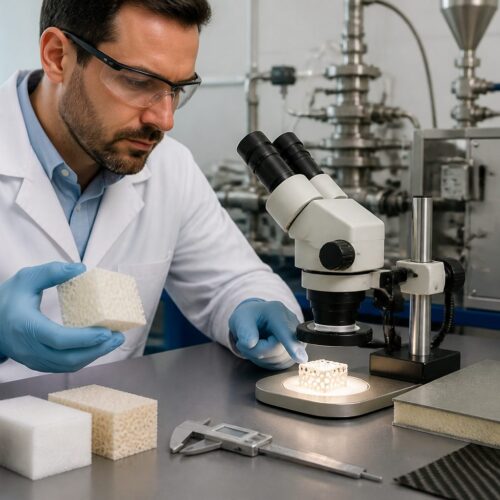

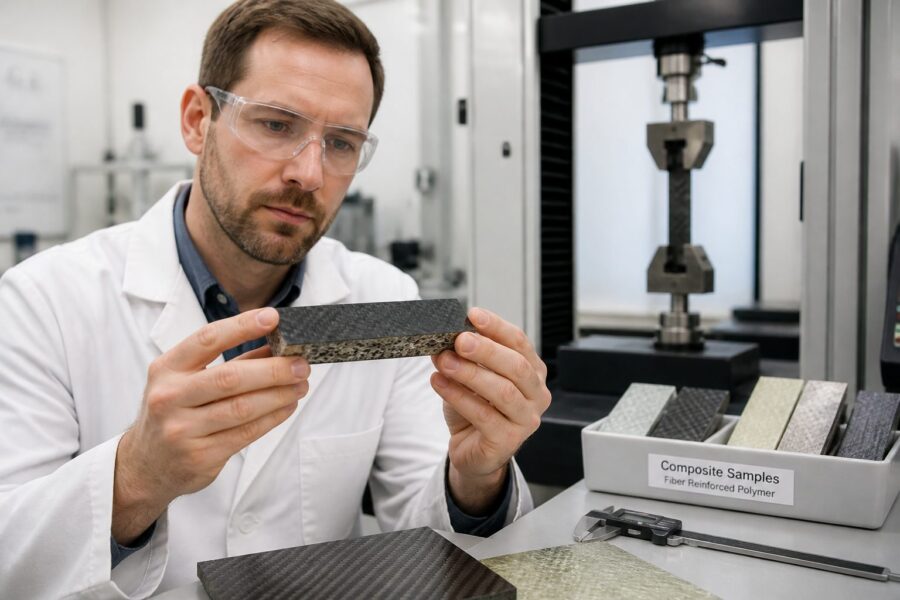
Fiber reinforced composites properties dictate how these advanced materials perform in various applications. Understanding these properties is essential for engineers and designers. It allows them to select the right materials and design structures that can withstand specific loads and environmental conditions.
This article explores the key properties of fiber reinforced composites. We will examine their mechanical, thermal, and environmental characteristics.
We’ll also discuss design considerations for composite structures. By understanding these factors, we can fully utilize the potential of composite materials.
What are Fiber-Reinforced Composites?
Fiber-reinforced composites are materials made from two or more components. They combine a reinforcing fiber with a matrix material.
The fibers provide strength and stiffness. The matrix binds the fibers together and distributes the load.
Common fiber materials include glass, carbon, and aramid. Matrix materials can be polymers, metals, or ceramics.
The combination of these materials results in a composite with enhanced properties. These properties are often superior to those of the individual components.
These composites are engineered to offer a unique combination of characteristics. This combination is often unachievable with traditional materials like steel or aluminum.
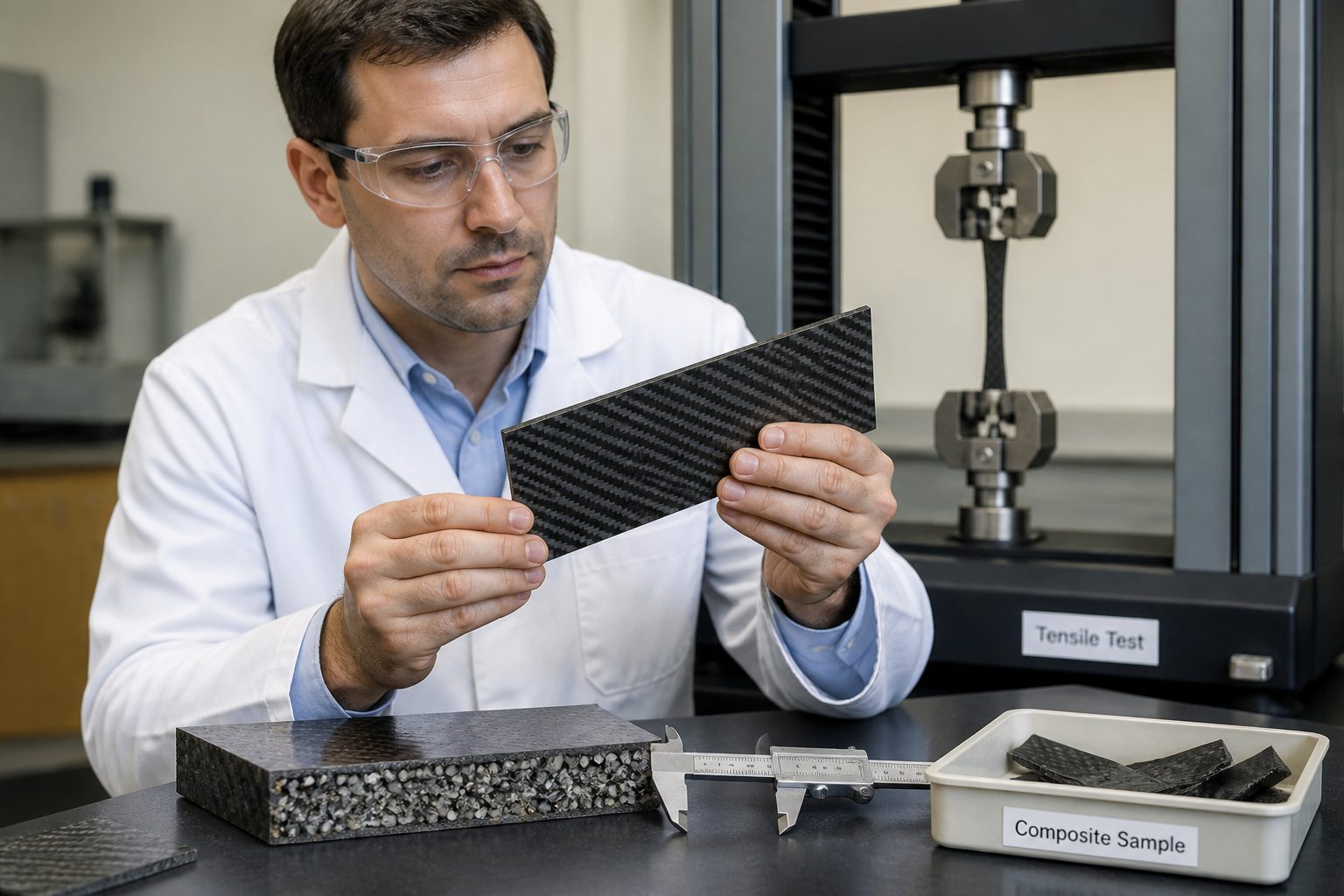

The specific properties of a fiber-reinforced composite are highly dependent on the type and arrangement of the fibers used. The choice of matrix material also plays a crucial role in determining the overall performance.
For example, carbon fiber composites are known for their exceptional strength-to-weight ratio. This makes them ideal for applications where weight reduction is a primary concern.
Similarly, glass fiber composites offer a good balance of strength, cost-effectiveness, and ease of manufacturing. They are widely used in various industries, including automotive and construction.
Key Mechanical Properties: Strength and Stiffness
Strength and stiffness are the most important mechanical properties of fiber reinforced composites. Strength refers to the material’s ability to withstand stress without breaking.
Stiffness, on the other hand, measures the material’s resistance to deformation under load. Fiber reinforcement significantly enhances both strength and stiffness.
The type and orientation of the fibers play a crucial role. Aligned fibers provide maximum strength in the direction of the fiber orientation.
The matrix material also contributes to the overall mechanical properties. It transfers the load to the fibers and prevents them from buckling.
The strength of a composite material can be further categorized into tensile strength, compressive strength, and shear strength. Tensile strength refers to the material’s ability to resist being pulled apart.
Compressive strength, conversely, measures its ability to withstand being crushed. Shear strength indicates its resistance to forces that cause sliding or deformation.
The stiffness of a composite is often quantified by its Young’s modulus. A higher Young’s modulus indicates a stiffer material, meaning it will deform less under a given load.
The relationship between strength and stiffness is not always straightforward. A material can be very strong but not very stiff, or vice versa.
Therefore, it is important to consider both properties when selecting a composite material for a specific application. The fiber volume fraction, the fiber orientation, and the bonding between the fiber and matrix all significantly affect these properties.
The Role of Fiber Volume Fraction
Fiber volume fraction is the ratio of fiber volume to the total volume of the composite. A higher fiber volume fraction generally leads to increased strength and stiffness.
However, there is an optimal fiber volume fraction. Exceeding this can lead to increased brittleness and reduced impact resistance.
| Property | Low Fiber Volume | High Fiber Volume |
|---|---|---|
| Strength | Lower | Higher |
| Stiffness | Lower | Higher |
| Impact Resistance | Higher | Lower |
| Brittleness | Lower | Higher |
The matrix material must adequately wet the fibers. This ensures proper bonding and load transfer.
Poor wetting can lead to voids and defects. These defects reduce the mechanical properties of the composite.
The optimal fiber volume fraction typically ranges from 50% to 70%, depending on the specific materials and application. Achieving this optimal fraction requires careful control of the manufacturing process.
Techniques such as vacuum bagging and resin transfer molding are commonly used to ensure proper fiber wetting and consolidation. These processes help to minimize voids and maximize the fiber volume fraction.
In addition to the fiber volume fraction, the distribution of fibers within the matrix is also important. Uniform fiber distribution ensures that the load is evenly distributed throughout the composite.
Clustering or misalignment of fibers can create stress concentrations, which can reduce the overall strength and stiffness of the composite. Therefore, careful attention must be paid to fiber placement during manufacturing.
The interface between the fiber and the matrix is critical for effective load transfer. Strong bonding between the fiber and matrix is essential for maximizing the mechanical properties of the composite.
Durability and Environmental Resistance
Durability refers to a material’s ability to maintain its properties over time. Environmental resistance is its ability to withstand degradation from environmental factors.
Fiber reinforced composites can exhibit excellent durability and environmental resistance. However, this depends on the materials used and the specific environment.
Polymer matrix composites are susceptible to moisture absorption. This absorption can lead to swelling, reduced strength, and degradation of the fiber-matrix interface.
Exposure to ultraviolet (UV) radiation can also degrade polymer matrices. Additives can be used to improve UV resistance and prolong the service life of the composite.
The durability of a composite material is also affected by its resistance to fatigue. Fatigue is the weakening of a material due to repeated loading and unloading.
Composites can be designed to have excellent fatigue resistance by carefully selecting the fiber and matrix materials and optimizing the fiber orientation. Surface treatments can also be applied to improve fatigue performance.
In addition to moisture and UV radiation, composites can also be affected by temperature, chemicals, and abrasion. The selection of the appropriate matrix material is crucial for ensuring resistance to these factors.
For example, epoxy resins offer good resistance to chemicals and high temperatures, while polyester resins are more susceptible to degradation. Protective coatings can be applied to further enhance environmental resistance.
Regular inspection and maintenance are essential for ensuring the long-term durability of composite structures. This includes checking for signs of damage, such as cracks or delamination, and repairing them promptly.
Chemical Resistance and Corrosion
The chemical resistance of a composite depends on the matrix material. Polymer matrices generally offer good resistance to many chemicals.
However, certain solvents and acids can cause degradation. Composites with metal matrices can be susceptible to corrosion.
Protective coatings can be applied to prevent corrosion. The selection of appropriate materials is crucial for ensuring long-term durability in corrosive environments.
Proper design and manufacturing processes also play a significant role. They minimize the risk of environmental degradation.
The type of chemical exposure is a critical factor in determining the appropriate composite material. Acids, bases, solvents, and other chemicals can react differently with various matrix materials.
For instance, vinyl ester resins offer excellent resistance to acids and bases, making them suitable for applications in chemical processing plants. Epoxy resins generally provide good resistance to solvents and fuels.
When metal matrix composites are used in corrosive environments, the choice of metal is crucial. Aluminum and titanium alloys offer good corrosion resistance, while steel is more susceptible to rust.
Protective coatings, such as paints, varnishes, or specialized chemical-resistant coatings, can be applied to the composite surface. These coatings act as a barrier, preventing the chemicals from reaching the matrix material.
Regular inspections and maintenance are essential to ensure the continued chemical resistance of composite structures. Any signs of degradation or damage should be addressed promptly to prevent further corrosion or chemical attack.
Thermal Properties of Composites
The thermal properties of fiber reinforced composites are important in many applications. These properties include thermal conductivity, thermal expansion, and heat resistance.
Thermal conductivity measures a material’s ability to conduct heat. Fiber reinforced composites generally have lower thermal conductivity compared to metals.
The thermal expansion coefficient describes how a material changes in size with temperature. Composites can be designed to have very low or even negative thermal expansion coefficients.
This is useful in applications where dimensional stability is critical. High heat resistance is essential for composites used in high-temperature environments.
The thermal conductivity of a composite material depends on the thermal conductivity of both the fiber and the matrix. Fibers generally have higher thermal conductivity than polymer matrices.
Therefore, increasing the fiber volume fraction can increase the overall thermal conductivity of the composite. However, the orientation of the fibers also plays a role.
Composites with fibers aligned in the direction of heat flow will have higher thermal conductivity in that direction. The coefficient of thermal expansion (CTE) is an important property for applications where the composite will be subjected to temperature changes.
If the CTE of the composite is significantly different from the CTE of other materials it is bonded to, thermal stresses can develop. These stresses can lead to failure of the composite or the bonded joint.
Composites can be designed to have a CTE that matches the CTE of other materials, such as metals or ceramics. This is achieved by carefully selecting the fiber and matrix materials and controlling the fiber orientation.
Coefficient of Thermal Expansion (CTE)
The CTE of a composite depends on the CTE of the fiber and matrix materials. It also depends on the fiber orientation.
Composites can be tailored to match the CTE of other materials. This reduces thermal stresses in bonded or assembled structures.
Polymer matrix composites have limited high-temperature performance. The matrix material can degrade or soften at elevated temperatures.
Ceramic matrix composites offer superior high-temperature performance. They maintain their strength and stiffness at very high temperatures.
The CTE is a measure of how much a material expands or contracts for each degree Celsius (or Fahrenheit) change in temperature. A low CTE is desirable in applications where dimensional stability is critical, such as aerospace structures and precision instruments.
Carbon fiber composites can be designed to have a very low or even negative CTE. This is because carbon fibers have a negative CTE in the fiber direction, which can be used to offset the positive CTE of the matrix material.
The fiber orientation also affects the CTE of the composite. Unidirectional composites have different CTEs in the fiber direction and the transverse direction.
The CTE in the fiber direction is typically lower than the CTE in the transverse direction. By carefully controlling the fiber orientation, the CTE of the composite can be tailored to meet specific requirements.
For high-temperature applications, ceramic matrix composites (CMCs) are often used. CMCs can withstand temperatures up to 2000°C without significant degradation.
Impact Resistance and Damage Tolerance
Impact resistance is a material’s ability to withstand sudden, high-energy loads. Damage tolerance is its ability to maintain structural integrity after being damaged.
Fiber reinforced composites can exhibit good impact resistance and damage tolerance. However, their performance depends on several factors.
The type of fiber and matrix material is crucial. Tougher matrix materials, such as epoxy resins, improve impact resistance.
The fiber orientation also affects impact performance. Woven or braided fiber architectures provide better impact resistance compared to unidirectional laminates.
Impact resistance is particularly important in applications where the composite structure is likely to be subjected to collisions or impacts. Examples include automotive body panels, aircraft wings, and sporting goods.
Damage tolerance refers to the ability of a material to withstand damage without catastrophic failure. This is important because composite structures can be susceptible to damage from impacts, scratches, or other sources.
Tougher matrix materials can help to improve damage tolerance by absorbing energy and preventing crack propagation. The fiber architecture also plays a role, with woven or braided fabrics providing better resistance to crack growth.
The interface between the fiber and the matrix is also important for damage tolerance. Strong bonding between the fiber and matrix can help to prevent delamination, which is a common failure mode in composite structures.
Techniques such as stitching or z-pinning can be used to further improve damage tolerance by reinforcing the interlaminar region. These techniques involve inserting fibers through the thickness of the laminate to prevent delamination.
Failure Mechanisms in Composites
Composites can fail through various mechanisms. These include fiber breakage, matrix cracking, and delamination.
Delamination is the separation of layers in a composite laminate. It is a common failure mode under impact loading.
- Use toughened matrix materials
- Employ stitching or z-pinning techniques
- Optimize the fiber architecture
- Apply surface treatments
- Incorporate energy-absorbing layers
These strategies enhance the composite’s ability to absorb energy during impact. They prevent catastrophic failure.
Non-destructive testing (NDT) methods can be used to detect damage in composites. This allows for early detection and repair, preventing further degradation.
Fiber breakage occurs when the fibers are subjected to stresses that exceed their tensile strength. This can be caused by excessive loading or by defects in the fibers.
Matrix cracking is the formation of cracks in the matrix material. This can be caused by thermal stresses, mechanical loading, or environmental factors.
Delamination is a particularly serious failure mode because it can significantly reduce the strength and stiffness of the composite. It is often caused by interlaminar shear stresses, which are stresses that act parallel to the layers of the laminate.
Other failure mechanisms include fiber-matrix debonding, which is the separation of the fiber from the matrix, and void formation, which is the presence of air pockets within the composite.
Understanding these failure mechanisms is essential for designing composite structures that are resistant to failure. By carefully selecting the materials and manufacturing processes, engineers can minimize the risk of these failure modes.
Design Considerations for Composite Structures
Designing with composite materials requires careful consideration of their unique properties. Unlike metals, composites are anisotropic, meaning their properties vary with direction.
The design must account for the specific loading conditions. It also needs to consider the environmental factors that the structure will experience.
Finite element analysis (FEA) is a powerful tool for analyzing composite structures. It allows engineers to predict the behavior of the structure under various loads.
The manufacturing process also influences the design. Certain manufacturing methods are better suited for complex shapes or high-volume production.
The anisotropic nature of composites means that the strength and stiffness of the material are different in different directions. This is due to the orientation of the fibers within the matrix.
Therefore, it is important to carefully consider the fiber orientation when designing a composite structure. The fibers should be oriented in the direction of the highest stresses to maximize the strength and stiffness of the structure.
Environmental factors, such as temperature, humidity, and UV radiation, can also affect the performance of composite structures. It is important to select materials that are resistant to these factors.
FEA is a computer-based simulation technique that can be used to predict the behavior of composite structures under various loading conditions. This can help engineers to optimize the design of the structure and ensure that it is strong enough to withstand the applied loads.
The manufacturing process can also influence the design of composite structures. For example, certain manufacturing methods are better suited for creating complex shapes, while others are better suited for high-volume production.
Selecting the Right Composite Material
Choosing the right composite material involves evaluating several factors. These include the required strength, stiffness, weight, and cost.
Carbon fiber composites offer high strength and stiffness at a low weight. Glass fiber composites are more cost-effective but have lower strength and stiffness.
Aramid fiber composites provide excellent impact resistance and energy absorption. The matrix material should be selected based on the environmental conditions and the desired properties.
Epoxy resins are commonly used for high-performance applications. Polyester resins are more affordable but have lower strength and temperature resistance.
The selection process should begin with a clear understanding of the performance requirements of the application. This includes defining the required strength, stiffness, weight, and environmental resistance.
Once the performance requirements are defined, the next step is to evaluate the available composite materials. This includes considering the properties of the fiber and matrix materials, as well as the manufacturing process.
Carbon fiber composites are often used in aerospace and automotive applications where high strength and low weight are critical. Glass fiber composites are commonly used in marine and construction applications where cost-effectiveness is important.
Aramid fiber composites are used in ballistic protection and other applications where impact resistance is required. The matrix material should be selected based on the environmental conditions and the desired properties.
Epoxy resins offer good resistance to chemicals and high temperatures, while polyester resins are more susceptible to degradation. The cost of the composite material is also an important consideration.
The Future of Fiber-Reinforced Composites
The field of fiber reinforced composites is continuously evolving. New materials and manufacturing processes are constantly being developed.
Research is focused on developing more sustainable and environmentally friendly composites. This includes using bio-based resins and recycled fibers.
Advanced manufacturing techniques, such as 3D printing, are enabling the production of complex composite structures. These structures have tailored properties.
As technology advances, fiber reinforced composites will play an increasingly important role. This role will be seen in a wide range of applications.
One of the key areas of development is the use of nanomaterials to enhance the properties of composites. Nanomaterials, such as carbon nanotubes and graphene, can be added to the matrix material to improve strength, stiffness, and thermal conductivity.
Another area of focus is the development of self-healing composites. These composites can repair themselves when damaged, extending their service life and reducing maintenance costs.
3D printing, also known as additive manufacturing, is revolutionizing the way composites are manufactured. It allows for the creation of complex shapes and structures with tailored properties.
The use of bio-based resins and recycled fibers is also becoming increasingly important. This helps to reduce the environmental impact of composite materials and promote sustainability.
As technology advances, fiber reinforced composites will continue to play an increasingly important role in a wide range of applications, including aerospace, automotive, construction, and energy.
Conclusion
Understanding the fiber reinforced composites properties is essential for designing high-performance structures. These properties depend on the materials used, the manufacturing process, and the design considerations.
By carefully selecting the right materials and optimizing the design, engineers can fully utilize the potential of composite materials. They can create structures that are strong, lightweight, durable, and environmentally resistant.
From aerospace to automotive, and construction to sporting goods, fiber reinforced composites are transforming industries with their unique blend of properties. These materials are enabling engineers to create innovative designs that were previously impossible.
As research and development continue, we can expect to see even more advanced composite materials and manufacturing processes in the future. This will further expand the range of applications for these versatile materials.
The key to success with fiber reinforced composites lies in a thorough understanding of their properties and careful consideration of the design and manufacturing process. By following these principles, engineers can unlock the full potential of these materials and create structures that are stronger, lighter, and more durable than ever before.