
Polymer rheology is essential for understanding how polymers behave under different conditions. It dictates their processability, performance, and overall suitability for various applications. This article explores the fundamental concepts, measurement techniques, and applications of polymer rheology.
Understanding the flow and deformation characteristics of polymers is crucial for engineers and scientists working with these materials. We’ll cover everything from basic definitions to practical applications of polymer rheology basics.
So, if you’re curious about how polymers respond to stress and strain, you’ve come to the right place. Keep reading to discover the fascinating world of polymer flow and deformation.
What is Polymer Rheology?
Polymer rheology is the study of the flow and deformation of polymers. It examines how polymers respond to applied forces, whether in a liquid or solid state. This field is important because it helps us predict how polymers will behave during processing and in their final applications.
Rheology helps determine the relationship between stress, strain, and time for polymeric materials. It’s not just about viscosity; it encompasses a broader understanding of a material’s mechanical behavior under various conditions.
Understanding polymer rheology is crucial for optimizing manufacturing processes. For example, it helps in controlling the flow of molten polymers during injection molding or extrusion.
Moreover, rheological properties influence the final product’s performance. A material’s resistance to deformation or its ability to recover after stress are key factors in many applications.
The study of polymer rheology also involves examining the effects of temperature, pressure, and molecular weight on flow behavior. These factors can significantly alter the rheological properties of a polymer.
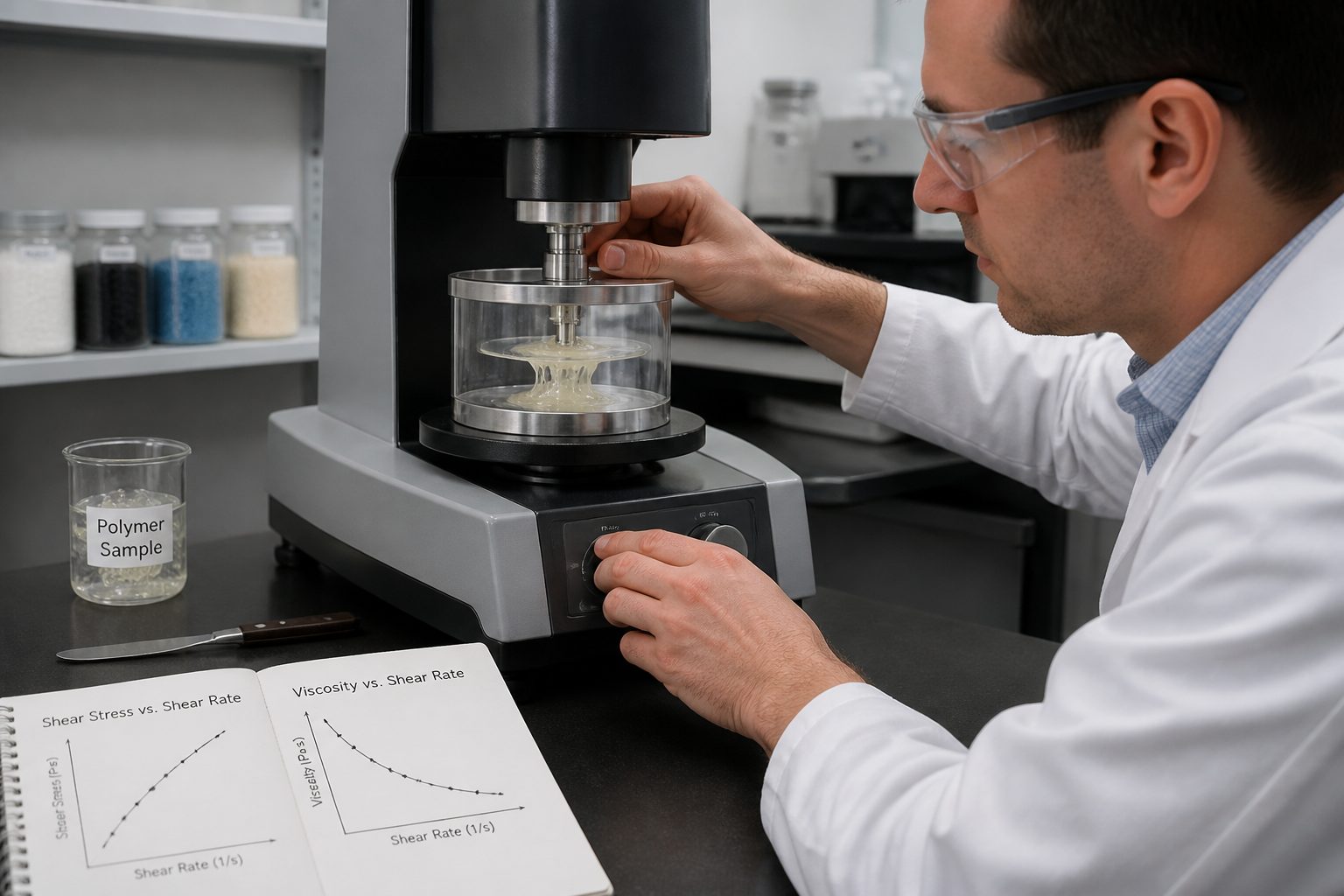
Polymer rheology is a complex field with numerous sub-disciplines. These include the study of polymer melts, solutions, and solids, each with its own unique challenges and applications.
The principles of rheology are applied in a wide range of industries, from plastics manufacturing to food processing. Understanding the flow behavior of polymers is essential for creating new and improved products.
Furthermore, rheology plays a critical role in the development of advanced materials, such as nanocomposites and bio-based polymers. These materials often exhibit complex rheological behavior that must be carefully characterized and controlled.
The importance of polymer rheology extends to areas like pharmaceuticals, where the flow properties of drug formulations can affect their efficacy. The controlled release of drugs often depends on the precise rheological characteristics of the delivery system.
By studying polymer rheology, we can gain a deeper understanding of the fundamental relationships between a polymer’s structure and its macroscopic properties. This knowledge allows us to design and process polymers more effectively, leading to better products and innovative technologies.
Viscosity: Resistance to Flow
Viscosity is a measure of a fluid’s resistance to flow. In simpler terms, it describes how easily a fluid can be poured or pumped.
For polymers, viscosity is influenced by factors like molecular weight, chain structure, and temperature. Higher molecular weight polymers generally have higher viscosities.
Temperature also plays a significant role; as temperature increases, viscosity typically decreases. This is because higher temperatures provide more energy for polymer chains to move past each other.
Polymer solutions and melts often exhibit non-Newtonian behavior. This means their viscosity changes with the applied shear rate.
Shear thinning, or pseudoplasticity, is a common phenomenon where viscosity decreases as shear rate increases. Shear thickening, also known as dilatancy, is less common but occurs in some polymer systems where viscosity increases with shear rate.
The concept of viscosity is fundamental to understanding how polymers behave during processing. High viscosity can make it difficult to process a polymer, while low viscosity can lead to defects in the final product.
Different types of polymers exhibit different viscosity characteristics. For example, linear polymers tend to have higher viscosities than branched polymers of the same molecular weight.
The viscosity of a polymer can be measured using various techniques, including capillary viscometry and rotational viscometry. These techniques provide quantitative data on a polymer’s resistance to flow under different conditions.
Understanding the relationship between viscosity and polymer structure is crucial for designing polymers with specific properties. By controlling molecular weight, chain branching, and other structural features, it’s possible to tailor the viscosity of a polymer to meet the requirements of a particular application.
Furthermore, the viscosity of polymer blends can be complex and depend on the compatibility of the different polymers. Immiscible blends may exhibit phase separation, leading to unusual viscosity behavior.
Viscoelasticity: A Combination of Properties
Viscoelasticity describes materials that exhibit both viscous and elastic characteristics when undergoing deformation. Polymers are a prime example of viscoelastic materials, showing a combination of liquid-like and solid-like behaviors.
This dual nature means that polymers can store energy like an elastic solid and dissipate energy like a viscous fluid. The balance between these behaviors depends on the polymer’s structure, temperature, and the rate at which it is deformed.
| Property | Viscous Behavior | Elastic Behavior |
|---|---|---|
| Description | Dissipates energy as heat | Stores energy and recovers |
| Response to Stress | Irreversible deformation | Reversible deformation |
| Time Dependence | Flow increases with time | Immediate response |
| Example | Honey flowing | Rubber band stretching |
Viscoelasticity is a key property that distinguishes polymers from simple fluids or solids. It’s responsible for many of the unique behaviors observed in polymeric materials.
The viscoelastic behavior of a polymer can be characterized using techniques like dynamic mechanical analysis (DMA). DMA measures the storage modulus (elastic component) and loss modulus (viscous component) as a function of temperature and frequency.
The ratio of the loss modulus to the storage modulus is known as the tan delta, which provides a measure of the damping characteristics of the material. A high tan delta indicates that the material is more viscous, while a low tan delta indicates that it is more elastic.
Understanding viscoelasticity is crucial for predicting the performance of polymers in various applications. For example, in tires, viscoelasticity affects the grip, rolling resistance, and wear characteristics.
In adhesives, viscoelasticity influences the bond strength and durability. The ability of an adhesive to dissipate energy through viscous flow can prevent crack propagation and improve long-term performance.
Furthermore, viscoelasticity plays a critical role in the behavior of biological polymers, such as proteins and DNA. These molecules exhibit complex viscoelastic properties that are essential for their function.
Time-Dependent Behavior
Polymers often display time-dependent behavior, meaning their response to stress changes over time. Creep and stress relaxation are two key phenomena that illustrate this behavior.
Creep is the gradual deformation of a material under constant stress. Stress relaxation, on the other hand, is the decrease in stress over time when a material is held at a constant strain.
These behaviors are critical in applications where polymers are subjected to long-term loads or deformations. For instance, understanding creep is essential for designing polymer components in structural applications.
The time-dependent behavior of polymers is also influenced by temperature. Higher temperatures generally accelerate creep and stress relaxation processes.
This is because increased thermal energy allows polymer chains to move more freely, leading to faster deformation or stress reduction.
Creep can be a significant concern in applications where polymers are used to support loads over extended periods. The gradual deformation can lead to dimensional changes and eventual failure.
Stress relaxation is important in applications where polymers are used as seals or gaskets. The ability of the polymer to maintain a constant force over time is crucial for preventing leaks.
The time-dependent behavior of polymers can be modeled using various viscoelastic models, such as the Maxwell model and the Kelvin-Voigt model. These models provide a mathematical framework for predicting creep and stress relaxation behavior.
The parameters in these models can be determined experimentally by measuring the creep and stress relaxation response of a polymer. These parameters can then be used to predict the long-term behavior of the polymer under different loading conditions.
Understanding the time-dependent behavior of polymers is essential for ensuring the reliability and durability of polymer-based products. By carefully considering creep and stress relaxation, engineers can design products that meet the demands of their intended applications.
Measurement Techniques
Various techniques are used to measure the rheological properties of polymers. These methods provide valuable data for characterizing polymer behavior under different conditions.
Common techniques include viscometry, rheometry, and dynamic mechanical analysis (DMA). Each technique offers unique insights into a polymer’s flow and deformation characteristics.
- Viscometry measures viscosity under steady shear flow
- Rheometry measures viscosity and elasticity under various flow conditions
- Dynamic mechanical analysis (DMA) measures viscoelastic properties as a function of temperature and frequency
- Capillary rheometry measures viscosity at high shear rates, relevant to processing
- Extensional rheometry measures resistance to stretching
Viscometry is a relatively simple technique that measures the resistance of a fluid to flow. It’s often used to determine the viscosity of polymer solutions and melts under steady shear conditions.
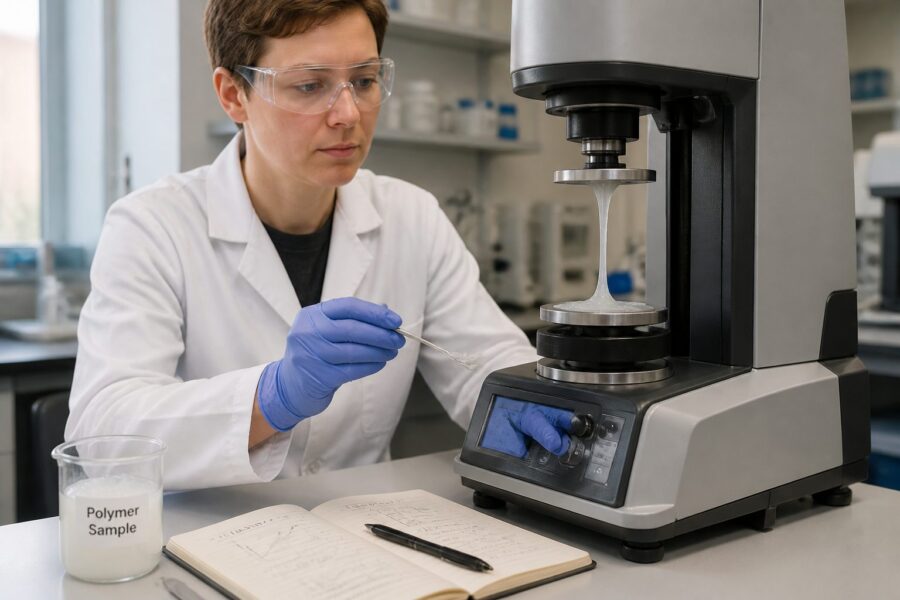
Rheometry is a more sophisticated technique that can measure both viscosity and elasticity. Rheometers can apply various types of deformation, including steady shear, oscillatory shear, and extensional flow.
Dynamic mechanical analysis (DMA) is a powerful technique for characterizing the viscoelastic properties of polymers. DMA measures the storage modulus, loss modulus, and tan delta as a function of temperature and frequency.
Capillary rheometry is used to measure viscosity at high shear rates, which are relevant to many polymer processing operations. This technique involves forcing a polymer melt through a small capillary and measuring the pressure drop.
Extensional rheometry measures the resistance of a polymer to stretching. This technique is particularly important for characterizing the behavior of polymers during film blowing and fiber spinning.
Applications of Rheology in Polymer Processing
Rheology plays a crucial role in various polymer processing techniques. Understanding how polymers flow and deform is essential for optimizing processes like extrusion, injection molding, and film blowing.
In extrusion, rheological properties influence the flow of molten polymer through a die. Controlling viscosity and elasticity is vital for achieving the desired shape and dimensions of the extruded product.
Injection molding involves injecting molten polymer into a mold cavity. Rheological properties affect how easily the polymer fills the mold and how uniformly it solidifies.
Film blowing is used to produce thin polymer films. The rheological behavior of the polymer melt determines the film’s thickness, uniformity, and mechanical properties.
Rheological measurements also help in troubleshooting processing problems. For example, if a polymer exhibits excessive die swell during extrusion, adjusting the processing conditions or modifying the polymer’s formulation can help mitigate the issue.
In extrusion, the die design is heavily influenced by the rheological properties of the polymer. The shape of the die must be carefully chosen to ensure uniform flow and prevent defects.
In injection molding, the gate location and mold temperature are critical parameters that affect the filling process. Understanding the rheological behavior of the polymer is essential for optimizing these parameters.
In film blowing, the blow-up ratio and draw-down ratio are important variables that determine the film’s properties. The rheological properties of the polymer melt influence the stability of the bubble and the uniformity of the film.
Rheological measurements can also be used to monitor the quality of polymer materials. Changes in rheological properties can indicate degradation or contamination of the polymer.
By applying rheological principles, engineers can optimize polymer processing operations and produce high-quality products with desired properties. This leads to improved efficiency and reduced waste in manufacturing.
The Impact of Molecular Weight
Molecular weight significantly impacts the rheological properties of polymers. Higher molecular weight generally leads to increased viscosity and elasticity.
Longer polymer chains create more entanglements, which increase resistance to flow. This effect is particularly pronounced in polymer melts and concentrated solutions.
The molecular weight distribution also plays a role. Polymers with a broad molecular weight distribution tend to have different rheological behavior compared to those with a narrow distribution.
Broad distributions can result in non-Newtonian behavior over a wider range of shear rates. This is because the shorter chains flow more easily at higher shear rates, while the longer chains still contribute to viscosity.
Controlling molecular weight and its distribution is therefore crucial for tailoring polymer rheology to specific applications. Polymer scientists can use techniques like polymerization control and blending to achieve desired rheological properties.
The relationship between molecular weight and viscosity is often described by the Mark-Houwink equation. This equation relates the intrinsic viscosity of a polymer solution to its molecular weight.
Gel permeation chromatography (GPC) is a common technique for measuring the molecular weight distribution of polymers. GPC separates polymer chains based on their size and provides information about the relative amounts of different molecular weight species.
The entanglement molecular weight is a critical parameter that affects the rheological behavior of polymer melts. Above the entanglement molecular weight, polymer chains become highly entangled, leading to a significant increase in viscosity and elasticity.
Molecular weight also affects the mechanical properties of polymers. Higher molecular weight polymers tend to have higher tensile strength and toughness.
By carefully controlling the molecular weight and molecular weight distribution, polymer scientists can tailor the rheological and mechanical properties of polymers to meet the specific requirements of various applications.
Temperature and Pressure Effects
Temperature and pressure are critical factors that influence polymer rheology. Temperature affects the mobility of polymer chains, while pressure influences the free volume and interactions between chains.
Increasing temperature generally reduces viscosity as polymer chains gain more kinetic energy. This allows them to move more easily past each other, decreasing resistance to flow.
The temperature dependence of viscosity is often described by the Arrhenius equation or the Williams-Landel-Ferry (WLF) equation. These equations provide a quantitative relationship between temperature and viscosity.
Pressure, on the other hand, typically increases viscosity. Higher pressure reduces the free volume between polymer chains, making it more difficult for them to move.
The effect of pressure is particularly important in processes like injection molding, where polymers are subjected to high pressures. Understanding how pressure affects rheology is crucial for optimizing these processes.
The glass transition temperature (Tg) is a critical parameter that affects the temperature dependence of polymer rheology. Above Tg, polymers exhibit rubbery behavior, while below Tg, they are glassy and brittle.
The WLF equation is particularly useful for describing the temperature dependence of viscosity near the glass transition temperature. This equation takes into account the free volume available for polymer chain movement.
High-pressure rheometry is used to measure the viscosity of polymers under high-pressure conditions. This technique is essential for understanding the behavior of polymers in processes like extrusion and injection molding.
The pressure dependence of viscosity can also affect the phase behavior of polymer blends. High pressure can promote miscibility in some polymer blends.
By carefully controlling temperature and pressure, engineers can tailor the rheological properties of polymers to meet the specific requirements of various applications. This is crucial for optimizing polymer processing operations and producing high-quality products.
Rheology Modifiers and Additives
Rheology modifiers and additives are often used to tailor the flow properties of polymers. These substances can alter viscosity, elasticity, and other rheological characteristics to improve processing or enhance performance.
Common rheology modifiers include plasticizers, fillers, and chain extenders. Plasticizers reduce viscosity by increasing the free volume between polymer chains, making them more flexible.
Fillers, such as silica or calcium carbonate, can increase viscosity and improve mechanical properties. Chain extenders increase molecular weight, leading to higher viscosity and elasticity.
The choice of rheology modifier depends on the specific application and desired properties. For example, in coatings, thickeners are used to increase viscosity and prevent sagging.
In adhesives, rheology modifiers can improve bond strength and application characteristics. Understanding how these additives affect rheology is essential for formulating polymer products with optimal performance.
Thixotropic agents are a type of rheology modifier that causes a decrease in viscosity over time under shear. These agents are often used in paints and coatings to improve application properties.
Anti-settling agents are used to prevent fillers from settling out of a suspension. These agents typically increase the viscosity of the suspension at low shear rates.
Impact modifiers are added to polymers to improve their toughness and resistance to impact. These modifiers often consist of rubbery particles that absorb energy during impact.
Processing aids are used to improve the flow characteristics of polymer melts during processing. These aids can reduce viscosity and prevent melt fracture.
By carefully selecting and incorporating rheology modifiers and additives, engineers can tailor the properties of polymers to meet the specific requirements of various applications. This leads to improved performance and enhanced product quality.
Advanced Rheological Models
Advanced rheological models are used to describe the complex flow behavior of polymers. These models go beyond simple Newtonian descriptions to account for viscoelasticity, time-dependent effects, and non-linear behavior.
Common models include the Maxwell model, the Kelvin-Voigt model, and the more sophisticated Phan-Thien-Tanner (PTT) model. The Maxwell model describes a viscoelastic fluid with a single relaxation time.
The Kelvin-Voigt model represents a viscoelastic solid with a retarded elastic response. The PTT model is a more complex model that accounts for non-linear viscoelasticity and is often used for polymer melts.
These models are used in simulations and predictive calculations to optimize polymer processing and design. Accurate modeling of rheological behavior is crucial for predicting how polymers will behave under complex flow conditions.
Computational fluid dynamics (CFD) simulations often incorporate these rheological models to simulate polymer flow in processes like extrusion and injection molding. These simulations help engineers optimize process parameters and design better products.
The Oldroyd-B model is another commonly used viscoelastic model that accounts for the effects of chain orientation and stretching. This model is often used to simulate the flow of polymer solutions.
The Carreau model is a generalized Newtonian fluid model that describes the shear-thinning behavior of polymer melts. This model is often used to predict the viscosity of polymer melts over a wide range of shear rates.
The Doi-Edwards model is a molecular model that describes the viscoelastic behavior of entangled polymer melts. This model is based on the concept of reptation, where polymer chains move through a network of entanglements.
The use of advanced rheological models requires sophisticated numerical techniques and computational resources. However, these models can provide valuable insights into the complex flow behavior of polymers and help engineers optimize polymer processing operations.
By combining experimental measurements with advanced rheological modeling, engineers can gain a comprehensive understanding of the rheological behavior of polymers and design products with improved performance and reliability.
Conclusion
Polymer rheology is a multifaceted field with significant implications for polymer processing and applications. Understanding the fundamental concepts, measurement techniques, and applications of polymer rheology is essential for anyone working with these materials.
From controlling flow in manufacturing to predicting long-term performance, rheology provides the insights needed to optimize polymer use. By mastering the polymer rheology basics, engineers and scientists can unlock the full potential of these versatile materials.
The future of polymer rheology research lies in developing more sophisticated models and measurement techniques to better understand the complex behavior of polymers. This will enable the design of new and improved polymer materials for a wide range of applications.
The integration of rheology with other disciplines, such as polymer chemistry and materials science, is also crucial for advancing the field. This interdisciplinary approach will lead to a more holistic understanding of polymer behavior and enable the development of innovative technologies.
As polymers continue to play an increasingly important role in our lives, the importance of polymer rheology will only continue to grow. By investing in research and education in this field, we can ensure that we have the knowledge and expertise to harness the full potential of these versatile materials.