
Polymer films are everywhere, from food wraps to electronic device protection, crucial for packaging, agriculture, medicine, and many other industries. Understanding their manufacturing reveals the ingenious engineering behind their widespread use.
Two primary methods dominate polymer film production: blown film extrusion and cast film extrusion. Each offers unique advantages, yielding films with distinct properties suitable for different applications. We will explore the intricacies of both techniques and their impact on material performance.
The choice between blown and cast film depends on desired end-use properties like clarity, strength, barrier capabilities, and cost. Mastering these processes allows engineers to fine-tune films for specific, demanding requirements. This deep dive into polymer film manufacturing blown cast methods will explain these critical distinctions.
Precisely controlling film characteristics during manufacturing is a cornerstone of modern material science. This control determines everything from a film’s tear resistance to its ability to protect contents from moisture and oxygen, driving continuous innovation by polymer engineers.
Overview of Polymer Film Manufacturing Methods
Polymer film manufacturing fundamentally relies on extrusion, where molten plastic is forced through a die to create a continuous profile. This initial step forms the raw material into a uniform shape, ready for further processing. The type of die and subsequent cooling method define the two main film production routes.
Blown film extrusion creates a tubular film by extruding polymer through an annular die, then inflating it into a bubble, offering balanced mechanical properties. Conversely, cast film extrusion involves extruding molten polymer through a flat slot die onto a chilled roller, yielding films with excellent optical clarity and high gloss due to rapid cooling.
Both methods primarily use thermoplastic polymers like polyethylene (PE), polypropylene (PP), and polyethylene terephthalate (PET). These materials melt when heated and solidify upon cooling, allowing for continuous processing. The specific polymer grade significantly influences final film properties, including flexibility, stiffness, and barrier performance.
For example, low-density polyethylene is common for flexible packaging, while high-density polyethylene provides more stiffness and strength. Engineers select materials based on the performance requirements of the final product.
Film thickness is another critical parameter, ranging from very thin food wraps to thicker construction barriers. Both blown and cast film lines produce a wide range of thicknesses, with process control ensuring consistent film gauge across the entire width.
Choosing the correct manufacturing method depends on a careful analysis of desired film characteristics and target market. Blown film often suits bags and heavy-duty sacks needing balanced strength, while cast film excels in applications demanding optical clarity and precise thickness control.
The efficiency of these processes is vital for commercial viability. High-speed production lines reduce manufacturing costs, making polymer films economical. Continuous innovation in machinery and polymer science drives further improvements in film quality and production efficiency.
Understanding these fundamental distinctions is key to appreciating modern polymer film production’s complexities. Each method offers a unique pathway to creating films tailored for specific performance needs, with precise control over polymer flow and cooling making these processes effective.
The Blown Film Extrusion Process
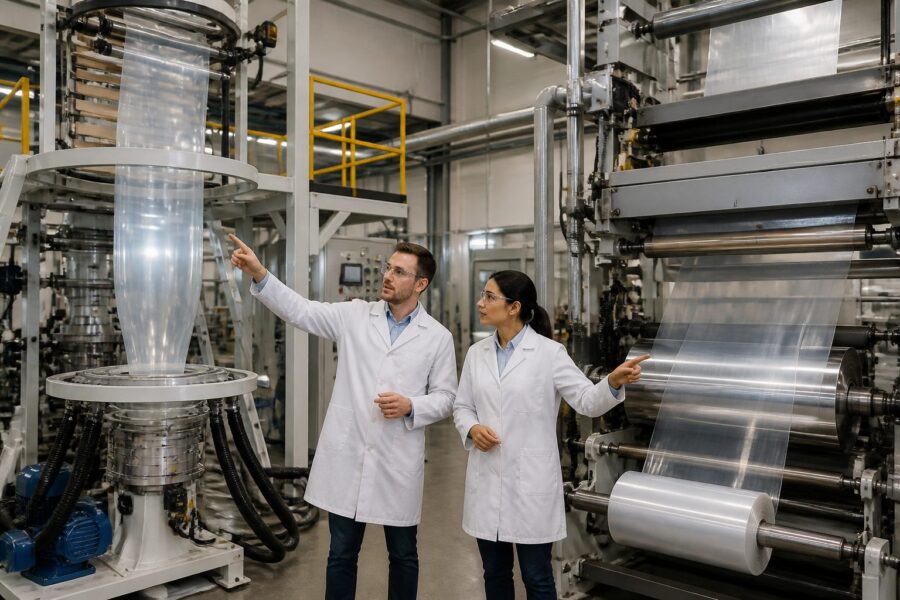
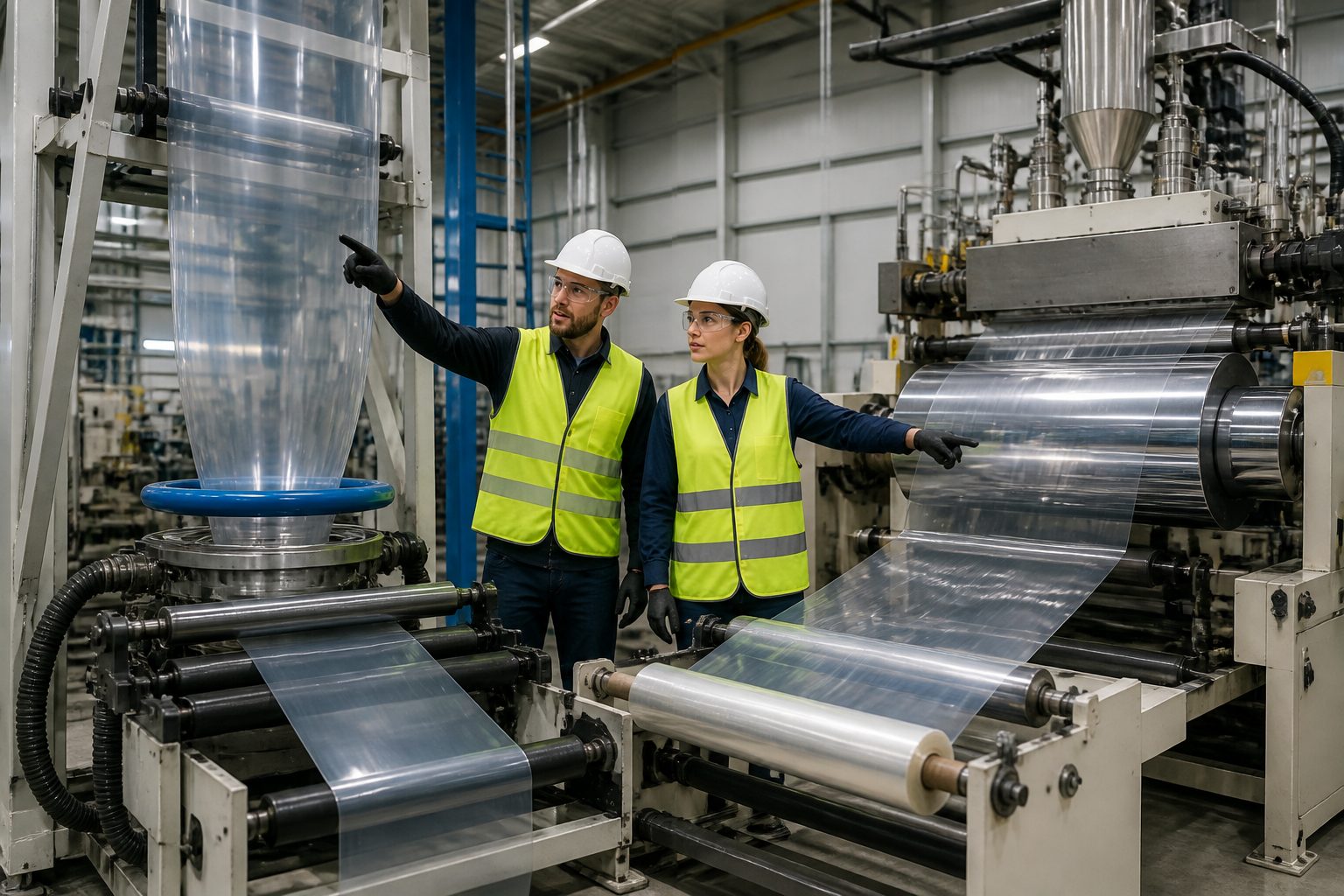
The blown film extrusion process starts by melting polymer pellets in an extruder. This molten plastic then flows through an annular (ring-shaped) die, forming a tube that emerges vertically upwards.
An air ring cools the exterior of the molten tube, while internal air simultaneously inflates it into a bubble, stretching the polymer circumferentially and longitudinally. The size of this bubble, controlled by internal air pressure, determines the final film width.
The bubble continues upwards, cooling as it rises, until it reaches nip rolls at the top of the tower. These rolls flatten the bubble into a two-layer film and pull it upwards, maintaining tension. The flattened film then travels to a winder for packaging.
The blow-up ratio (BUR), the ratio of the die opening to the final bubble diameter, is a critical parameter influencing film properties. A higher BUR generally results in better balanced mechanical properties in the machine and transverse directions, making blown film ideal for bags needing strength in all directions.
The `blown film extrusion process` inherently creates biaxial orientation due to this simultaneous stretching, contributing to the film’s toughness and puncture resistance. Many manufacturers prefer this method for applications like shopping bags, heavy-duty sacks, and agricultural films.
Controlling air flow, die temperature, and haul-off speed is essential for consistent film quality. Variations can lead to uneven thickness or defects. Modern blown film lines use sophisticated control systems to maintain precise operating conditions.
Equipment for blown film production includes the extruder, annular die, air ring, cooling tower, nip rolls, and winder. Operators must monitor all these elements closely for optimal performance.
Blown films often appear slightly hazy compared to cast films due to their slower cooling rate and higher crystallinity. However, this increased crystallinity also contributes to their excellent barrier properties against gases and moisture, beneficial for preserving packaged goods.
| Feature | Blown Film | Cast Film |
|---|---|---|
| Orientation | Biaxially oriented (inherent) | Uniaxially oriented (MD) |
| Clarity | Lower (hazy) | Higher (transparent) |
| Thickness Uniformity | Moderate | Excellent |
| Typical Applications | Bags, liners, agricultural films | Wraps, labels, hygiene products |
| Cooling Rate | Slower (air cooled) | Faster (chill roll) |
| Surface Finish | Less glossy | High gloss |
Cast Film Extrusion: Process and Equipment
Cast film extrusion begins with melting polymer pellets in an extruder, similar to the blown film process. The molten polymer then exits through a flat slot die, creating a wide, thin sheet immediately cast onto a highly polished, temperature-controlled chill roll.
The rapid cooling by the chill roll is a defining characteristic, solidifying the polymer almost instantly. This quick quenching prevents significant crystallization, resulting in a film with excellent transparency and high gloss. Intimate contact between the molten film and the chill roll surface is crucial for heat transfer.
After the chill roll, the solid film passes through a series of take-off rolls, which guide it and maintain tension, preventing wrinkles or distortions. Finally, the film is wound onto cores by a winder.
The `cast film production line` allows for precise control over film thickness and width, often achieved using automatic die gap adjustment systems. This precision is a major advantage for applications requiring tight tolerances, yielding outstanding gauge uniformity.
Cast films typically display superior optical properties, including high clarity and low haze, making them ideal for packaging where product visibility is key. Their smooth, glossy surface also enhances printability and aesthetic appeal, characteristics highly valued in consumer packaging.
While blown film inherently introduces biaxial orientation, cast film initially has significant orientation only in the machine direction (MD). Any transverse direction (TD) orientation must be introduced in a separate, subsequent stretching step, affecting the film’s mechanical properties.
Common polymers used include polypropylene (CPP), linear low-density polyethylene (LLDPE), and some polyesters. Each polymer contributes specific properties like stiffness, sealability, or heat resistance, making cast film widely adaptable.
Applications for cast films include stretch wrap, disposable hygiene products, clear bags for textiles, and protective liners. Their excellent heat sealability also makes them suitable for form-fill-seal packaging operations. The smooth surface and consistent thickness are key benefits for these uses.
The equipment setup for cast film is generally more compact horizontally compared to blown film lines, offering advantages in facility space and maintenance accessibility. However, the chill roll system requires careful temperature control and maintenance.
The ability to produce films with superior optical qualities and precise thickness control gives cast film a distinct edge. Manufacturers often choose this process when visual appeal and dimensional accuracy are paramount, making the `cast film production line` a cornerstone of high-quality film manufacturing.
Biaxial Orientation and Its Effect on Film Properties
Biaxial orientation is a critical process for enhancing the mechanical and barrier properties of polymer films. It involves stretching a film in two perpendicular directions: the machine direction (MD) and the transverse direction (TD). This stretching aligns the polymer chains, dramatically improving film performance.
The process can be done sequentially (stretched first in one direction, then the other, typically using rollers for MD and tenter frames for TD) or simultaneously (stretched in both directions at once for better orientation balance).
Stretching the film increases its tensile strength, making it much stronger and more resistant to tearing. This physical toughening results from molecular alignment within the polymer structure. Oriented films can withstand higher stresses during processing and end-use.
Beyond mechanical strength, biaxial orientation significantly improves the film’s barrier properties against gases and moisture. The more ordered molecular structure makes it harder for small molecules to permeate, a huge advantage for packaging perishable goods.
Optical clarity and gloss also often improve with biaxial orientation, especially for polymers like polypropylene and polyester. The stretching process reduces haze and increases transparency, creating films that look better and allow for clear product visibility, enhancing aesthetic appeal.
The most prominent example is `biaxially oriented polymer film`, commonly known as BOPP (Biaxially Oriented Polypropylene) or BOPET (Biaxially Oriented Polyethylene Terephthalate). These films are ubiquitous in snack food packaging, labels, and flexible electronics, their superior properties making them highly desirable.
BOPP films are known for excellent stiffness, high clarity, and good moisture barrier. They are also relatively inexpensive to produce given their performance benefits, making them a go-to choice for many packaging applications.
BOPET films offer even higher strength, temperature resistance, and superior gas barrier properties compared to BOPP. They are often used in more demanding applications, such as microwaveable packaging, magnetic tapes, and electrical insulation. The orientation process unlocks their full potential.
The degree of orientation, or stretch ratio, directly impacts the final film properties. Engineers carefully control this ratio to achieve the desired balance of strength, barrier, and optical qualities. Too much or too little stretching can lead to suboptimal performance or even film breakage.
Biaxial orientation also affects a film’s shrink characteristics, useful for shrink labels and tamper-evident seals. When heated, oriented films tend to revert towards their original, unstretched dimensions, a valuable controlled shrinkage for certain applications.
Multilayer Film Structures and Coextrusion
Modern packaging often requires films to possess a combination of properties that no single polymer can provide alone. This challenge is overcome through multilayer film structures, where different polymer layers are combined. Coextrusion is the primary method for creating these sophisticated films in a single step.
Coextrusion involves simultaneously extruding two or more molten polymers through a single die, where they combine to form a layered structure. Each layer contributes a specific function, such as barrier protection, heat sealability, stiffness, or printability, allowing for highly customized film designs.
- Enhance moisture barrier
- Improve oxygen barrier
- Provide effective heat sealability
- Increase puncture resistance
- Optimize printability and aesthetics
- Add structural integrity and stiffness
- Include an adhesive layer for bonding
- Offer UV protection
- Incorporate anti-fog properties
- Facilitate easy-open features
A common example is a food packaging film with an outer layer for printability, a middle layer for oxygen barrier (like EVOH or nylon), and an inner layer for heat sealing. This composite structure ensures optimal food preservation, with careful selection of each polymer crucial for performance.
The coextrusion process applies to both blown film and cast film lines, allowing for multilayer film production with tubular or flat geometries, significantly expanding applications. Engineers must design the die and extruder configuration to ensure uniform flow of each polymer layer.
Adhesive layers are often incorporated between incompatible polymers to ensure strong bonding and prevent delamination, which would compromise film integrity and barrier performance. These tie layers are typically specialized polymers designed for adhesion.
The complexity of multilayer films can range from two to more than nine distinct layers, each serving a specific purpose. Designing these structures requires a deep understanding of polymer compatibility, processing conditions, and end-use requirements.
Coextrusion offers significant economic advantages over laminating individual films, as it is a single, continuous process. This reduces material handling, energy consumption, and overall production costs, representing an efficient way to create high-performance films.
These advanced film structures are crucial for extending the shelf life of perishable goods and protecting sensitive products. They represent the pinnacle of `polymer film manufacturing blown cast` capabilities, pushing material science boundaries by combining disparate properties in one truly transformative film.
The development of new specialty polymers for coextrusion continues to expand possibilities for film designers. Innovations in barrier materials, sealants, and sustainable polymers are constantly emerging, offering exciting opportunities for future product development in this dynamic field.
Applications of Polymer Films in Packaging and Industrial Use
Polymer films are indispensable across countless industries due to their versatility, low cost, and ability to be tailored for specific functions. Packaging represents the largest application sector, where films protect, preserve, and present goods, with a staggering variety of packaging films available.
In food packaging, films extend shelf life by providing barriers against oxygen, moisture, and contaminants, significantly reducing food waste. Examples include flexible pouches for snacks, vacuum-sealed bags for meat, and stretch films for pallet wrapping, all engineered to meet strict food safety standards.
Non-food consumer goods also rely heavily on polymer films for protection and branding. From detergent bottles with shrink-wrap labels to textile bags and protective wraps for electronics, specialized films are used, with visual appeal and printability being key.
Industrial applications are equally diverse and critical. Agricultural films protect crops from pests and weather, control soil temperature, and retain moisture, enhancing crop yield and reducing the need for certain chemicals.
In construction, thick polymer sheets serve as vapor barriers, roofing membranes, and protective covers during building. Their durability and resistance to environmental factors are highly valued, contributing to the longevity and energy efficiency of structures.
Medical and pharmaceutical industries use highly specialized films for sterile packaging, surgical drapes, and drug delivery systems. These films must meet stringent requirements for purity, biocompatibility, and barrier performance, making precision manufacturing absolutely essential.
Electronics manufacturing utilizes films for insulation, protective layers in displays, and flexible circuits. The high purity and specific electrical properties of these films are crucial for device performance. As electronics become smaller and more flexible, demand for advanced films grows.
The choice between blown and cast films often dictates suitability. For instance, `blown film extrusion process` films produce heavy-duty sacks and industrial liners due to their balanced strength. Meanwhile, `cast film production line` excels at making clear wraps and hygiene films.
`Biaxially oriented polymer film` (like BOPP and BOPET) is particularly important for high-performance packaging such as snack bags and coffee pouches. Their enhanced strength and barrier properties extend product freshness, and their lightweight nature reduces transportation costs.
Continuous innovation in polymer science and manufacturing techniques ensures new applications for films are always emerging. From smart packaging to biodegradable films, the future of polymer film use is dynamic and foundational to modern life.
Conclusion
The world of polymer films is a testament to clever material science and sophisticated engineering, with blown and cast film processes as its twin pillars. Each method shapes molten plastic into films with distinct characteristics, tailored for an incredible array of uses. Understanding these differences is key to appreciating their widespread impact.
The `blown film extrusion process` excels at creating films with balanced mechanical strength and good barrier properties, perfect for applications like bags and industrial liners. Its inherent biaxial orientation provides toughness and tear resistance, making it a workhorse for many packaging needs.
Conversely, the `cast film production line` delivers films known for their superior optical clarity, high gloss, and precise thickness uniformity. These qualities make cast films ideal for clear wraps, labels, and hygiene products where visual appeal and dimensional accuracy are paramount, a distinct advantage of rapid cooling.
Beyond these foundational methods, techniques like biaxial orientation and coextrusion push the boundaries of film performance. `Biaxially oriented polymer film` provides dramatically increased strength and barrier, while coextrusion allows for multilayer structures combining multiple desired properties. These innovations maximize film utility.
The ability to combine different polymers and manufacturing techniques allows for unparalleled customization. Films can be precisely engineered for everything from preserving delicate foods to providing robust protection in harsh industrial settings, showcasing impressive design specificity.
The ongoing drive for sustainability also heavily influences these processes. Innovations focus on using recycled content, developing biodegradable polymers, and optimizing energy efficiency, aiming to reduce the environmental footprint of polymer films.
Ultimately, the continuous evolution in `polymer film manufacturing blown cast` technologies reflects a constant quest for better performance, greater efficiency, and more sustainable solutions. As new materials and processing techniques advance, polymer films’ capabilities will only continue to grow.
The sophisticated interplay between polymer chemistry, process engineering, and application demands ensures polymer films remain at the forefront of material innovation. Their versatility and engineered precision make them truly invaluable across our modern world, underpinning countless products we use daily.