
Polymers generally act as insulators, blocking electrical current rather than conducting it. Traditional plastics, for example, find wide use because they stop electricity from flowing, making them safe for housing wires and electronic components. This insulating property defined their role in technology for a long time, limiting their utility in applications requiring electron transport.
However, scientists discovered that certain organic polymers could be modified to conduct electricity, sparking a revolution in materials science. This discovery challenged conventional wisdom about plastics and opened new avenues for innovation. These materials, known as conductive polymers, bridge the gap between metals and traditional polymers, offering unique properties.
The rise of conductive polymer applications electronics has transformed fields from flexible displays to advanced energy storage devices. Their lightweight nature, processability, and tunable electrical properties make them highly attractive for next-generation technologies. Understanding these materials means appreciating how we can now integrate plastic-like flexibility with metallic conductivity.
This groundbreaking shift from insulator to conductor in polymers has paved the way for entirely new classes of electronic devices. It allows for the creation of components that are not only efficient but also inherently flexible and sustainable. Their organic nature provides unique advantages in terms of cost-effective manufacturing processes, such as printing and solution processing, opening doors for widespread adoption in various high-volume and niche markets.
The journey of conductive polymers, from scientific curiosity to a cornerstone of modern materials science, highlights how fundamental understanding of molecular structures can lead to revolutionary practical applications. Continued exploration of these materials promises even more exciting developments in the future of electronics.
Understanding Electrical Conductivity in Polymer Systems
Most polymers are electrical insulators because their electrons are tightly bound within saturated covalent bonds. These electrons lack the mobility needed to carry an electrical current efficiently through the material. This fundamental characteristic makes them perfect for insulation but unsuitable for active electronic functions.
Conductive polymers break this rule by featuring a backbone of alternating single and double bonds, creating a conjugated system. This arrangement allows for the delocalization of pi-electrons along the polymer chain. These delocalized electrons are not confined to a single atom or bond, giving them greater freedom to move.
The presence of these mobile charge carriers enables intrinsic conductivity in these materials. Without further modification, this intrinsic conductivity is often quite low; pure, undoped conjugated polymers typically act as semiconductors.
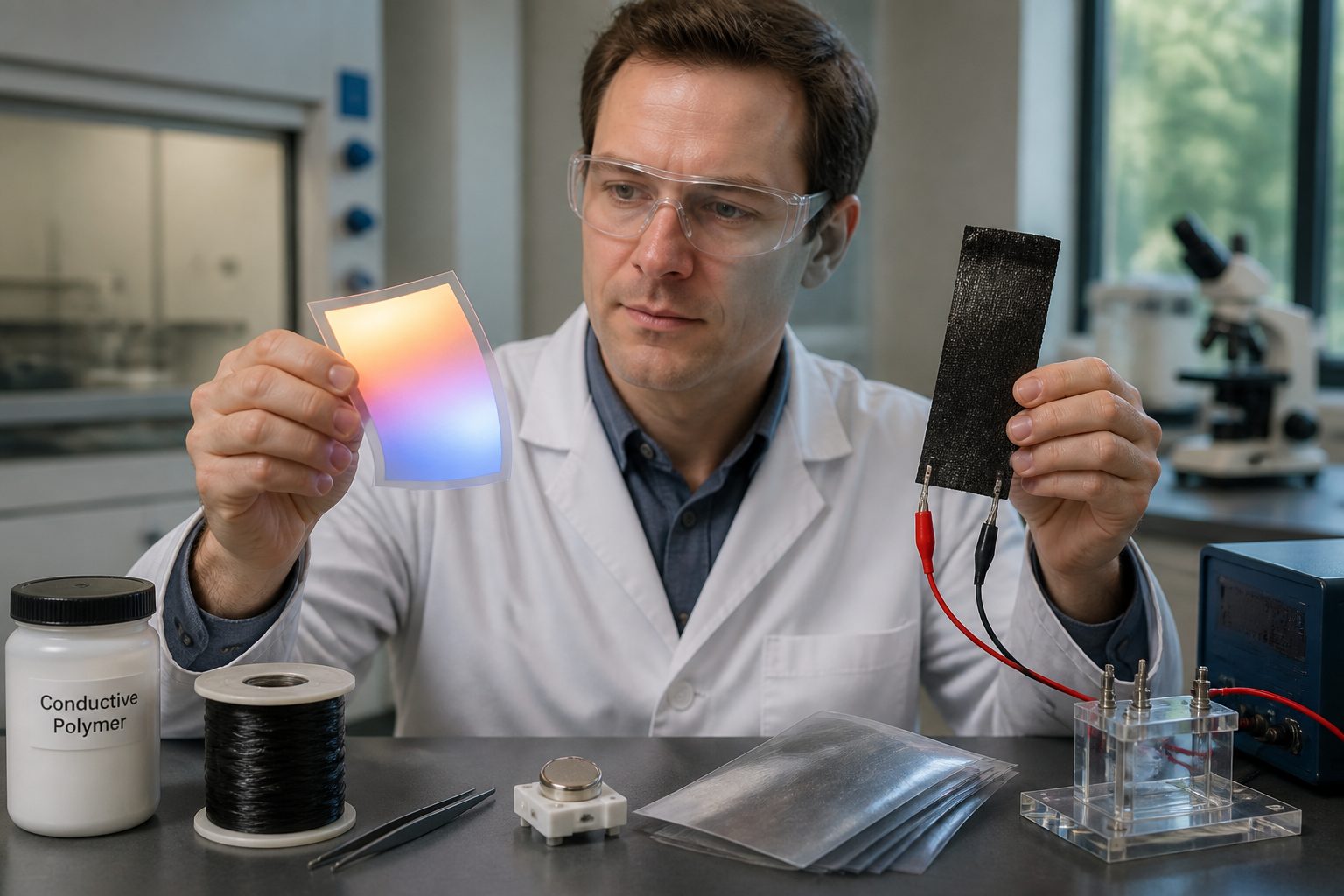
To achieve high conductivity, these polymers undergo a process called doping, which introduces additional charge carriers into the system. Doping either adds or removes electrons from the conjugated backbone, creating positive (holes) or negative (electrons) charge carriers. This process dramatically increases the material’s electrical conductivity, often by many orders of magnitude.
The unique electronic structure allows for charge transport through various mechanisms, including interchain hopping and intrachain delocalization. Tailoring the polymer’s structure and doping method helps achieve specific electrical properties for diverse applications.
The ability to tune conductivity through chemical synthesis and post-synthesis doping makes organic electronics polymer materials incredibly versatile. This control is essential for integrating them into complex electronic devices, proving the immense potential of conductive polymer applications electronics.
The concept of a conjugated system is central to understanding how these polymers conduct electricity, referring to a molecular structure where p-orbitals overlap across multiple adjacent atoms, forming a continuous region of electron delocalization that provides pathways for charge movement.
Unlike traditional metals, charge transport in conductive polymers involves electron delocalization within segments and hopping between chains. Interchain hopping is influenced by morphology and packing density, with optimization key to enhancing conductivity.
Doping fundamentally alters the polymer’s electronic band structure, creating new energy levels (polarons or bipolarons) that act as mobile charge carriers. The type and concentration of dopant critically determine the final conductivity.
Moreover, polymer chain flexibility means these materials adapt to mechanical stress, offering advantages in flexible electronics not found in brittle inorganic semiconductors. This inherent flexibility, combined with tunable electrical properties, makes them ideal for wearable devices and conformable sensors.
Key Conducting Polymers: PEDOT, Polyaniline, and Polythiophene
Among the many conductive polymers studied, a few stand out for their widespread use and unique properties. These include PEDOT, polyaniline, and polythiophene, each offering distinct advantages for various technological uses. Their chemical structures and electronic behaviors make them particularly useful in different organic electronics polymer systems.
PEDOT, or poly(3,4-ethylenedioxythiophene), is perhaps the most commercially successful conducting polymer today. It is known for its excellent environmental stability, high conductivity, and transparency in its oxidized state. This combination of properties makes PEDOT conducting polymer a preferred choice for many transparent electrode and antistatic applications.
Polyaniline (PANI) is another significant conductive polymer, notable for its relatively low cost and versatile electrochemical properties. PANI can exist in several oxidation states, each with different electrical conductivities and colors. This allows for tunable properties, making it useful in sensors and corrosion protection coatings.
Polythiophene and its derivatives also play a substantial role, particularly in organic photovoltaic cells and organic field-effect transistors. Researchers can modify polythiophene’s side chains to improve solubility, processability, and electronic properties. This flexibility in molecular design helps optimize their performance in specific device architectures.
Each polymer brings distinct characteristics, dictating suitability for different conductive polymer applications electronics. For example, PEDOT’s stability is ideal for displays, while polyaniline’s pH sensitivity suits sensor development. The choice depends on specific device requirements.
Scientists continue to explore new derivatives and blends to push performance boundaries, aiming for higher conductivities, better flexibility, and improved stability. This ensures the family of organic electronics polymer materials will keep expanding.
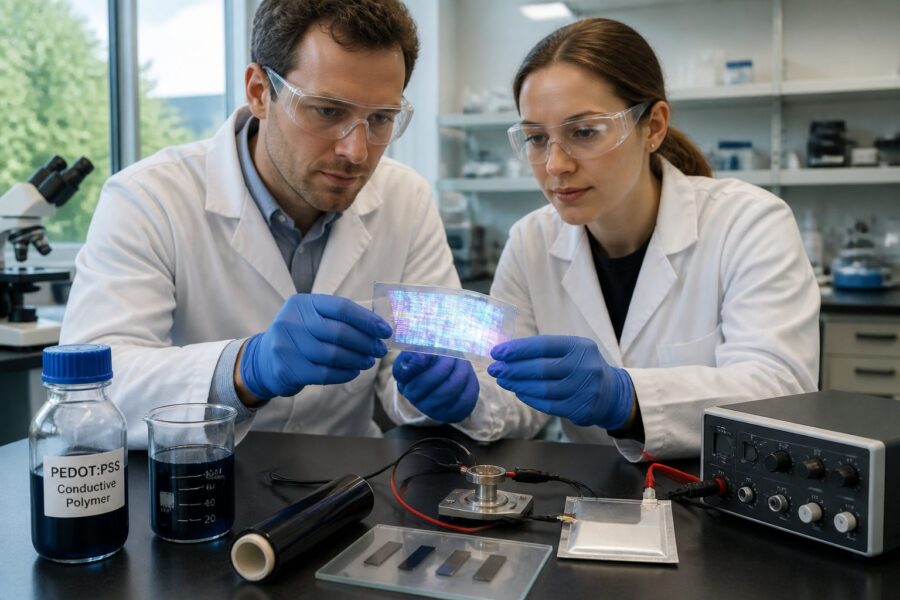
PEDOT’s commercial success, often as PEDOT:PSS, stems from its water dispersibility and film-forming capabilities, enabling easy solution-based processing like spin-coating and inkjet printing. Its transparency and high work function are critical for efficient charge injection in organic electronic devices.
Polyaniline’s advantage lies in its controllable oxidation states, manifesting as different colors and conductivities. This makes PANI attractive for electrochromic devices and chemical sensors responding to pH variations.
Polythiophene derivatives are prized for excellent charge carrier mobilities and tunable optical properties, crucial for light harvesting in solar cells. Researchers engineer energy levels by altering chemical structure, optimizing power conversion efficiency in organic photovoltaics.
Other notable conductive polymers include polypyrrole and polyacetylene. While polyacetylene suffers from poor environmental stability, polypyrrole offers good conductivity and biocompatibility, making it relevant for biomedical applications. Each contributes uniquely to organic electronics polymer materials.
Synthesis and Doping of Conductive Polymers
The creation of conductive polymers involves specific polymerization techniques designed to yield conjugated backbones. Chemical oxidation polymerization and electrochemical polymerization are two common methods used to synthesize these unique materials. Each method offers distinct advantages in terms of control over polymer structure and film morphology.
Once synthesized, the polymer often needs to be “doped” to achieve high electrical conductivity. Doping is a post-synthesis treatment that involves introducing chemical species to either oxidize or reduce the polymer backbone. This process creates charge carriers, such as polarons or bipolarons, which can then move along the polymer chains.
Chemical oxidation polymerization involves reacting monomers with an oxidizing agent in solution, forming long polymer chains. This scalable and economical method produces large quantities, with oxidant and reaction conditions impacting molecular weight and structural regularity.
Electrochemical polymerization applies an electric potential to a monomer solution, polymerizing it directly onto an electrode. This offers precise control over film thickness and morphology, ideal for thin, uniform films and in-situ doping, simplifying fabrication.
Doping is analogous to adding impurities to silicon, but for polymers, it involves molecular changes. P-doping (oxidative) removes electrons, creating positive charge carriers (holes), while n-doping (reductive) adds electrons, creating negative charge carriers. Doping effectiveness depends on the polymer’s electronic structure and dopant’s chemical properties.
Vapor phase polymerization (VPP) is gaining attention for creating highly conductive, uniform films on various substrates. VPP offers excellent control over film properties and can be performed at lower temperatures, beneficial for heat-sensitive substrates and complex device architectures.
| Doping Type | Mechanism | Typical Dopants | Effect on Polymer |
|---|---|---|---|
| P-doping (Oxidative) | Removes electrons from polymer backbone | Iodine, FeCl3, p-toluenesulfonic acid | Creates positive charge carriers (holes) |
| N-doping (Reductive) | Adds electrons to polymer backbone | Alkali metals (Na, K), organic bases | Creates negative charge carriers (electrons) |
| Chemical Doping | Direct reaction with chemical oxidizing/reducing agents | Various acids, bases, halogens | Achieves bulk conductivity, often irreversible |
| Electrochemical Doping | Controlled oxidation/reduction via applied voltage | Electrolyte ions (ClO4-, BF4-) | Allows reversible doping, useful for batteries/sensors |
The choice of doping method and dopant is crucial for optimizing the conductive polymer’s electrical and physical properties, influencing conductivity, stability, and processability. Researchers constantly seek new dopants and strategies to push performance limits.
In PEDOT:PSS, PSS acts as a p-dopant, oxidizing the PEDOT backbone and making it conductive. PSS also provides a counterion, stabilizing charged PEDOT chains and enhancing water dispersibility. This blend exemplifies a highly effective, commercially viable doping strategy.
Conductive Polymers in Organic LEDs and Display Technology
Conductive polymers have become indispensable components in modern display technology, especially in Organic Light-Emitting Diodes (OLEDs). Their ability to conduct electricity while remaining transparent makes them perfect for the intricate layers of these cutting-edge displays. This integration has reshaped how we think about flexible and vibrant screens.
In OLEDs, conductive polymers often serve as hole injection or hole transport layers. They facilitate the efficient movement of positive charge carriers from the anode into the emissive layer. This role is crucial for balancing charge injection and maximizing the device’s light-emitting efficiency.
The PEDOT conducting polymer, particularly in its doped form (PEDOT:PSS), is a prime example of this application. It offers high transparency, good film-forming properties, and excellent work function matching with indium tin oxide (ITO) anodes. This makes PEDOT:PSS a standard material for improving device performance and lifetime in commercial OLEDs.
Beyond OLEDs, conductive polymers are used in flexible electrodes for bendable and rollable displays, enabling devices that adapt to various shapes without losing functionality. This pushes design boundaries in consumer electronics.
The lightweight, flexible nature of organic electronics polymer materials makes them attractive for wearable displays and smart textiles, moving applications like integrated screens in clothing or transparent window displays from labs to prototypes, showcasing their versatility.
Researchers continuously improve the stability and efficiency of polymer layers. Enhancing conductivity and environmental resilience of materials like PEDOT is key to widespread adoption in demanding display environments, driving advances in durable, brighter flexible displays.
Stretchable electronics rely heavily on conductive polymers’ unique mechanical properties. These materials withstand significant deformation without losing conductivity, vital for electronic skin and biomedical implants, expanding possibilities for conformable, interactive displays.
Conductive polymers are explored as transparent conductive electrodes, potentially replacing expensive, brittle ITO. Polymer-based electrodes offer superior flexibility and cost-effective processing, reducing manufacturing complexities and material costs, which could democratize advanced display technology.
Their use in electrochromic displays, where color changes in response to electrical signals, is another fascinating application. Polymers like polyaniline switch between colors and opacities, offering energy-efficient display options for smart windows or dynamic signage.
Processing conductive polymers from solution at low temperatures is a game-changer for large-area flexible displays, enabling efficient, scalable roll-to-roll processing that significantly reduces production costs. These manufacturing advantages are crucial for commercial viability and accessibility.
Energy Storage Applications: Supercapacitors and Batteries
Conductive polymers are gaining significant traction in the development of advanced energy storage systems, especially supercapacitors and batteries. Their unique electrochemical properties make them excellent candidates for electrode materials. This focus on polymer battery electrode material aims to create lighter, more flexible, and higher-performing devices.
In supercapacitors, these polymers offer high power density and rapid charge/discharge cycles. They achieve this by storing charge through pseudocapacitance, involving fast reversible redox reactions on the polymer surface. This mechanism provides higher energy density than traditional electrostatic double-layer capacitors.
Conductive polymers’ pseudocapacitive behavior results from rapid, reversible doping/dedoping processes involving ion insertion and extraction from the electrolyte, leading to Faradaic charge storage. This distinguishes them from carbon-based materials relying on surface adsorption.
For batteries, conductive polymers serve as active electrode materials in lithium-ion and redox flow batteries. They can act as both cathodes and anodes, offering high theoretical capacity, low cost, and environmental friendliness compared to conventional metal oxides, making them attractive for next-generation battery chemistries.
The flexibility of organic electronics polymer materials enables bendable and stretchable batteries and supercapacitors. This is crucial for integrating energy storage into wearables, smart textiles, and implantable medical devices, essential for widespread adoption.
Researchers continuously improve energy density and cycle life of polymer-based energy storage devices, optimizing polymer structure, creating composites with carbon nanotubes or graphene, and developing novel electrolytes. These efforts bridge the performance gap with inorganic systems while retaining polymer advantages.
- Enhance electrode conductivity
- Increase specific capacitance
- Improve cycling stability
- Enable flexible device designs
- Reduce overall device weight
- Lower material costs
- Facilitate rapid charging
- Provide wide operating temperature ranges
The lightweight nature of conductive polymers significantly reduces the overall weight of energy storage devices, beneficial for portable electronics, electric vehicles, and aerospace where weight reduction is critical. Lighter devices improve portability and energy efficiency.
The abundance of organic precursors offers a sustainable alternative to rare earth metals in traditional battery materials, addressing resource depletion and environmental impact. This shift towards organic materials supports a greener economy.
Biosensors and Biomedical Uses of Conductive Polymers
The application of conductive polymers extends well beyond electronics and energy storage, finding a compelling niche in biosensors and biomedical devices. Their biocompatibility, flexibility, and tunable electrochemical properties make them ideal for interfacing with biological systems. This opens up possibilities for real-time diagnostics and advanced therapeutic tools.
In biosensors, conductive polymers often act as transducer elements, converting biological recognition events into measurable electrical signals. They provide a stable platform for immobilizing enzymes, antibodies, or DNA strands. This allows for the sensitive and selective detection of various analytes, from glucose levels to specific disease biomarkers.
For example, polyaniline and PEDOT derivatives are frequently used in glucose sensors for diabetes management. Their ability to rapidly respond to changes in glucose concentration and their stability in aqueous environments are key advantages. These sensors offer a non-invasive or minimally invasive way to monitor health parameters continuously.
Beyond sensing, conductive polymers are explored for neural interfaces and drug delivery systems. Their electrical conductivity and mechanical flexibility allow seamless integration with soft biological tissues, leading to effective brain-computer interfaces or targeted drug release via electrical stimuli.
Smart bandages incorporating organic electronics polymer materials represent another exciting area. These could monitor wound healing and deliver medication directly, revolutionizing patient care with active, responsive medical interventions.
Research also focuses on using these polymers in tissue engineering scaffolds, where electrical properties guide cell growth and differentiation. Stimulating nerve or muscle cells with electrical signals from a polymer scaffold could accelerate tissue regeneration, demonstrating their profound impact in healthcare.
The inherent biocompatibility of many conductive polymers minimizes adverse reactions when implanted, crucial for long-term medical applications. This makes them superior to traditional inorganic materials that can cause inflammation, and their soft nature reduces mechanical mismatch with biological tissues.
In neural prosthetics, conductive polymers form flexible electrodes conforming to brain contours, improving signal transmission and reducing tissue damage. These advanced interfaces could restore sensory functions or control prosthetic limbs with greater precision, transforming neurotechnology.
For drug delivery, conductive polymers can release therapeutic agents in a controlled manner, often triggered by electrical impulses or pH changes. This targeted, on-demand release minimizes systemic side effects and maximizes drug efficacy, representing a significant leap in personalized medicine.
Integration of conductive polymers into wearable health monitoring devices allows continuous, real-time tracking of physiological parameters like heart rate, respiration, and muscle activity. These flexible sensors, seamlessly incorporated into clothing or skin patches, provide comfort and convenience, paving the way for proactive health management and early disease detection.
Conclusion
Conductive polymers have truly transformed our understanding of organic materials, moving them from inert insulators to active components in advanced technologies. Their unique ability to conduct electricity while maintaining polymer characteristics has opened up countless possibilities, influencing fields from displays to medical devices.
The journey from basic research into conjugated systems to commercial products like OLEDs highlights material innovation. Scientists continue to push boundaries, developing new organic electronics polymer structures and refining synthesis, ensuring more sophisticated applications in the coming years.
The versatility of these materials, evidenced by their role as a polymer battery electrode material and in high-performance biosensors, is remarkable. Their lightweight nature, flexibility, and cost-effective manufacturing potential make them attractive alternatives to traditional inorganic materials, driving adoption.
Looking ahead, developing environmentally friendly, sustainable conductive polymers is a key focus. Researchers explore bio-derived feedstocks and less toxic synthesis routes to minimize their ecological footprint, broadening appeal and applicability.
Further improvements in conductivity, long-term stability, and seamless integration remain active research areas. Overcoming these challenges will unlock new generations of flexible electronics, efficient energy solutions, and highly sensitive diagnostic tools. The potential for conductive polymer applications electronics is far from exhausted.
Ultimately, conductive polymers stand as a testament to human ingenuity in materials science, embodying functionality and adaptability. They empower designers and engineers to create devices previously only imagined, shaping a future where electronics are more flexible, sustainable, and integrated into our lives. This field promises continued excitement and innovation.
The interdisciplinary nature of conductive polymer research, spanning chemistry, physics, materials science, and engineering, drives its rapid progress. Collaborations are essential for translating fundamental discoveries into practical solutions, ensuring a holistic approach to material development.
As manufacturing techniques advance, like roll-to-roll processing and 3D printing of polymer inks, the cost-effectiveness and scalability of conductive polymer production will improve. This will accelerate adoption in consumer electronics, automotive, and healthcare sectors, with ease of processing being a significant competitive advantage.
The future of conductive polymers holds immense promise, with research pushing towards self-healing properties, higher conductivities, and seamless integration into complex biological systems. These advancements will redefine what is possible with organic materials, a testament to continuous innovation.