
Fiber optic cables have revolutionized data transmission, enabling faster and more reliable communication across vast distances. The performance and durability of these cables depend significantly on the materials used in their construction.
Selecting the right fiber optic cable materials is crucial for ensuring optimal performance and longevity. This article provides a detailed look into the various materials that make up fiber optic cables and how they contribute to their overall functionality.
We’ll discuss the core components, including the core and cladding, as well as protective layers such as coatings, buffers, strength members, and outer jackets. We will also examine how different materials are chosen based on specific application requirements.
What are Fiber Optic Cables?
Fiber optic cables are transmission cables that use light to transmit data instead of electrical signals. They consist of optical fibers, which are thin strands of glass or plastic that carry light signals over long distances with minimal loss.
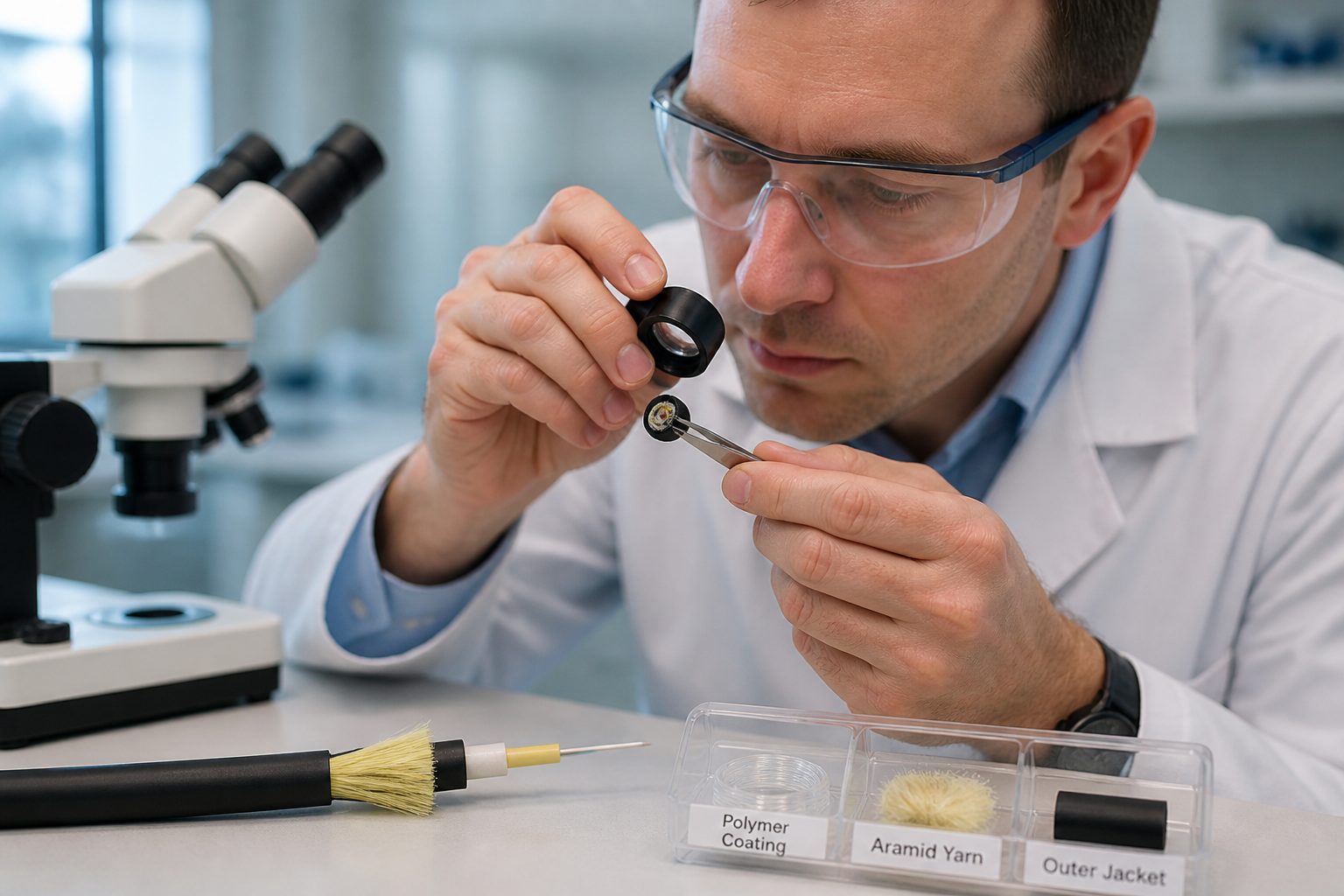
These cables are essential for modern communication networks, enabling high-speed internet, telecommunications, and data storage solutions. The basic structure includes the core, cladding, coating, strength members, and an outer jacket.
The core is the central part of the fiber where light travels, while the cladding surrounds the core and reflects light back into it. Coatings protect the fiber from moisture and damage, and strength members add mechanical support.
Finally, the outer jacket provides overall protection against environmental factors. Understanding the role of each component helps in appreciating the importance of material selection in fiber optic cable design.
Fiber optic cables represent a significant advancement over traditional copper cables. The use of light allows for much higher bandwidth and faster data transfer rates. This technology has become the backbone of the internet and many other communication systems.

The development of fiber optic cables has transformed industries ranging from telecommunications to medicine. In telecommunications, fiber optics have enabled the rapid growth of internet services and mobile networks. In medicine, they are used in endoscopes and other imaging devices to provide minimally invasive diagnostics.
The reliability of fiber optic cables is also a key advantage. Unlike copper cables, fiber optic cables are not susceptible to electromagnetic interference, which can disrupt data transmission. This makes them ideal for use in environments with high levels of electrical noise.
The installation and maintenance of fiber optic cables require specialized equipment and expertise. However, the benefits of using fiber optics often outweigh the costs, especially in applications where high bandwidth and reliability are critical.
Fiber optic technology continues to evolve, with ongoing research focused on improving performance and reducing costs. New materials and manufacturing techniques are constantly being developed to enhance the capabilities of fiber optic cables.
The future of communication networks will undoubtedly rely heavily on fiber optic technology. As demand for bandwidth increases, fiber optic cables will play an increasingly important role in connecting the world.
Core Materials: Glass and Plastic
The core of a fiber optic cable is the most important part, as it is where the light signals travel. The two primary materials used for the core are glass and plastic.
Glass cores are typically made from ultra-pure silica, which allows for minimal light loss and high bandwidth. Plastic cores, on the other hand, are made from polymers such as polymethyl methacrylate (PMMA) or polycarbonate.
Glass optical fibers are preferred for long-distance communication due to their superior optical properties. They can transmit signals over many kilometers without significant signal degradation, making them ideal for long-haul networks.
Plastic optical fibers are more flexible and easier to handle, making them suitable for shorter distances and applications where bending is required. They are commonly used in automotive applications, industrial control systems, and short-range data links.
The choice between glass and plastic cores depends largely on the specific requirements of the application. Glass cores offer superior performance in terms of bandwidth and signal attenuation, but they are more expensive and less flexible than plastic cores.
Silica glass used in fiber optic cores is manufactured to extremely high purity levels to minimize impurities that could absorb or scatter light. This high purity is essential for achieving the low signal loss required for long-distance transmission.
Plastic optical fibers, while having higher attenuation, offer advantages in terms of cost and ease of installation. They are also more resistant to cracking and breaking than glass fibers, making them suitable for harsh environments.
The development of new plastic materials with improved optical properties is an ongoing area of research. These advancements could potentially expand the use of plastic optical fibers in a wider range of applications.
Doping silica with other elements, such as germanium, can modify its refractive index and improve its performance in specific applications. This technique is commonly used to create different types of glass fibers with tailored optical properties.
The manufacturing process for glass and plastic optical fibers is highly specialized. It involves precise control over temperature, pressure, and chemical composition to ensure that the fibers meet the required specifications.
Cladding Materials and Their Role
The cladding is a layer of material that surrounds the core and is essential for the total internal reflection of light within the fiber. The cladding material must have a lower refractive index than the core material.
This difference in refractive index causes the light to bounce back into the core, preventing it from escaping and ensuring efficient transmission. Common cladding materials include silica for glass fibers and fluorinated polymers for plastic fibers.
The quality of the cladding material is crucial for maintaining signal integrity. Impurities or imperfections in the cladding can cause light scattering and signal loss, reducing the cable’s overall performance.
Proper selection of cladding materials ensures that the fiber optic cable meets the required performance standards for its intended application. The interface between the core and cladding must be smooth and uniform to minimize light scattering.
The refractive index difference between the core and cladding is a critical parameter in fiber optic design. A larger refractive index difference results in a higher numerical aperture, which allows the fiber to accept light from a wider range of angles.
The cladding also provides mechanical support to the core, protecting it from damage during handling and installation. The cladding material must be strong enough to withstand the stresses imposed on the fiber.
In some fiber optic designs, multiple layers of cladding are used to further improve performance. These additional cladding layers can help to reduce signal loss and improve the fiber’s resistance to bending.
The manufacturing process for the cladding is similar to that for the core, requiring precise control over material composition and processing conditions. The cladding must be applied uniformly and without defects to ensure optimal performance.
The choice of cladding material is often dictated by the type of core material used. Silica cladding is typically used with silica cores, while fluorinated polymer cladding is used with plastic cores.
The long-term stability of the cladding material is also an important consideration. The cladding must be resistant to degradation from exposure to moisture, heat, and other environmental factors.
Comparison of Core and Cladding Materials
Choosing the appropriate materials for both the core and cladding is essential for optimal fiber optic cable performance. Different materials offer unique advantages and are suited for specific applications.
Glass cores provide superior optical properties for long-distance transmission, while plastic cores offer greater flexibility for shorter distances. The cladding material must complement the core material to ensure effective light confinement.
| Material | Core | Cladding |
|---|---|---|
| Silica | High purity, low loss | Lower refractive index |
| PMMA | Flexible, easy to handle | Fluorinated polymers |
| Polycarbonate | Durable, impact resistant | Specialty polymers |
| Doped Silica | Enhanced refractive index | Pure or doped silica |
The table above summarizes the key characteristics of different core and cladding materials. Silica is the preferred material for high-performance applications, while PMMA and polycarbonate are suitable for lower-cost, shorter-distance applications.
The compatibility between the core and cladding materials is crucial for achieving optimal performance. The materials must have similar thermal expansion coefficients to prevent stress-induced damage.
The refractive index difference between the core and cladding must be carefully controlled to ensure efficient light confinement. A larger refractive index difference allows for a higher numerical aperture, but it can also increase signal loss.
The choice of materials also depends on the manufacturing process used to create the fiber. Some materials are easier to process than others, which can affect the cost and yield of the manufacturing process.
The long-term reliability of the materials is another important consideration. The materials must be resistant to degradation from exposure to moisture, heat, and other environmental factors.
The cost of the materials is also a factor, especially in high-volume applications. Silica is generally more expensive than plastic, but it offers superior performance.
The selection of core and cladding materials is a complex process that requires careful consideration of all these factors. The optimal choice depends on the specific requirements of the application and the trade-offs between performance, cost, and reliability.
Coating and Buffer Materials
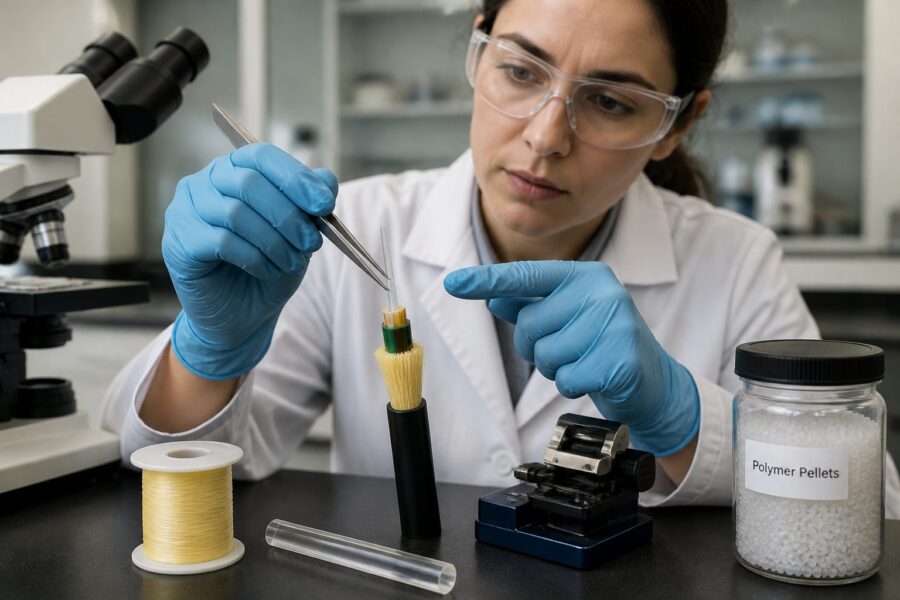
Coatings and buffers are protective layers applied to the cladding of the optical fiber. These layers protect the delicate glass or plastic from environmental factors and mechanical stress.
The primary function of the coating is to protect the fiber from surface defects that could lead to breakage. Buffers provide additional protection and isolation from external forces, such as bending and twisting.
Common coating materials include acrylates, which are applied in multiple layers to provide both flexibility and strength. Acrylate coatings are known for their excellent adhesion to the glass or plastic cladding and their ability to withstand temperature variations.
Buffer materials can be either tight-buffered or loose-tube. Tight-buffered cables have a solid buffer layer that is in direct contact with the coating, providing maximum protection but reducing flexibility. Loose-tube cables have a hollow tube filled with gel around the fiber, allowing the fiber to move freely and reducing stress.
The coating is typically applied immediately after the fiber is drawn from the preform to protect the pristine surface from damage. The coating process is critical to the long-term reliability of the fiber.
Acrylate coatings are available in a variety of formulations to meet different performance requirements. Some coatings are designed to be highly flexible, while others are designed to be highly resistant to abrasion.
The buffer material provides additional protection to the fiber during handling and installation. Tight-buffered cables are commonly used in indoor applications where the cable is subject to frequent bending and handling.
Loose-tube cables are commonly used in outdoor applications where the cable is subject to temperature variations and mechanical stress. The gel in the loose tube helps to protect the fiber from these stresses.
The choice between tight-buffered and loose-tube cables depends on the specific requirements of the application. Tight-buffered cables offer greater protection, while loose-tube cables offer greater flexibility.
The materials used for coatings and buffers must be carefully selected to ensure compatibility with the core and cladding materials. The materials must also be resistant to degradation from exposure to moisture, heat, and other environmental factors.
Strength Members and Outer Jacket Materials
Strength members and outer jackets are essential components of fiber optic cables, providing mechanical protection and environmental resistance. Strength members add tensile strength to the cable, preventing it from stretching or breaking under stress.
The outer jacket protects the inner components from moisture, abrasion, and other environmental factors. Common strength member materials include aramid yarns (such as Kevlar), fiberglass, and steel.
Aramid yarns are lightweight and strong, providing excellent tensile strength without adding excessive weight to the cable. Fiberglass is another lightweight option that offers good strength and is non-conductive.
Steel strength members are used in harsh environments where maximum protection is required. Outer jacket materials include polyethylene (PE), polyvinyl chloride (PVC), polyurethane (PU), and flame-retardant versions of these materials.
Polyethylene is cost-effective and provides good moisture resistance, while PVC offers good flexibility and abrasion resistance. Polyurethane is highly durable and resistant to chemicals, making it suitable for industrial applications.
Flame-retardant jackets are used in indoor applications to prevent the spread of fire. The selection of strength members and outer jacket materials depends on the specific requirements of the application and the environment in which the cable will be used.
The strength members are typically located around the buffer tubes or tight-buffered fibers to provide maximum tensile strength. The amount of strength member material required depends on the expected tensile load on the cable.
The outer jacket material is chosen based on the environmental conditions in which the cable will be installed. Polyethylene is a good choice for outdoor applications where moisture resistance is important.
PVC is a good choice for indoor applications where flexibility and abrasion resistance are important. Polyurethane is a good choice for industrial applications where chemical resistance is important.
Flame-retardant jackets are required in many indoor applications to meet building codes. These jackets are designed to prevent the spread of fire in the event of a fire.
The color of the outer jacket is often used to identify the type of fiber optic cable. For example, yellow jackets are typically used for single-mode fiber cables, while orange jackets are typically used for multimode fiber cables.
Material Selection for Different Applications
The choice of fiber optic cable materials varies depending on the application. Different environments and performance requirements necessitate different material properties.
For example, long-distance telecommunications require high-purity glass fibers with minimal signal loss. Indoor applications may prioritize flame-retardant materials for safety, while outdoor applications need materials that can withstand extreme temperatures and moisture.
- Long-distance telecommunications: glass core, polyethylene jacket
- Indoor networking: plastic core, flame-retardant PVC jacket
- Submarine cables: steel strength members, polyurethane jacket
- Industrial applications: aramid yarns, chemical-resistant jacket
- Automotive applications: plastic core, flexible jacket
Submarine cables require robust materials that can withstand high pressure and saltwater corrosion. Industrial applications demand chemical-resistant jackets and strength members that can endure harsh conditions.
In long-distance telecommunications, the primary concern is minimizing signal loss over long distances. This requires the use of high-purity glass fibers and low-attenuation cladding materials.
In indoor networking, the primary concern is safety. Flame-retardant jackets are required to prevent the spread of fire in the event of a fire.
Submarine cables are subjected to extreme pressure and saltwater corrosion. This requires the use of robust materials such as steel strength members and polyurethane jackets.
Industrial applications often involve exposure to harsh chemicals and extreme temperatures. This requires the use of chemical-resistant jackets and strength members that can withstand these conditions.
Automotive applications require flexible cables that can withstand vibration and temperature variations. Plastic cores and flexible jackets are commonly used in these applications.
The selection of materials for fiber optic cables is a complex process that requires careful consideration of the specific requirements of the application. The optimal choice depends on the trade-offs between performance, cost, and reliability.
Advancements in Fiber Optic Cable Materials
Ongoing research and development efforts are continuously improving fiber optic cable materials. New materials and manufacturing techniques are enhancing cable performance, durability, and cost-effectiveness.
One area of advancement is the development of new polymer materials for plastic optical fibers. These new polymers offer improved optical properties and higher temperature resistance, expanding the range of applications for plastic fibers.
Another area of focus is the creation of more durable and environmentally friendly jacket materials. Researchers are exploring bio-based polymers and recycled materials to reduce the environmental impact of fiber optic cables.
Additionally, new coating technologies are being developed to provide better protection against moisture and mechanical damage. Nanomaterials are being incorporated into coatings to enhance their strength and barrier properties.
The development of new polymer materials for plastic optical fibers is driven by the desire to improve their optical properties and temperature resistance. These improvements would allow plastic fibers to be used in a wider range of applications, including high-speed data transmission.
The use of bio-based polymers and recycled materials in jacket materials is driven by the growing concern for sustainability. These materials can help to reduce the environmental impact of fiber optic cables.
The incorporation of nanomaterials into coatings is driven by the desire to improve their strength and barrier properties. Nanomaterials can help to protect the fiber from moisture and mechanical damage, extending its lifespan.
New manufacturing techniques are also being developed to improve the performance and reduce the cost of fiber optic cables. These techniques include improved fiber drawing processes and more efficient coating methods.
The advancements in fiber optic cable materials are constantly pushing the boundaries of what is possible. These advancements are leading to faster, more reliable, and more sustainable communication networks.
Research into new materials is crucial for meeting the ever-increasing demands of modern communication systems. As bandwidth requirements continue to grow, advanced materials will be essential for enabling future generations of fiber optic cables.
Future Trends in Fiber Optic Cable Technology
The future of fiber optic cable technology is likely to be shaped by several key trends. These include the increasing demand for higher bandwidth, the expansion of fiber optic networks into new areas, and the growing emphasis on sustainability.
As data transmission needs continue to grow, fiber optic cables will need to support even higher data rates. This will require the development of new fiber designs and materials that can minimize signal loss and maximize bandwidth.
The expansion of fiber optic networks into rural areas and developing countries will drive the need for more cost-effective and easy-to-install cables. New cable designs that are lighter, more flexible, and easier to splice will be essential for these applications.
Sustainability will become an increasingly important consideration in the design and manufacturing of fiber optic cables. The use of recycled materials, bio-based polymers, and energy-efficient manufacturing processes will help reduce the environmental impact of these cables.
Innovations in optical fiber technology, such as multi-core fibers and photonic crystal fibers, promise to further increase data transmission capacity. These advanced fiber designs require precise control over material composition and structure.
The integration of fiber optics with other technologies, such as wireless communication and artificial intelligence, will create new opportunities for innovation. Fiber optic cables will play a crucial role in supporting the infrastructure for 5G and future generations of wireless networks.
The increasing demand for higher bandwidth is driving the development of new fiber designs and materials. Multi-core fibers, for example, can increase data transmission capacity by packing multiple cores into a single fiber.
The expansion of fiber optic networks into rural areas and developing countries is driving the need for more cost-effective and easy-to-install cables. These cables must be durable and able to withstand harsh environmental conditions.
Sustainability is becoming an increasingly important consideration in the design and manufacturing of fiber optic cables. The use of recycled materials and bio-based polymers can help to reduce the environmental impact of these cables.
The integration of fiber optics with other technologies is creating new opportunities for innovation. Fiber optic cables will play a crucial role in supporting the infrastructure for 5G and future generations of wireless networks.
Quantum communication is an emerging field that could revolutionize data security. Fiber optic cables are being used to transmit quantum signals over long distances.
Conclusion
The materials used in fiber optic cables are critical to their performance and durability. From the core and cladding to the coatings, strength members, and outer jacket, each component plays a vital role in ensuring efficient and reliable data transmission.
Selecting the right materials for each application is essential for optimizing cable performance and longevity. Ongoing advancements in materials science and manufacturing techniques are continuously improving fiber optic cable technology, paving the way for faster, more reliable, and more sustainable communication networks.
The future of communication networks depends on the continued development of advanced fiber optic cable technology. As data transmission needs continue to grow, fiber optic cables will play an increasingly important role in connecting the world.
The selection of materials for fiber optic cables is a complex process that requires careful consideration of the specific requirements of the application. The optimal choice depends on the trade-offs between performance, cost, and reliability.
Ongoing research and development efforts are focused on improving the performance, durability, and sustainability of fiber optic cable materials. These efforts are paving the way for faster, more reliable, and more environmentally friendly communication networks.
Fiber optic cables have transformed the way we communicate and access information. Their continued development will be essential for meeting the ever-increasing demands of the digital age.