
Filament winding stands as a cornerstone technology in the realm of advanced composite manufacturing. This specialized process creates high-strength cylindrical composite structures by precisely wrapping continuous fibers, impregnated with resin, around a rotating mandrel. It is a method prized for producing lightweight, durable components with exceptional mechanical properties.
Engineers and material scientists rely on filament winding to fabricate parts that must withstand extreme internal pressures or axial loads. Think about rocket motor casings, high-pressure gas tanks, or even structural elements in aerospace applications; these components often owe their strength to this sophisticated technique. The ability to tailor fiber orientation makes filament winding incredibly versatile for specific performance requirements.
Understanding the filament winding process is essential for anyone involved in high-performance materials. This article will explore the intricate steps involved, the factors influencing structural integrity, and the diverse applications where filament winding truly shines. We will examine how this method delivers superior strength and stiffness in demanding environments.
The Filament Winding Process: Step by Step
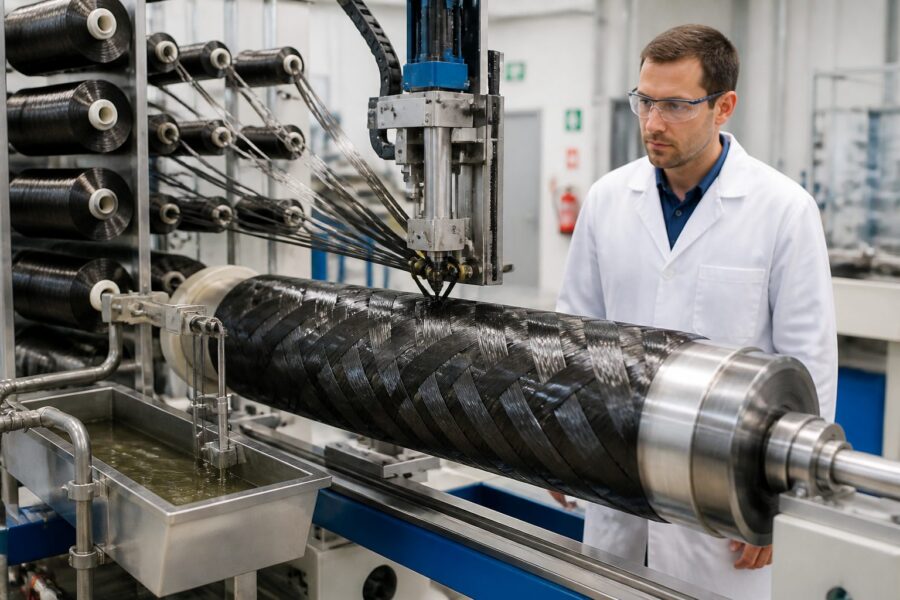
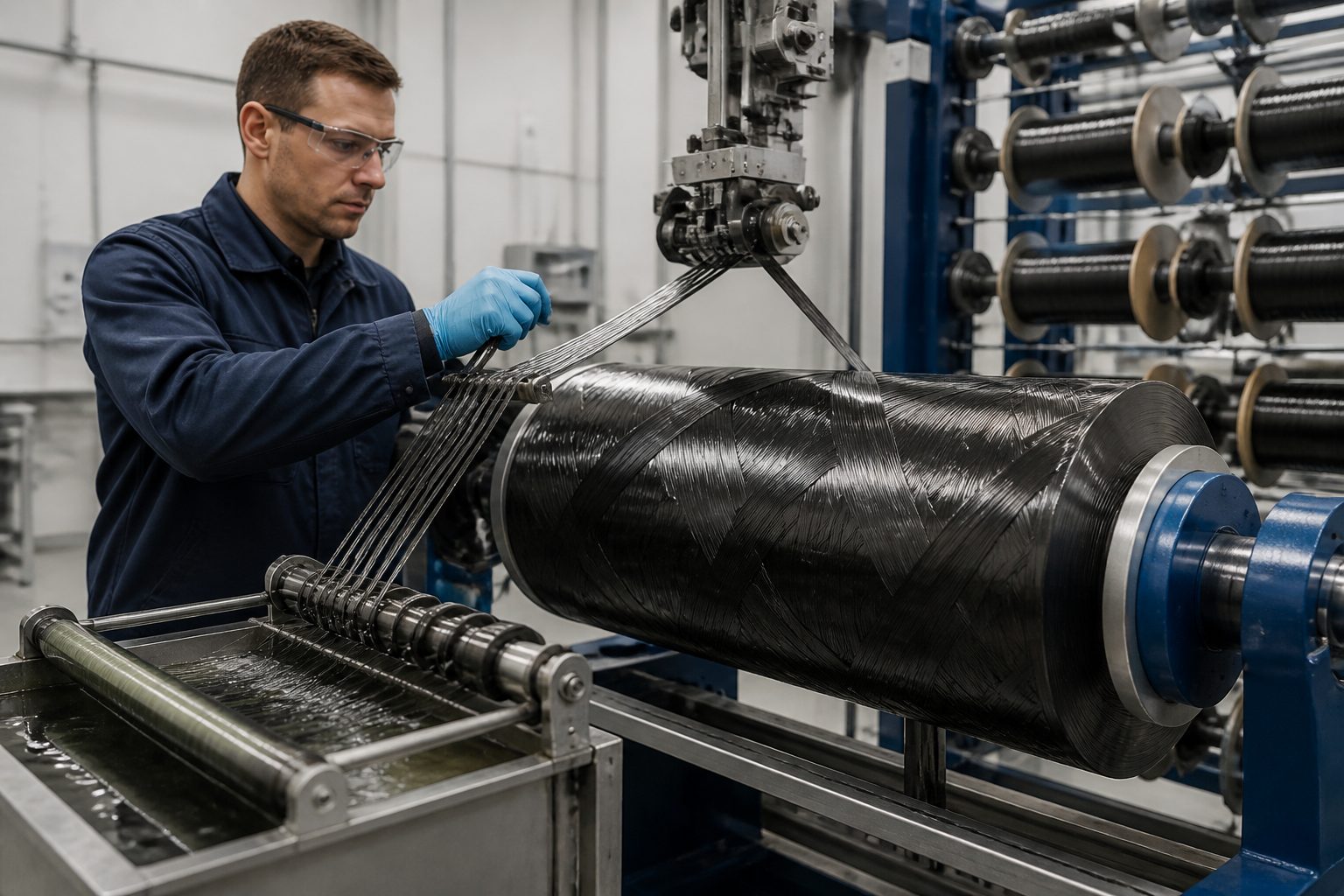
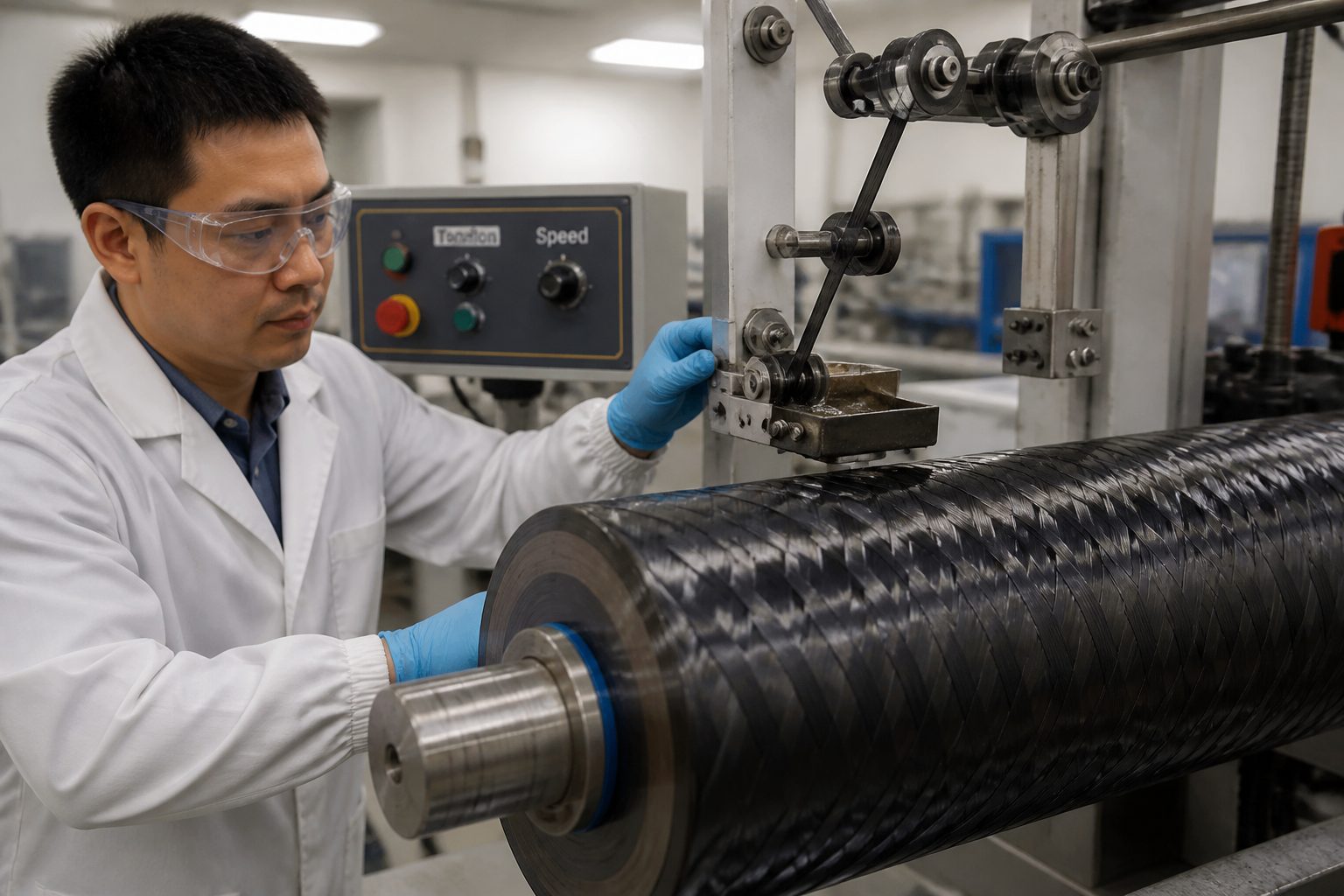
The filament winding process begins with continuous fibers, often carbon, glass, or aramid, drawn from spools. These fibers then pass through a resin bath, where they become thoroughly impregnated with a thermosetting polymer matrix. This impregnation ensures that each fiber strand is completely coated, allowing for optimal load transfer within the final composite.
Next, a winding machine precisely guides the resin-impregnated fibers onto a rotating mandrel. The mandrel, which dictates the internal shape of the part, rotates at a controlled speed while the fiber delivery head moves axially along its length. This synchronized movement creates specific winding patterns, crucial for achieving the desired structural properties of the filament winding process cylindrical composites.
After the desired thickness and fiber architecture are achieved, the wound part undergoes a curing stage. This typically involves heating the entire assembly in an oven, which initiates a chemical reaction in the resin, transforming it from a liquid to a solid polymer. The curing process locks the fibers in place, forming a rigid, monolithic composite structure.
Once cured, the mandrel is removed from the composite part. Mandrel removal methods vary depending on the mandrel material; some are collapsible, others are soluble, and some are permanent components of the final product. This step reveals the finished internal surface of the filament-wound component, ready for further processing or assembly.
The entire sequence, from fiber preparation to mandrel removal, requires meticulous control over tension, speed, temperature, and fiber placement. Any deviation can compromise the structural integrity and performance of the finished product. This careful control ensures the creation of robust and reliable composite structures for critical applications.
Winding Patterns and Their Effect on Structural Performance
The choice of winding pattern fundamentally dictates the mechanical properties and load-bearing capabilities of a filament-wound structure. Engineers select specific patterns to optimize the composite’s response to various stress conditions. This careful selection is a key aspect of designing high-performance components.
Hoop winding, characterized by fibers laid almost perpendicularly to the mandrel axis (close to 90 degrees), primarily resists internal pressure. This pattern excels in containing radial expansion, making it ideal for composite pressure vessel manufacturing. It provides excellent circumferential strength but offers little resistance to axial loads.
Helical winding involves fibers laid at an angle between 0 and 90 degrees to the mandrel axis, creating a crisscross pattern. This pattern provides balanced strength in both axial and circumferential directions, distributing loads more evenly. It is often used where components experience both internal pressure and axial forces.
Polar winding, where fibers pass over the ends of the mandrel, offers significant axial strength. This pattern effectively resists longitudinal tension and compression, making it suitable for structures requiring high stiffness along their length. It often complements helical or hoop layers for multi-directional strength.
Achieving optimal structural performance often involves combining these patterns in multi-layered designs, a process known as winding angle optimization. By varying the fiber placement composite cylinder can achieve tailored anisotropic properties, meaning its strength and stiffness differ based on the direction of applied force. This precise engineering ensures the final product meets exact specifications for its intended use.
Machine Types and Mandrel Systems
Filament winding machines come in various configurations, primarily defined by the number of axes of motion they possess. Each machine type offers different levels of complexity and capability for shaping composite structures. The choice of machine depends heavily on the geometry and production volume of the part.
Two-axis machines, the simplest type, control the mandrel’s rotation and the fiber delivery head’s axial movement. These machines are well-suited for producing basic cylindrical or conical shapes. More complex geometries require additional axes to manipulate the fiber path with greater precision and versatility.
| Machine Type | Axes of Motion | Typical Applications | Mandrel Movement |
|---|---|---|---|
| 2-Axis Winder | Mandrel rotation, Carriage traverse | Pipes, simple tanks, cylinders | Rotates on fixed axis |
| 3-Axis Winder | Mandrel rotation, Carriage traverse, Cross-feed | Complex tanks, pressure vessels, cones | Rotates, carriage moves, head moves perpendicular |
| 4-Axis Winder | Mandrel rotation, Carriage traverse, Cross-feed, Mandrel tilt/yaw | Rocket motor casings, complex aerospace parts, non-axisymmetric shapes | Rotates, carriage moves, head moves perpendicular, mandrel can tilt |
| Multi-Axis Winder | 5+ axes (e.g., robotic arm) | Highly intricate geometries, adaptive winding, research | Full spatial control |
Resin Systems Used in Filament Winding
The resin system plays a critical role in the overall performance of filament-wound composites, acting as the matrix that binds the fibers together. Selecting the right resin involves considering factors such as mechanical properties, processing characteristics, and environmental resistance. This choice profoundly impacts the final product’s durability and functionality.
Epoxy resins are a popular choice due to their excellent adhesion to various fibers, high strength, and good chemical resistance. They offer a wide range of cure temperatures and processing viscosities, allowing for flexibility in manufacturing parameters. Epoxy systems are often preferred for high-performance applications where reliability is paramount.
Polyester resins provide a more cost-effective alternative while still offering good mechanical properties and reasonable chemical resistance. They cure quickly and are less sensitive to moisture during processing, making them suitable for high-volume production of less critical components. However, their shrinkage during curing can sometimes be a concern.
Vinyl ester resins combine some of the best attributes of both epoxies and polyesters. They offer superior corrosion resistance compared to polyesters and better toughness than many epoxies. This makes them an excellent choice for applications exposed to aggressive chemicals or demanding environmental conditions.
Beyond these common types, specialized resins like phenolics or polyimides are used for extreme temperature environments, such as those found in aerospace or defense. The resin’s viscosity, pot life, and cure kinetics are all crucial parameters that must be carefully controlled during the filament winding process. These properties directly influence the quality of fiber impregnation and the overall laminate consolidation.
Manufacturing Composite Pressure Vessels and Pipes
Filament winding is the go-to method for creating composite pressure vessel manufacturing for applications demanding high strength-to-weight ratios. These vessels hold gases or liquids under extreme pressure, making their structural integrity absolutely critical. The precise fiber placement composite cylinder ensures maximum efficiency in containing these forces.
The process allows for tailoring the laminate structure to withstand specific stresses, primarily hoop stress from internal pressure and axial stress from end caps. This capability is paramount for safety and longevity in demanding environments. Every layer and winding angle contributes to the vessel’s overall resilience.
- Optimize winding angle for internal pressure
- Ensure uniform fiber tension
- Control resin content precisely
- Implement multi-layered winding patterns
- Monitor curing temperature and time
- Conduct rigorous post-curing inspection
Aerospace and Defense Applications of Filament-Wound Structures
The aerospace and defense sectors rely heavily on filament winding for components that demand exceptional performance under severe conditions. The ability to produce lightweight parts with high strength and stiffness is a major advantage in these industries. Every gram saved in an aircraft or missile translates to increased efficiency or payload capacity.
Rocket motor casings are a prime example of filament-wound structures in aerospace. These casings must contain immense pressures and temperatures during launch, while remaining as light as possible to maximize fuel efficiency and thrust. Carbon fiber filament winding provides the necessary strength and thermal stability for these critical components.
Aircraft fuselage sections, particularly those with complex curves or specific load requirements, can also benefit from filament winding. This method allows for optimized fiber placement, ensuring that structural loads are efficiently carried throughout the airframe. The result is a more robust and fuel-efficient aircraft design.
In defense, filament-wound components appear in missile bodies, torpedoes, and specialized protective structures. These applications require materials that can withstand high impact, extreme speeds, and harsh operating environments. The tailored strength of filament-wound composites offers a significant advantage over traditional metallic structures.
Beyond these, applications extend to drone components, satellite structures, and various internal pressure vessels for spacecraft. The continuous innovation in winding angle optimization and fiber placement composite cylinder designs pushes the boundaries of what is possible. Filament winding remains a cornerstone technology for advancing both aerospace and defense capabilities.
Quality Control and Non-Destructive Testing
Ensuring the structural integrity and reliability of filament-wound composites is paramount, especially for critical applications. Robust quality control measures are integrated throughout the entire manufacturing process. These checks help to identify and mitigate potential defects before they compromise performance.
During the winding phase, continuous monitoring of fiber tension, resin content, and winding angle is essential. Automated systems often track these parameters in real-time, alerting operators to any deviations from the specified manufacturing tolerances. This proactive approach helps maintain consistent part quality.
After curing, non-destructive testing (NDT) techniques become crucial for assessing the internal structure without damaging the part. Ultrasonic testing, for example, uses sound waves to detect voids, delaminations, or resin-rich areas within the laminate. This method provides a detailed map of the internal integrity of the filament winding process cylindrical composites.
Acoustic emission testing is another valuable NDT method, particularly for composite pressure vessel manufacturing. This technique listens for microscopic stress waves generated by crack propagation or fiber breakage under load. It can provide early warnings of structural degradation, indicating potential failure points before they become critical.
Visual inspection, although seemingly basic, remains an important initial step to identify surface imperfections such as scratches, resin starvation, or uneven fiber distribution. Coupled with advanced NDT methods, a comprehensive quality control program ensures that filament-wound structures meet the highest performance and safety standards. This meticulous attention to detail is non-negotiable for high-performance applications.
The Future of Filament Winding Technology
The field of filament winding is far from static, with continuous advancements pushing the boundaries of what is achievable. Researchers and engineers are actively exploring new materials, automation techniques, and process optimizations. These innovations promise even more efficient and versatile composite manufacturing.
One significant area of development is automated fiber placement (AFP) combined with filament winding capabilities. AFP offers greater control over individual fiber tow placement, allowing for highly complex and optimized geometries. This hybrid approach enables the creation of structures with unprecedented levels of tailored performance.
In-situ curing technologies are also gaining traction, where the resin cures immediately as the fibers are wound onto the mandrel. This eliminates the need for a separate oven curing step, drastically reducing manufacturing time and energy consumption. Techniques like UV curing or electron beam curing show great promise for faster production cycles.
The integration of smart materials and sensors directly into filament-wound structures represents another exciting frontier. These “smart composites” could self-monitor their structural health, detect damage in real-time, or even self-heal. Such capabilities would revolutionize maintenance and safety protocols for critical components.
Further research into novel fiber and resin systems, including thermoplastics and bio-derived polymers, will expand the application range of filament winding. As demand for lightweight, high-performance materials grows across industries, the filament winding process cylindrical composites will continue to evolve, offering innovative solutions for complex engineering challenges. This ongoing development ensures its relevance for years to come.
Conclusion
Filament winding stands as a testament to precision engineering, offering an unparalleled method for creating cylindrical composite structures with exceptional strength and lightness. Its ability to precisely place fibers and optimize winding angles makes it indispensable for demanding applications. This technique is truly foundational for modern high-performance materials.
From the meticulous step-by-step process of fiber impregnation and winding to the critical curing and mandrel removal, every stage contributes to the final product’s integrity. The careful selection of winding patterns, machine types, and resin systems allows for highly customized components. These choices are vital for achieving specific performance goals.
The impact of filament winding is most evident in sectors where failure is not an option, such as composite pressure vessel manufacturing and aerospace applications. These industries rely on the method’s ability to produce parts that withstand extreme forces and harsh environments. The consistent reliability is a key driver for its continued adoption.
As technology advances, so too does the sophistication of filament winding, with innovations like automated fiber placement and in-situ curing promising even greater efficiencies. The ongoing development of new materials and smart composite integration ensures the technique remains at the forefront of advanced manufacturing. This continuous evolution expands its potential applications.
Ultimately, the filament winding process cylindrical composites will continue to shape the future of high-performance engineering. It provides engineers with the tools to design and build lighter, stronger, and more resilient structures for a wide array of industries. This powerful manufacturing method truly embodies the cutting edge of material science.